Advertisements
Advertisements
Question
The power of poetry lies in suggestion and understatement. Discuss this with reference to the poem.
Advertisements
Solution
Understatement means to state or represent less strongly or strikingly than the facts would bear out. Thus, it is a very well known fact that it is very understating to decide one's status or level of knowledge based on his/her color. The play of words between the landlady and the poet clearly proves that a man's color and the region has nothing to do with the levels of education he has attained and the power of wisdom he possesses. The questions posed by the landlady became a mockery at her own level of intellect. Thus, the poem very strongly suggests that the question of civilisation does not rest on its own color. Soyinka humorously uses sarcasm as he says 'Shamed/By ill-mannered silence" when it is obvious that is the woman who is the ill-mannered of the two.
APPEARS IN
RELATED QUESTIONS
Read the following passage and complete the activities given below :
A1 Find out :
Find from the passage the related words to the sea and write them.

ON FIERCE monsoon nights, about one and a quarter-mile off the Mumbai harbor, there have been occasions when 52-year-old Bikaji Ramchandra Dhuri is the only man on the sea. From the watchtower of the Prongs Reef Lighthouse, which is surrounded on all sides by the Arabian Sea, he has heard the sea rage like a possessed spirit – the darkness dispelled only by the beam of light flung across the waters from the tower he mans.
Dhuri is one of the last breeds of lighthouse keepers on the Indian coast, as a majority of the 182 lighthouses in the country are now unmanned. Built-in 1871, the Prongs Reef lighthouse was modeled on Scotland’s Skerryvore Rocks Lighthouse and is located at a strategic spot on the western coast, marking the entrance to the busy Mumbai Harbour. It was meant to stem the number of shipwrecks off the harbor, which the lone Colaba lighthouse could not illumine on its own. “Even now, during nights, for fishing vessels without any gadgets, it’s the soft light from this tower which directs us to Mumbai,” says Vinayak Koli, a boatsman who helps ferry people and also goes on fishing expeditions.
Throughout the year, Dhuri lives in the lighthouse for 15 days at a stretch, when he is relieved by another keeper. In the monsoon, it becomes his home for three months. “We call it the Kalapana as we are alone in the middle of the sea for days, with basic supplies – and the revolving light that keeps the sea awake,” he says.
A2 Fill in the following information using words from the passage :
(i) The Prongs Reef lighthouse was modeled on _______.
(ii) Dhuri lives in the lighthouse for _______ at a stretch.
(iii) _______ is one of the last breeds of lighthouse keepers on the Indian coast.
(iv) The majority of the _______ lighthouses in the country are now unmanned.
| Violent | Scattered | Place of shelter for ships | Shine light |
A4
A5 Personal Response
Imagine you have to spend a night in a lighthouse. Narrate your experience.
Notice these expression in the text. Infer their meaning from the context.
swathe
Tick the item that is closest in meaning to the following phrase.
to meet one's match
Discuss in small groups.
‘On reading Shelley’s A Defence of Poetry, the question insistently occurs why there is no similar A Defence of Science written by a scientist of equal endowment.’
Qua story’: what does the word mean? Find other expressions using the word qua.
Divide the class into 5 groups. Each group can prepare a decorative chart/poster using an epigrammatic line from the poem. You may use calligraphy/painting/or Paint program on a computer. (With permission, put up these charts in your school.)
Add the appropriate Prefix to make the following word opposite in meaning.
continue
Say why the speaker of the poem wishes to be a-
hawker
The word 'report' means -
(a) Give a spoken or written account of something.
(b) Cover an event or subject as a journalist or reporter.
Make a list of archaic words from the poem and give their modern equivalents.
Write 3 to 4 lines about the following in your own words.
First Neurosurgeon
Fill in the gap, choosing a word from the bracket to make an appropriate comparison.
(tall / quiet / humble / merry / busy / slippery / fast / sly / slow / big)
as ______ as a lark
Read the following phrase and use it in a sentence of your own in proper form.
To voice something
Answer the following question in short.
Explain the significance of the title.
Write a sentence each about three of your friends. Each time you should say what your friend cannot do, and yet, pay a compliment to your friend.
Wash your handkerchief clean. Hang it with a peg to dry in the wind. Watch how it flutters.
Read aloud the speech in which Thiruvalluvar explains how the fabric was made. Present the process in the form of a chart. Draw pictures for the chart and label them.
State whether the following statement is True or False:
Lysander and Demetrius fall in love with Helena as a result of the love potion.
“A Midsummer-Night’s Dream” is one of the best examples of Shakespeare’s Comedy of Errors. Comment.
‘Smart Answers’: Form a large group. Each person asks the next one a question to get him to say ‘yes’ or ‘no’. He/She can use appropriate statements, requests, or even other questions as a response. But if he/she says ‘yes’ or ‘no’, he/she is out. Otherwise, he/she continues the game. Questions cannot be repeated.
Complete the following table.
| No. | Utterance | Who said it | To whom | When |
| (a) | I touched it in the hall at the ministry. | ___________ | ___________ | ___________ |
| (b) | It will give us time to look some more. | ___________ | ___________ | ___________ |
| (c) | I might have needed it. | ___________ | ___________ | ___________ |
| (d) | You must have made a mistake. | ___________ | ___________ | ___________ |
| (e) | Well, I lost it. | ___________ | ___________ | ___________ |
| (f) | Mine was an imitation. | ___________ | ___________ | ___________ |
Find pairs of rhyming words from the poem.
Find three lines, that contain images of nature in the autumn season.
During daytime
- _______________________
- _______________________
- _______________________
Answer in your own words.
What did Neel realise from his encounter with his ancestors?
Where does the brook join the river?
Correct the following sentence and rewrite it.
Jesus had actually visited Papa Panov only once on Christmas Eve.
Do you know of similar stories in your mother tongue or in other languages? Narrate it in short.
Now try to add a contradictory word to the following:
- What a ______ mess you’ve got us into!
- It’s a ______ imitation of a diamond necklace.
- My trip to Matheran was a ______ holiday.
- With such heavy makeup, she looks ______ ugly.
- A ______ crowd gathered to see the magic show.
Note: Contrasting words that go together are examples of the language device called Oxymoron.
Read the poem aloud using proper intonation.
Would you like to be a netizen?
What does 'Rangaawali' mean?
Complete the given tabular column with the suitable plural forms.
| chair | - | |
| box | - | |
| Eskimo | - | |
| lady | - | |
| radius | - | |
| formula | - | |
| child | - | |
| deer | - | |
| loaf | - | |
| hero | - |
Read the data below and answer the following question.
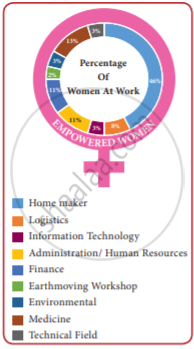
Choose the correct answer.
Identify the three jobs where the same percentage of women work.
‘My tongs are like a tiger among toys.’ It means ______
What do you need to learn to live a good life in this world?
Work in groups of five. Tell the story in ten sentences.
You can begin the story like this:
The author’s Grandfather served in the Indian Forest Service.
After his retirement he built ______ Now continue the story. Each one should say one sentence.
The girl admitted to her brother that she was badly frightened.
Amuthan locked the door behind him.
Did Santhosh enjoy his morning walk? How do you know?
Put the given time expressions in the correct columns.
| winter | morning | 2’ o clock | evening | 1947 |
| March | Sunday | 15th August | 4.30 PM | wedding day |
| in | at | on |
How will you treat your guest?
______helped Bujju to reach his family.
Choose the correct answer.
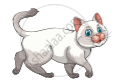
Fill in the blank
He has bat ______ ball.
What were the people excited about?
Read the advertisement and answer the question given below.

What is the advertisement about?
Write a paragraph on the topic ‘Park’.
The monster tree was protecting the ______.
Fill in the blank
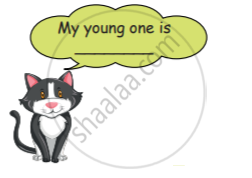
Recite the poem with correct intonation.
The king looked for a______.
The merchants sold things made of______.
Match the words with similar meaning.
| truck | subway |
| underground | lorry |
| tap | wallet |
| purse | faucet |
Do we worry when the progress is slow?
Why was Chris worried?
Do you think Nasruddin was good at archery?
The rabbit had
What did he learn about the birds?
How can we identify insecure websites?
