Advertisements
Advertisements
Question
The pencil leads are made of mainly:
(a) lithium
(b) charcoal
(c) lead
(d) graphite
Advertisements
Solution
graphite
The pencil leads are mainly made of graphite.
APPEARS IN
RELATED QUESTIONS
Give reason why carbon compounds are generally poor conductors of electricity.
State the reason to explain why covalent compounds "are bad conductors of electricity".
What type of bonds are present in methane (CH4) and sodium chloride (NaCl)?
Fill in the following blank with suitable word:
The general formula CnH2n for cycloalkanes is the same as that of ...........
Friedrich Wohler converted an inorganic compound into an organic compound in the laboratory.
Write the name and formula of organic compound formed.
Draw the electron-dot structure of NH3 and state the type of bonding.
Explain why, diamond can be used in rock drilling equipment but graphite cannot.
State one use of diamond which depends on its 'extraordinary brilliance' and one use of graphite which depends on its being 'black and quite soft'.
The number of carbon atoms joined in a spherical molecule of buckminsterfullerene is:
(a) fifty
(b) sixty
(c) seventy
(d) ninety
Complete the following:
In case of non-polar covalent bond, the covalent bond is formed in the ______ of atoms and shared electrons are ______ distributed. (corner, middle, equally, unequally)
Draw all possile structural formulae of compound from their molecular formula given below.
C4H10
Explain why Carbon tetrachloride does not dissolve in water.
Fill in the blank from the choice given in bracket.
The compound that does not have a lone pair of electrons is ___________. (Water, Ammonia, carbon tetrachloride)
Which of the following is a common characteristic of a covalent compound?
Explain why carbon tetrachloride does not dissolve in water.
Covalent bonds can be single, double or triple covalent bonds. How many electrons are shared in each? Give an example of each type.
Define a covalent bond.
Complete the following activity.
Write the names of the hydrocarbons for the following structural formula.
(isobutylene, cyclohexane, propene, cyclohexene, cyclopentane, benzene, propyne, isobutane, propane)
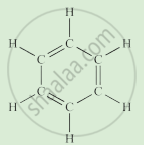 |
Complete the following activity.
Write the names of the hydrocarbons for the following structural formula.
(isobutylene, cyclohexane, propene, cyclohexene, cyclopentane, benzene, propyne, isobutane, propane)
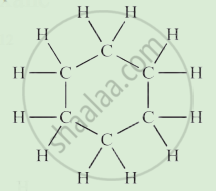 |
Carbon forms four covalent bonds by sharing its four valence electrons with four univalent atoms, e.g., hydrogen. After the formation of four bonds, carbon attains the electronic configuration of ______.
