Advertisements
Advertisements
Question
The number of carbon atoms joined in a spherical molecule of buckminsterfullerene is:
(a) fifty
(b) sixty
(c) seventy
(d) ninety
Advertisements
Solution
sixty
The number of carbon atoms joined in a spherical molecule of buckminsterfullerene is 60.
APPEARS IN
RELATED QUESTIONS
Write structural formula of Methane.
Write any three features and give two examples of covalent compounds
State whether the following statement is true or false:
Diamond and graphite are the covalent compounds of carbon element (C)
What type of bonds are present in CO2 molecule? Draw their electron-dot structures.
Fill in the blank in the following sentence:
In forming N2 molecule, .............. electrons are shared by each atom of nitrogen.
What type of chemical bond is present in chlorine molecule? Explain your answer.
State one use of diamond which depends on its 'extraordinary brilliance' and one use of graphite which depends on its being 'black and quite soft'.
A hydrocarbon having one double bond has 100 carbon atoms in its molecule. The number of hydrogen atoms in its molecule will be
(a) 200
(b) 198
(c) 202
(d) 196
Explain the following:
polar covalent compounds electricity.
Write answer as directed.
Saturated hydrocarbons are classified into three types. Write these names giving one example each.
Draw electron - dot structure and structural formula of methane.
Choose the correct answer from the options given below
Condition favorable for formation of a covalent bond is
Covalent bonds can be single, double or triple covalent bonds. How many electrons are shared in each? Give an example of each type.
What are Allotropes? Name any two allotropic forms of carbon. Give one use of it.
Name two carbon compounds used in day-to-day life.
Write an Explanation.
Alkyne
Complete the following activity.
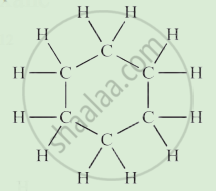
Write the names of the hydrocarbons for the following structural formula.
(isobutylene, cyclohexane, propene, cyclohexene, cyclopentane, benzene, propyne, isobutane, propane)
 |
Carbon forms four covalent bonds by sharing its four valence electrons with four univalent atoms, e.g., hydrogen. After the formation of four bonds, carbon attains the electronic configuration of ______.
State the reasons, why carbon cannot
- Lose four electrons to form C4+ cation and
- Gain four electrons to form C4- anion.
How does carbon overcome this problem to form compounds?
