Advertisements
Advertisements
Question
Why is graphite a good conductor of electricity but diamond is a non-conductor of electricity?
Advertisements
Solution
Graphite is a good conductor of electricity because of the presence of free electrons in its crystal. As we know that an atom of carbon has 4 valence electrons, in a graphite crystal, each carbon atom is connected to only three other carbon atoms by covalent bonds. This means that the fourth valence electron of each carbon atom is free. These free moving electrons are responsible for the conduction of electricity in a graphite crystal. But in the case of diamond these free electrons are not available due to its structure. Hence, diamond is a non-conductor.
APPEARS IN
RELATED QUESTIONS
Why covalent compounds are different from ionic compounds?
Name the element whose one of the allotropic forms is buckminsterfullerene.
Buckminsterfullerene is spherical molecule in which 60 carbon atoms are arranged in interlocking hexagonal and pentagonal rings of carbon atoms.
How many pentagons of carbon atoms are present in one molecule of buckminsterfullerene?
Give one example of a molecule containing a triple covalent bond.
What is buckminsterfullerene?
Give the formula of the compound that would be formed by the combination of the following pair of elements:
K and H
What do you understand by polar covalent compounds?
Which element exhibits the property of catenation to maximum extent and why?
Draw an electron dot structure of the following molecule. (Without showing the circle) :
Ethene
Draw all possile structural formulae of compound from their molecular formula given below.
C3H4
Explain the Structural isomerism term with example.
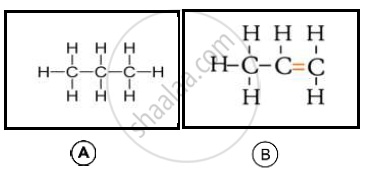
Observe the straight chain hydrocarbons given below and answer the following
questions :
i) Which of the straight chain compounds from A and B is saturated and unsaturated straight chains?
ii) Name these straight chains.
iii) Write their chemical formulae and number of – CH2 - units.
The molecule which contains a triple covalent bond is ______.
Compound X consists of molecules.
Choose the letter corresponding to the correct answer from the options A, B, C and D given below:
X is likely to have a ______.
Acids dissolve in water and produce positively charged ions. Draw the structure of these positive ions.
Name two compounds that are covalent when taken pure but produce ions when dissolved in water.
Name two compounds that are covalent when taken pure but produce ions when dissolved in water.
Give an example for each of the following statement.
Formation of coordinate covalent bond between NH3 ➝ BF3 molecules
Which of the following are correct structural isomers of butane?
- \[\begin{array}{cc}
\ce{H}\phantom{...}\ce{H}\phantom{...}\ce{H}\phantom{...}\ce{H}\\
|\phantom{....}|\phantom{....}|\phantom{....}|\\
\ce{H - C - C - C - C - H}\\
|\phantom{....}|\phantom{....}|\phantom{....}|\\
\ce{H}\phantom{...}\ce{H}\phantom{...}\ce{H}\phantom{...}\ce{H}\\
\end{array}\] - \[\begin{array}{cc}
\ce{H}\phantom{...}\ce{H}\phantom{...}\ce{H}\\
|\phantom{....}|\phantom{....}|\\
\ce{H - C - C - C - H}\\
|\phantom{.....}|\phantom{.....}|\\
\ce{H}\ce{H-C-H}\ce{H}\\
|\\
\ce{H}\\
\end{array}\] - \[\begin{array}{cc}
\ce{H}\phantom{...}\ce{H}\phantom{...}\ce{H}\\
|\phantom{....}|\phantom{....}|\\
\ce{H - C - C - C - H}\\
|\phantom{.....}\backslash\phantom{..}|\\
\phantom{....}\ce{H}\phantom{......}\ce{C - H}\phantom{}\\
\phantom{.......}|\\
\phantom{.......}\ce{H}\\
\end{array}\] - \[\begin{array}{cc}
\ce{H}\phantom{...}\ce{H}\\
|\phantom{....}|\\
\ce{H - C - C - H}\\
|\phantom{....}|\\
\ce{H - C - C - H}\\
|\phantom{....}|\\
\ce{H}\phantom{...}\ce{H}\\
\end{array}\]
