Advertisements
Advertisements
Question
The mass number of a nucleus is equal to
Options
the number of neutrons in the nucleus
the number of protons in the nucleus
the number of nucleons in the nucleus
none of them.
Advertisements
Solution
the number of nucleons in the nucleus
Mass number of a nucleus is defined as the sum of the number of neutron and protons present in the nucleus, i.e. the number of nucleons in the nucleus.
APPEARS IN
RELATED QUESTIONS
Write the relationship between the size of a nucleus and its mass number (A)?
Suppose we have 12 protons and 12 neutrons. We can assemble them to form either a 24Mg nucleus or two 12C nuclei. In which of the two cases more energy will be liberated?
As the mass number A increases, the binding energy per nucleon in a nucleus
In one average-life,
For nuclei with A > 100,
(a) the binding energy of the nucleus decreases on an average as A increases
(b) the binding energy per nucleon decreases on an average as A increases
(c) if the nucleus breaks into two roughly equal parts, energy is released
(d) if two nuclei fuse to form a bigger nucleus, energy is released.
Assume that the mass of a nucleus is approximately given by M = Amp where A is the mass number. Estimate the density of matter in kgm−3 inside a nucleus. What is the specific gravity of nuclear matter?
A neutron star has a density equal to that of the nuclear matter. Assuming the star to be spherical, find the radius of a neutron star whose mass is 4.0 × 1030 kg (twice the mass of the sun).
What is the unit of mass when measured on the atomic scale?
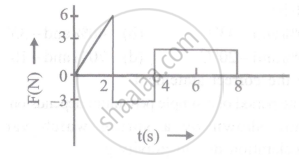
The force 'F' acting on a particle of mass 'm' is indicated by the force-time graph shown below. The change in momentum of the particle over the time interval from zero to 8s is:
A nucleus of mass M emits a γ-ray photon of frequency 'v'. The loss of internal energy by the nucleus is ______.
A given coin has a mass of 3.0 g. Calculate the nuclear energy that would be required to separate all the neutrons and protons from each other. Assume that the coin is entirely made of \[_{29}^{63}Cu\] atoms (of mass 62.92960 u).
Which of the following is the famous mass-energy equivalence relation given by Einstein?
In Einstein's mass-energy equivalence relation, the symbol c stands for:
The approximate value of the velocity of light in vacuum used in the mass-energy equivalence relation is:
Experimental verification of Einstein's mass-energy relation has been achieved in the study of:
In a reaction, the conservation law of energy states that the initial energy and the final energy are equal, provided that:
Calculate the energy equivalent of 1 g of substance.
