Advertisements
Advertisements
Question
A neutron star has a density equal to that of the nuclear matter. Assuming the star to be spherical, find the radius of a neutron star whose mass is 4.0 × 1030 kg (twice the mass of the sun).
Advertisements
Solution
Given:
Mass of the neutron star, M = 4.0 × 1030 kg
Density of nucleus , d = `2.4 xx 10^17`
Density of nucleus, d= `M/V`
Here, V is the volume of the nucleus.
`therefore V = M/d = (4 xx 10^30)/(2.4 xx 10^17)`
= `1/0.6 xx 10^13`
= `1/6 xx 10^14`
If R is the radius, then the volume of the neutron star is given by
`V = 4/3piR^3`
`therefore 1/6 xx 10^14 = 4/3 xx pi xx R^3`
⇒ `R^3 = 1/6 xx 3/4 xx 1/pi xx 10^14`
⇒ `R^3 = 1/8 xx 100/pi xx 10^12`
`therefore R = 1/2 xx 10^4 xx 3.17`
= `1.585 xx 10^4 = 15 "km"`
APPEARS IN
RELATED QUESTIONS
Draw the plot of binding energy per nucleon (BE/A) as a functino of mass number A. Write two important conclusions that can be drawn regarding the nature of nuclear force.
Write the relationship between the size of a nucleus and its mass number (A)?
A heavy nucleus X of mass number 240 and binding energy per nucleon 7.6 MeV is split into two fragments Y and Z of mass numbers 110 and 130. The binding energy of nucleons in Y and Z is 8.5 MeV per nucleon. Calculate the energy Q released per fission in MeV.
In one average-life,
For nuclei with A > 100,
(a) the binding energy of the nucleus decreases on an average as A increases
(b) the binding energy per nucleon decreases on an average as A increases
(c) if the nucleus breaks into two roughly equal parts, energy is released
(d) if two nuclei fuse to form a bigger nucleus, energy is released.
What is the unit of mass when measured on the atomic scale?
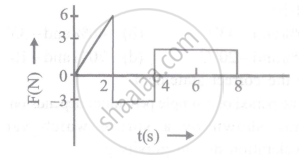
The force 'F' acting on a particle of mass 'm' is indicated by the force-time graph shown below. The change in momentum of the particle over the time interval from zero to 8s is:
A nucleus of mass M emits a γ-ray photon of frequency 'v'. The loss of internal energy by the nucleus is ______.
A given coin has a mass of 3.0 g. Calculate the nuclear energy that would be required to separate all the neutrons and protons from each other. Assume that the coin is entirely made of \[_{29}^{63}Cu\] atoms (of mass 62.92960 u).
Before the advent of the theory of special relativity, what was the presumption regarding mass and energy in a reaction?
Which of the following is the famous mass-energy equivalence relation given by Einstein?
In Einstein's mass-energy equivalence relation, the symbol c stands for:
The approximate value of the velocity of light in vacuum used in the mass-energy equivalence relation is:
Experimental verification of Einstein's mass-energy relation has been achieved in the study of:
In a reaction, the conservation law of energy states that the initial energy and the final energy are equal, provided that:
Calculate the energy equivalent of 1 g of substance.
