Advertisements
Advertisements
Question
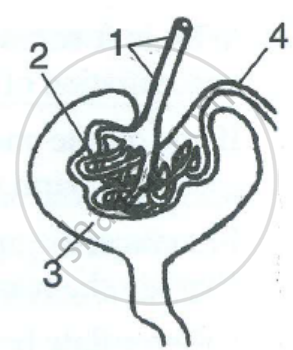
The given diagram represents a nephron and its blood supply. Study the diagram and answer the following questions:

(i) Label parts 1, 2, 3 and 4.
(ii) State the reason for the high hydrostatic pressure in the glomerulus.
(iii) Name the blood vessel which contains the least amount of urea in this diagram.
(iv) Name the two main stages of urine formation.
(v) Name the part of the nephron which lies in the renal medulla.
Advertisements
Solution
(i)
1 – Collecting duct
2 – Distal convoluted tubule (DCT)
3 – Descending limb of loop of Henle
4 – Bowman’s capsule
(ii) The diameter of efferent arteriole is narrower than the diameter of the afferent arteriole which builds the high hydrostatic pressure in the glomerulus.
(iii) Efferent arteriole
(iv) The two main stages of urine formation are ultrafiltration and tubular reabsorption.
(v) Henle’s loop and collecting tubules
RELATED QUESTIONS
The Biological/technical term for The removal of nitrogenous wastes from the body
Fill in the following blank with suitable word:
The organs which extract the nitrogenous wastes from the blood are ..........
What job is done by the kidneys?
If a patient is out on dialysis, he is most likely suffering from a severe ailment of the:
(a) circulatory system
(b) respiratory system
(c) excretory system
(d) digestive system
In humans, urea is formed in
Name the following:
The tuft of capillaries inside the Bowman's capsule.
Differentiate between the following pairs of term :
Renal cortex and renal medulla
Correct and rewrite the statements by changing the biological term that is underlined for the statement:
The kidney is composed of number of neurons.
Study the diagram given alongside and then answer the question that follow:
What is the technical term given to the process occurring in 2 and 3? Briefly describe the process.
Name the Following
The substance found in excess in the urine of a diabetic patient.
