Advertisements
Advertisements
Question
Fill in the following blank with suitable word:
The organs which extract the nitrogenous wastes from the blood are ..........
Advertisements
Solution
The organs which extract the nitrogenous wastes from the blood are kidneys.
APPEARS IN
RELATED QUESTIONS
How is the amount of urine produced regulated?
Explain Selective reabsorption
Name the procedure used in the working of artificial kidney.
Fill in the following blank with suitable word:
Gums and resins are the .......... products of plants.
Fill in the following blank with suitable word:
Bowman's capsule and tubule taken together make a..........
What is the name of the tubes which connect the kidneys to bladder?
Answer the following in short.
Define transpiration in plants.
Name the following:
The outer region of kidney containing the Bowman's capsule.
Name the following:
The part of kidney tubules where the term urine is first used for the fluid in it.
Why is it necessary to maintain a normal osmotic concentration of the blood?
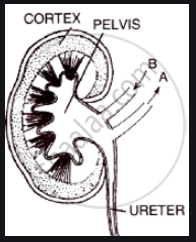
Look at the figure given bellow, it is a section of human kidney as seen from the front.

Is it a longitudinal section or a cross-section?
Given below is a highly simplified diagram of the human kidney cut open longitudinally. Answer the question that follow:
Name the functional units of the kidneys.
Give Technical Terms
The hormone that helps increase the reabsorption of water from the kidney tubules.
Write the functional activity of the following structure: Kidney
The process of diffusion of solvent particles from the region of less solute concentration to a region of high solute concentration through a semi-permeable membrane is known as ____________.
If a plant is releasing carbon dioxide and taking in oxygen during the day, does it mean that there is no photosynthesis occurring? Justify your answer.
Why is the rate of breathing in aquatic organisms much faster than in terrestrial organisms?
Give two examples of the following:
Water-soluble vitamins
