Advertisements
Advertisements
Question
If a plant is releasing carbon dioxide and taking in oxygen during the day, does it mean that there is no photosynthesis occurring? Justify your answer.
Advertisements
Solution
If a plant is releasing carbon dioxide and taking in oxygen during the day means the plant is respiring; it does not mean that there is no photosynthesis occurring in the plant. This is because Photosynthesis and respiration are two independent processes.
APPEARS IN
RELATED QUESTIONS
Why is it necessary to excrete waste products?
Name the Following
The organ which produces urea.
The Biological/technical term for The removal of nitrogenous wastes from the body
The form in which glucose in stored in liver.
State the exact location of the Loop of Henle.
Blood in the renal artery or renal vein (Which one has more urea ?)
Fill in the following blank with suitable word:
The organs which extract the nitrogenous wastes from the blood are ..........
A dialysis machine contains long tubes coiled in a tank containing dialysing solution
What does the dialysing solution contain?
Name the various organs of the human excretory system.
What is meant by dialysis? What type of patients are put on dialysis?
Fill in the blank.
.................. produces bile pigments from the heamoglobin of broken RBCs.
Differentiate between
excretion and transpiration
Answer the following in short.
What is excretion?
In summer the urine is slightly thicker than in winter explain the reason.
The following diagram represents a mammalian kidney tubule (nephron) and its blood supply.
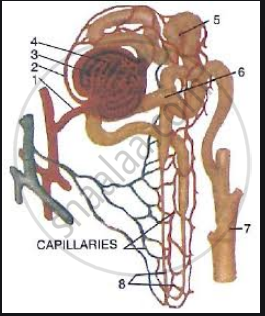
Parts indicated by the guidelines 1to 8 are as follows:
1. Afferent arteriole from renal artery
2. Efferent arteriole
3. Bowman's capsule
4. Glomerulus
5. Proximal convoluted tubule with blood capillaries
6. Distal convoluted tubule with blood capillaries
7. Collecting tubule
8. U-shaped loop of Henle
Study the diagram and answer the question that follow:
Which structure contains the lowest concentration of urea?
The following diagram represents a mammalian kidney tubule (nephron) and its blood supply.
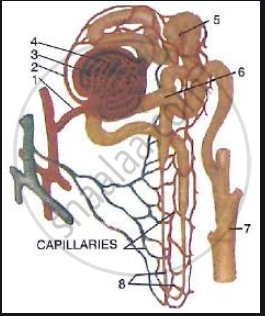
Parts indicated by the guidelines 1to 8 are as follows:
1. Afferent arteriole from renal artery
2. Efferent arteriole
3. Bowman's capsule
4. Glomerulus
5. Proximal convoluted tubule with blood capillaries
6. Distal convoluted tubule with blood capillaries
7. Collecting tubule
8. U-shaped loop of Henle
Study the diagram and answer the question that follow:
Which structure contains the highest concentration of urea?
Name the Following
The term used for Bowman’s capsule and glomerulus together.
Give Technical Term:
The duct which transports urine from the kidney to the urinary bladder.
Two green plants are kept separately in oxygen-free containers, one in the dark and the other in continuous light. Which one will live longer? Give reasons.
Identify the correct labels for A and B in the following diagram

