Advertisements
Advertisements
Question
The following diagram represents a mammalian kidney tubule (nephron) and its blood supply.
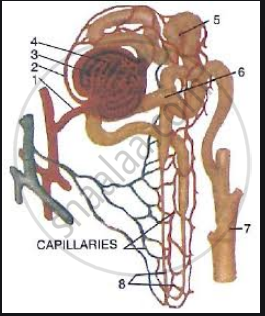
Parts indicated by the guidelines 1to 8 are as follows:
1. Afferent arteriole from renal artery
2. Efferent arteriole
3. Bowman's capsule
4. Glomerulus
5. Proximal convoluted tubule with blood capillaries
6. Distal convoluted tubule with blood capillaries
7. Collecting tubule
8. U-shaped loop of Henle
Study the diagram and answer the question that follow:
Which structure contains the lowest concentration of urea?
Advertisements
Solution
2/Efferent arteriole
RELATED QUESTIONS
Write the functions of the Urinary bladder
Define excretion.
The procedure of cleaning the blood of a person by using a kidney machine is known as ______.
Answer the following in short.
What is excretion?
Name the following:
The outer region of kidney containing the Bowman's capsule.
Label the diagram given below :

Look at the figure given below. It is a section of human kidney as seen from the front.
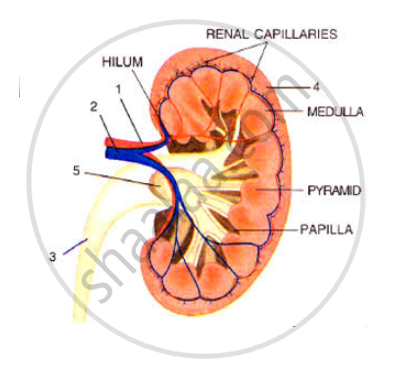
Which area/part (give its name and number given on the diagram) which contains the following:
(i) Malpighian capsule
(ii) The pyramids
(iii) Freshly collected urine
Choose the Odd One Out:
Hypotonic filtrate is formed in _______.
What is the purpose of making urine in the human body?
