Advertisements
Advertisements
प्रश्न
The following diagram represents a mammalian kidney tubule (nephron) and its blood supply.
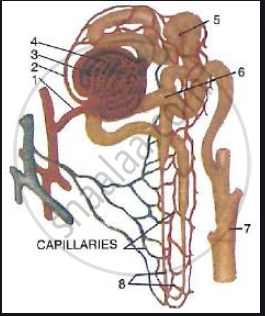
Parts indicated by the guidelines 1to 8 are as follows:
1. Afferent arteriole from renal artery
2. Efferent arteriole
3. Bowman's capsule
4. Glomerulus
5. Proximal convoluted tubule with blood capillaries
6. Distal convoluted tubule with blood capillaries
7. Collecting tubule
8. U-shaped loop of Henle
Study the diagram and answer the question that follow:
Which structure contains the lowest concentration of urea?
Advertisements
उत्तर
2/Efferent arteriole
संबंधित प्रश्न
The Biological/technical term for The removal of nitrogenous wastes from the body
Name the two waste products of the human body which are produced in the body cells.
Name the main nitrogenous waste in the human blood. How is it removed from the blood?
Fill in the blank :
Nitrogenous wastes in the urine are in the form of urea and .....................
Name the following:
The part of kidney tubules where the term urine is first used for the fluid in it.
Differentiate between the following pairs of term :
Renal cortex and renal medulla
Study the diagram given alongside and then answer the question that follow:
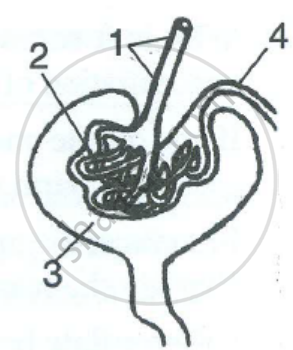
Name the parts labelled 1, 2, 3, and 4.
Choose the correct option.
The part of nephron which absorbs glucose and amino acid is ______.
The mode of excretion of nitrogenous wastes like ammonia which takes place by simple diffusion is called ______.
What is the purpose of making urine in the human body?
