Advertisements
Advertisements
प्रश्न
Study the diagram given alongside and then answer the question that follow:
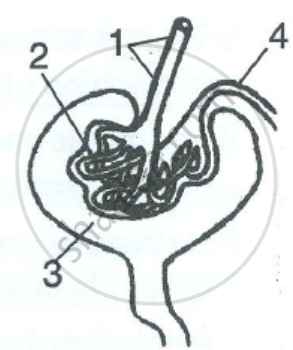
Name the parts labelled 1, 2, 3, and 4.
Advertisements
उत्तर
1 - Afferent arteriole
2 - Glomerulus
3 - Bowman's capsule
4 - Efferent arteriole
संबंधित प्रश्न
In which of the following are the largest amounts of nitrogen excreted from a mammalian body?
The excretory unit in the human excretory system is called ______.
Tick the most appropriate answer.
The process of removing waste from the body is called
Fill in the blank.
.................. produces bile pigments from the heamoglobin of broken RBCs.
Choose the correct answer:
Narrow apex of pyramid in kidney is called ___________
Differentiate between:
The Renal artery and the Renal vein.
Differentiate between:
Ureter and Urethra.
Give Technical Term:
The organ which filters out urea and uric acid from the bloodstream.
Give Technical Term:
The tube joining the kidney to the urinary bladder.
Write the functional activity of the following structure: Vasopressin
