Advertisements
Advertisements
प्रश्न
Fill in the following blank with suitable word:
The organs which extract the nitrogenous wastes from the blood are ..........
Advertisements
उत्तर
The organs which extract the nitrogenous wastes from the blood are kidneys.
APPEARS IN
संबंधित प्रश्न
Explain the term haemodialysis.
Draw a diagram of the human excretory system and label the various parts.
A dialysis machine contains long tubes coiled in a tank containing dialysing solution Of what substance are the tubes made?
The procedure of cleaning the blood of a person by using a kidney machine is known as:
(a) ketolysis
(b) hydrolysis
(c) dialysis
(d) photolysis
Fill in the blank.
....................... are present in the stem of pine tree that make the pinewood strong and durable.
Why is it necessary to maintain a normal osmotic concentration of the blood?
Given below is a diagram of a human kidney, cut open longitudinally. Answer the following:

(i) Give definition of excretion.
(ii) Name the unit of kidney.
(iii) Why does the cortex of kidney show dotted appearance?
(iv) List the functions of the kidney.
Choose the odd one out in the following series:
Renal fat, renal capsule, nerve.
The following diagram represents a mammalian kidney tubule (nephron) and its blood supply.
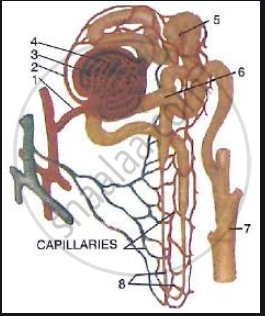
Parts indicated by the guidelines 1to 8 are as follows:
1. Afferent arteriole from renal artery
2. Efferent arteriole
3. Bowman's capsule
4. Glomerulus
5. Proximal convoluted tubule with blood capillaries
6. Distal convoluted tubule with blood capillaries
7. Collecting tubule
8. U-shaped loop of Henle
Study the diagram and answer the question that follow:
Which structure contains the highest concentration of urea?
Study the diagram given alongside and then answer the question that follow:
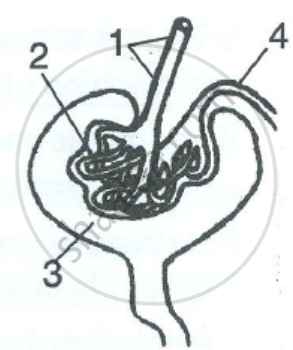
Name the parts labelled 1, 2, 3, and 4.
Name the Following
The Inner concave margin of kidney.
Name the Following
The branch of renal artery which enters into Bowman’s capsule.
Complete the following sentence with appropriate word:
Besides excretion, the kidneys also carry out the important function of ______.
Write the functional activity of the following structure:
Glomerulus
Hypotonic filtrate is formed in _______.
Complete the diagram/chart with correct labels/ information. Write the conceptual details regarding it.
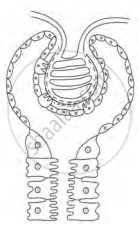
In a person the tubule part of the nephron is not functioning at all. What will its effect be on urine formation?
Leaves of a healthy potted plant were coated with vaseline. Will this plant remain healthy for long? Give reasons for your answer.
Identify the correct labels for A and B in the following diagram

