Advertisements
Advertisements
Question
The following table shows the weight of paddy cultivated in a particular village during the years 2010 to 2015
| Year | Paddy production |
| 2010 |  |
| 2011 |  |
| 2012 |  |
| 2013 |  |
| 2014 |  |
| 2015 |  |

Observe the pictograph and answer the following questions.
a) In which year paddy production was maximum?
b) In which year paddy production were equal?
c) Find the quantity of paddy production in 2015
d) Find the total quantity of paddy production particularly 2013, 2014, and 2015
Advertisements
Solution
a) 2010 ...(500 kg)
b) 2012, 2014
c) 200 kg
d) 200 + 300 + 200 = 700 kg
APPEARS IN
RELATED QUESTIONS
In a pictograph, if a symbol  represents 50 books in a library shelf, then the symbol
  represents 25 books.
A ______ represents data through pictures of objects.
On the scale of 1 unit length = 10 crore, the bar of length 6 units will represent ______ crore and of ______ units will represent 75 crore.
Following pictograph represents some surnames of people listed in the telephone directory of a city.
| Surname | Number of people  = 100 people = 100 people |
| Khan |  |
| Patel |  |
| Rao |  |
| Roy |  |
| Saikia |  |
| Singh |  |
Observe the pictograph and answer the following questions:
- How many people have surname ‘Roy’?
- Which surname appears the maximum number of times in the telephone directory?
- Which surname appears the least number of times in the directory?
- Which two surnames appear an equal number of times?
The number of bottles of cold drinks sold by a shopkeeper on six consecutive days is as follows:
| Day | Sunday | Monday | Tuesday | Wednesday | Thursday | Friday |
| Number of bottles | 350 | 200 | 300 | 250 | 100 | 150 |
Prepare a pictograph of the data using one symbol to represent 50 bottles.
The following table gives information about the circulation of newspapers (dailies) in a town in five languages.
| Language | English | Hindi | Tamil | Punjabi | Gujarati |
| Number of newspapers |
5000 | 8500 | 500 | 2500 | 1000 |
Prepare a pictograph of the above data, using a symbol of your choice, each representing 1000 newspapers.
Annual expenditure of a company in the year 2007-2008 is given below:
| Items | Expenditure (Rs in lakh) |
| Salaries of employees | 65 |
| Advertisement | 10 |
| Purchase of machinery | 85 |
| Electricity and water | 15 |
| Transportation | 25 |
| Other expenses | 30 |
Prepare a pictograph of the above data using an appropriate symbol to represent Rs 10 lakh.
Prepare a pictograph of the information given in the question.
Scale: 1 unit length = 10 tickets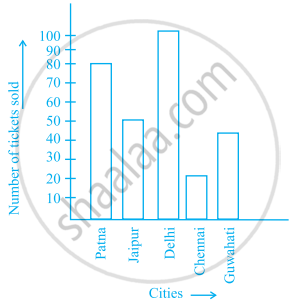
In preparing a pictograph for the data: Farming (60), Private Job (20), Government Job (30), and Other (40), which scale would be most efficient?
A shop sold mobile sets over a week. The pictograph uses 1 mobile icon = 6 sets.
Monday shows 4 icons, Tuesday shows 6 icons, and Wednesday shows 5 icons. How many mobile sets were sold on Tuesday?
