Advertisements
Advertisements
Question
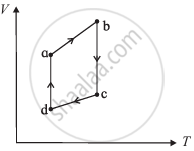
The figure shows the V-T diagram for one cycle of a hypothetical heat engine which uses the ideal gas. Draw the p-V diagram diagram of the system.
Advertisements
Solution
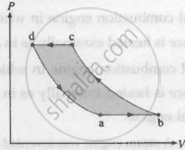 |
| P-V diagram (Schematic) |
ab: isobaric process,
bc: isothermal process,
cd: isobaric process,
da: isothermal process
`("P"_"a""V"_"a")/"T"_"a"=("P"_"b""V"_"b")/"T"_"b"=("P"_"c""V"_"c")/"T"_"c"=("P"_"d""V"_"d")/"T"_"d"` = ηR
APPEARS IN
RELATED QUESTIONS
A gas contained in a cylinder surrounded by a thick layer of insulating material is quickly compressed.
- Has there been a transfer of heat?
- Has work been done?
Answer in brief:
A gas contained in a cylinder surrounded by a thick layer of insulating material is quickly compressed has work been done?
Answer in brief.
What sets the limits on the efficiency of a heat engine?
Draw a p-V diagram and explain the concept of positive and negative work. Give one example each.
The efficiency of a heat engine working between the freezing point and boiling point of water is ____________.
State Clausius form of the second law of thermodynamics.
State Kelvin-Planck's statement of the second law of thermodynamics.
Define heat engine.
What are the processes involves in a Carnot engine?
State the second law of thermodynamics in terms of entropy.
Why does heat flow from a hot object to a cold object?
Explain the heat engine and obtain its efficiency.
Explain in detail the Carnot heat engine.
Derive the expression for Carnot engine efficiency.
Suppose a person wants to increase the efficiency of the reversible heat engine that is operating between 100°C and 300°C. He had two ways to increase efficiency.
- By decreasing the cold reservoir temperature from 100°C to 50°C and keeping the hot reservoir temperature constant
- by increasing the temperature of the hot reservoir from 300°C to 350°C by keeping the cold reservoir temperature constant.
Which is the suitable method?
A Carnot engine whose efficiency is 45% takes heat from a source maintained at a temperature of 327°C. To have an engine of efficiency of 60% what must be the intake temperature for the same exhaust (sink) temperature?
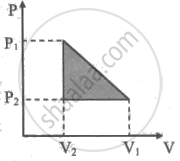
10 One mole of a van der Waals' gas obeying the equation `("P" + "a"/"V"^2)`(V - b) = RT undergoes the quasi-static cyclic process which is shown in the P-V diagram. The net heat absorbed by the gas in this process is ______
For a heat engine operating between temperatures t1 °C and t2 °C, its efficiency will be ______.
Heat engine transfers ______.
A heat engine operates between a cold reservoir at temperature T2 = 400 K and a hot reservoir at temperature T1. It takes 300 J of heat from the hot re ervoir and delivers 240 J of heat to the cold reservoir in a cycle. The minimum temperature of the hot reservoir has to be ______ K.
Which statement is incorrect?
Let η1 is the efficiency of an engine at T1 = 447°C and T2 = 147°C while η2, is the efficiency at T1 = 947°C and T2 = 47°C. The ratio `eta_1/eta_2` will be ______.
Draw a neat labelled P - V diagram for a typical heat engine.
The thermal efficiency of a heat engine is 25%. If in one cycle the heat absorbed from the hot reservoir is 50000 J, what is the heat rejected to the cold reservoir in one cycle?
What does a heat engine consist of?
What is a heat engine?
Mention any two elements of a heat engine.
