Advertisements
Advertisements
Question
Explain the heat engine and obtain its efficiency.
Advertisements
Solution
Heat Engine: In the modem technological world, the role of automobile engines plays a vital role in transportation. In motorbikes and cars, there are engines which take in petrol or diesel as input and do work by rotating wheels. Most of these automobile engines have efficiency not greater than 40%. The second law of thermodynamics puts a fundamental restriction on the efficiency of engines. Therefore understanding heat engines is very important.
Reservoir: It is defined as a thermodynamic system which has a very large heat capacity. By taking in heat from a reservoir or giving heat to the reservoir, the reservoir’s temperature does not change.
Example: Pouring a tumbler of hot water into the lake will not increase the temperature of the lake. Here the lake can be treated as a reservoir.
When a hot cup of coffee attains equilibrium with the open atmosphere, the temperature of the atmosphere will not appreciably change. The atmosphere can be taken as a reservoir.
We can define a heat engine as follows: A heat engine is a device which takes heat as input and converts this heat into work by undergoing a cyclic process.
A heat engine has three parts:
- Hot reservoir
- Working substance
- Cold reservoir
A Schematic diagram for a heat engine is given below:

Heat Engine
1. Hot reservoir (or) Source: It supplies heat to the engine. It is always maintained at a high-temperature TH.
2. Working substance: It is a substance like gas or water, which converts the heat supplied into Work.
3. Cold reservoir (or) Sink: The heat engine ejects some amount of heat (QL) into the cold reservoir after it doing work. It is always maintained at a low-temperature TL.
The heat engine works in a cyclic process. After a cyclic process, it returns to the same state. Since the heat engine returns to the same state after it ejects heat, the change in the internal energy of the heat engine is zero.
The efficiency of the heat engine is defined as the ratio of the work done (output) to the heat absorbed (input) in one cyclic process.
Let the working substance absorb heat QH units from the source and reject QL units to the sink after doing work W units.

Heat engine
We can write,
Input heat = Work done + ejected heat
QH = W + QL
W = QH – QL
Then the efficiency of the heat engine
η = `"output"/"input" = "W"/"Q"_"H" = ("Q"_"H" - "Q"_"L")/"Q"_"H"`
η = `"output"/"input" = "W"/"Q"_"H" = 1 - "Q"_"L"/"Q"_"H"`
Note here that QH, QL and W all are taken as positive, a sign convention followed in this expression.
Since QL < QH, the efficiency (η) always less than 1. This implies that heat absorbed is not completely converted into work. The second law of thermodynamics placed fundamental restrictions on converting heat completely into work.
APPEARS IN
RELATED QUESTIONS
A gas contained in a cylinder surrounded by a thick layer of insulating material is quickly compressed.
- Has there been a transfer of heat?
- Has work been done?
Answer in brief.
What sets the limits on the efficiency of a heat engine?
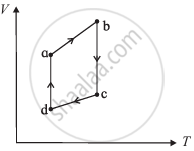
The figure shows the V-T diagram for one cycle of a hypothetical heat engine which uses the ideal gas. Draw the p-V diagram diagram of the system.
The efficiency of a heat engine working between the freezing point and boiling point of water is ____________.
State Kelvin-Planck's statement of the second law of thermodynamics.
Define heat engine.
Why does heat flow from a hot object to a cold object?
Explain the second law of thermodynamics in terms of entropy.
A heat engine operates between a cold reservoir at temperature T2 = 400 K and a hot reservoir at temperature T1. It takes 300 J of heat from the hot re ervoir and delivers 240 J of heat to the cold reservoir in a cycle. The minimum temperature of the hot reservoir has to be ______ K.
What does a heat engine consist of?
