Advertisements
Advertisements
Question
Explain in detail the Carnot heat engine.
Advertisements
Solution
In the year 1824, a young French engineer Sadi Carnot proved that a certain reversible engine operated in a cycle between hot and cold reservoirs can have maximum efficiency. This engine is called the Carnot engine.
A reversible heat engine operating in a cycle between two temperatures in a particular way is called a Carnot Engine. The Carnot engine has four parts which are given below.
(i) Source: It is the source of heat maintained at constant high-temperature TH. Any amount of heat can be extracted from it, without changing its temperature.

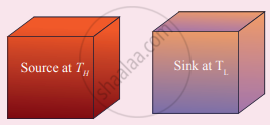
Carnot engine
(ii) Sink: It is a cold body maintained at a constant low-temperature TL. It can absorb any amount of heat.
(iii) Insulating stand: It is made of perfectly non-conducting material. Heat is not conducted through this stand.
(iv) Working substance: It is an ideal gas enclosed in a cylinder with perfectly non-conducting walls and a perfectly conducting bottom. A non-conducting and frictionless piston is fitted in it.
APPEARS IN
RELATED QUESTIONS
Answer in brief:
A gas contained in a cylinder surrounded by a thick layer of insulating material is quickly compressed has work been done?
Answer in brief.
What sets the limits on the efficiency of a heat engine?
Draw a p-V diagram and explain the concept of positive and negative work. Give one example each.
What are the processes involves in a Carnot engine?
Why does heat flow from a hot object to a cold object?
Suppose a person wants to increase the efficiency of the reversible heat engine that is operating between 100°C and 300°C. He had two ways to increase efficiency.
- By decreasing the cold reservoir temperature from 100°C to 50°C and keeping the hot reservoir temperature constant
- by increasing the temperature of the hot reservoir from 300°C to 350°C by keeping the cold reservoir temperature constant.
Which is the suitable method?
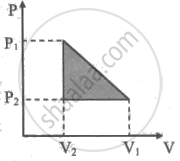
10 One mole of a van der Waals' gas obeying the equation `("P" + "a"/"V"^2)`(V - b) = RT undergoes the quasi-static cyclic process which is shown in the P-V diagram. The net heat absorbed by the gas in this process is ______
A heat engine operates between a cold reservoir at temperature T2 = 400 K and a hot reservoir at temperature T1. It takes 300 J of heat from the hot re ervoir and delivers 240 J of heat to the cold reservoir in a cycle. The minimum temperature of the hot reservoir has to be ______ K.
Which statement is incorrect?
Let η1 is the efficiency of an engine at T1 = 447°C and T2 = 147°C while η2, is the efficiency at T1 = 947°C and T2 = 47°C. The ratio `eta_1/eta_2` will be ______.
