Advertisements
Advertisements
प्रश्न
Explain in detail the Carnot heat engine.
Advertisements
उत्तर
In the year 1824, a young French engineer Sadi Carnot proved that a certain reversible engine operated in a cycle between hot and cold reservoirs can have maximum efficiency. This engine is called the Carnot engine.
A reversible heat engine operating in a cycle between two temperatures in a particular way is called a Carnot Engine. The Carnot engine has four parts which are given below.
(i) Source: It is the source of heat maintained at constant high-temperature TH. Any amount of heat can be extracted from it, without changing its temperature.

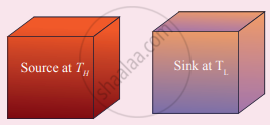
Carnot engine
(ii) Sink: It is a cold body maintained at a constant low-temperature TL. It can absorb any amount of heat.
(iii) Insulating stand: It is made of perfectly non-conducting material. Heat is not conducted through this stand.
(iv) Working substance: It is an ideal gas enclosed in a cylinder with perfectly non-conducting walls and a perfectly conducting bottom. A non-conducting and frictionless piston is fitted in it.
APPEARS IN
संबंधित प्रश्न
Draw a p-V diagram and explain the concept of positive and negative work. Give one example each.
The efficiency of a heat engine working between the freezing point and boiling point of water is ____________.
Define heat engine.
What are the processes involves in a Carnot engine?
Derive the expression for Carnot engine efficiency.
Explain the second law of thermodynamics in terms of entropy.
For a heat engine operating between temperatures t1 °C and t2 °C, its efficiency will be ______.
Draw a neat labelled P - V diagram for a typical heat engine.
What does a heat engine consist of?
Mention any two elements of a heat engine.
