Advertisements
Advertisements
प्रश्न
State Kelvin-Planck's statement of the second law of thermodynamics.
Advertisements
उत्तर
Kelvin-Planck's statement: It is impossible to construct a heat engine that operates in a cycle, whose sole effect is to convert the heat completely into work. This implies that no heat engine in the universe can have 100% efficiency.
APPEARS IN
संबंधित प्रश्न
Draw a p-V diagram and explain the concept of positive and negative work. Give one example each.
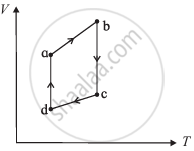
The figure shows the V-T diagram for one cycle of a hypothetical heat engine which uses the ideal gas. Draw the p-V diagram diagram of the system.
Define heat engine.
Explain in detail the Carnot heat engine.
Derive the expression for Carnot engine efficiency.
Suppose a person wants to increase the efficiency of the reversible heat engine that is operating between 100°C and 300°C. He had two ways to increase efficiency.
- By decreasing the cold reservoir temperature from 100°C to 50°C and keeping the hot reservoir temperature constant
- by increasing the temperature of the hot reservoir from 300°C to 350°C by keeping the cold reservoir temperature constant.
Which is the suitable method?
A Carnot engine whose efficiency is 45% takes heat from a source maintained at a temperature of 327°C. To have an engine of efficiency of 60% what must be the intake temperature for the same exhaust (sink) temperature?
For a heat engine operating between temperatures t1 °C and t2 °C, its efficiency will be ______.
The thermal efficiency of a heat engine is 25%. If in one cycle the heat absorbed from the hot reservoir is 50000 J, what is the heat rejected to the cold reservoir in one cycle?
What is a heat engine?
