Advertisements
Advertisements
प्रश्न
State Kelvin-Planck's statement of the second law of thermodynamics.
Advertisements
उत्तर
Kelvin-Planck's statement: It is impossible to construct a heat engine that operates in a cycle, whose sole effect is to convert the heat completely into work. This implies that no heat engine in the universe can have 100% efficiency.
APPEARS IN
संबंधित प्रश्न
Answer in brief:
A gas contained in a cylinder surrounded by a thick layer of insulating material is quickly compressed has work been done?
Answer in brief.
What sets the limits on the efficiency of a heat engine?
Draw a p-V diagram and explain the concept of positive and negative work. Give one example each.
State Clausius form of the second law of thermodynamics.
Define heat engine.
Explain in detail the Carnot heat engine.
Suppose a person wants to increase the efficiency of the reversible heat engine that is operating between 100°C and 300°C. He had two ways to increase efficiency.
- By decreasing the cold reservoir temperature from 100°C to 50°C and keeping the hot reservoir temperature constant
- by increasing the temperature of the hot reservoir from 300°C to 350°C by keeping the cold reservoir temperature constant.
Which is the suitable method?
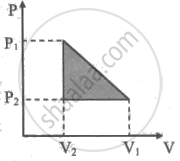
10 One mole of a van der Waals' gas obeying the equation `("P" + "a"/"V"^2)`(V - b) = RT undergoes the quasi-static cyclic process which is shown in the P-V diagram. The net heat absorbed by the gas in this process is ______
Heat engine transfers ______.
Let η1 is the efficiency of an engine at T1 = 447°C and T2 = 147°C while η2, is the efficiency at T1 = 947°C and T2 = 47°C. The ratio `eta_1/eta_2` will be ______.
