Advertisements
Advertisements
Question
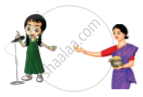
Tell the story of Pinocchio with actions.
Advertisements
Solution
Do it yourself.
APPEARS IN
RELATED QUESTIONS
Change the following into Direct Speech.
The stranger asked Nasrin where she lived.
Travelling can help a person to understand and appreciate different places. Discuss in groups and talk about the places you have visited recently. Present your experiences to the class.
Name the character or speaker.
“I am fine. We must wear the space suit.”
Pick and support any one of the three daughters. Say some sentences for the one you support and say some sentences against the other two to win.
| I support the first daughter because ....... | I support the second daughter because ....... | I support the third daughter because ....... |
 |
 |
 |
Is there any place near?

Read the passage three times and colour a hen for each time.

Some letter are missing in each word.
f ______ t
Spell these words through hand signs
- Helen
- was
What are the different kinds of books in this bookshop or in any other bookshop you have seen? Tell the class.
Every member contributes to forming a happy family. Share your views for a minute or two with your class.
Your friend competes with you in academics and sports. Think of the situation wherein you would not be affected by his/her victory and the ways in which you would encourage your friend to succeed.
You are travelling by train. When the Train Ticket Examiner enters your compartment, much to your shock, you realize you have forgotten to bring your train ticket. How will you handle the situation?
Prepare a speech on “The importance of a reading habit” in about 100–150 words using the hints given below together with your own ideas.
- Introduction
- Suggested value points Knowledge enrichment – Skill development – Meaningful usage of time – Overall development
- Conclusion
Build a conversation for the following situation with a minimum of five exchange.
A passenger and a railway staff regarding the cancellation of the reserved tickets.
Build a conversation for the following situation with a minimum of five exchange.
Two friends about the NSS camp which they are going to attend.
Extend the conversation with two more relevant exchange
| Receptionist | Good evening, sir. Welcome to Chennai. |
| Traveller | I would like to book a deluxe room in your hotel for 3 days. |
| Receptionist | ______ |
| Traveller | ______ |
| Receptionist | ______ |
| Traveller | ______ |
Organize a class debate on the motion ‘The advantages of social websites’. (Use the expressions for arguments like - First, firstly, I mean, My point is, In my opinion, Let me consider, etc.)
Assertion: The SI system of units is the suitable for measurement.
Reason: The SI unit of temperature is kelvin.
