Advertisements
Advertisements
Question
State and define Ohm’s law.
Advertisements
Solution
Ohm’s law states that at a constant temperature, the current flowing in a conductor is directly proportional to the potential difference across its ends, i.e., if the potential difference is halved, the current is also halved and if p.d. is doubled, the current is also doubled, i.e.,
V (potential difference) ∝ i (current)
Or V = iR, where R is constant, called the resistance of the conductor.
So V = iR represents Ohm’s law.
RELATED QUESTIONS
When a 12 V battery is connected across an unknown resistor, there is a current of 2.5 mA in the circuit. Find the value of the resistance of the resistor.
What is Resistivity?
An electrical bulb is marked 200V, 100W. Calculate the electrical resistance of its filament. If five such
bulbs are connected in series to a 200V supply, how much current will flow through them?
Name the law which is illustrated by the above V−I graph.
Which of the following is an ohmic resistance?
In the circuit shown below in Fig, calculate the value of x if the equivalent resistance between A and B is 4 Ω.

A wire has a length of 2.0 m and a resistance of 5.0 Ω. Find the electric field existing inside the wire if it carries a current of 10 A.
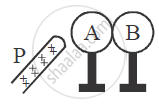
Two metallic spheres A and B kept on insulating stands are in contact with each other. A positively charged rod P is brought near the sphere A as shown in the figure. The two spheres are separated from each other, and the rod P is removed. What will be the nature of charges on spheres A and B?
Define temperature coefficient of resistance.
A current of 2amp flowing through a conductor produced 80 joule of heat in 10 sec. The resistance of the conductor is:-
