Advertisements
Advertisements
Question
Specific heat capacity of substance A is 3.8 J g−1 K−1 whereas the specific heat capacity of substance B is 0.4 J g−1 K−1.
- Which of the two is a good conductor of heat?
- How is one led to the above conclusion?
- If substances A and B are liquids then which one would be more useful in car radiators?
Advertisements
Solution
Given: Specific heat capacity of substance 3.8 J g−1 K−1
Specific heat capacity of substance B = 0.4 J g−1 K−1
(i) Substance B is a good conductor out of the two substances.
(ii) Substance B has a lower specific heat capacity than substance A. Therefore, it requires less heat to produce the same rise in temperature. However, specific heat capacity alone does not determine thermal conductivity.
(iii) Substance A would be more useful in car radiators because it has a higher specific heat capacity. It can absorb more heat for the same rise in temperature, helping to keep the engine cool.
RELATED QUESTIONS
Explain, Why is it advisabile to pour cold water over burns, caused on human body, by hot solids?
Describe a method to determine the specific heat capacity of a solid (say, a piece of copper).
A piece of ice is heated at a constant rate. The variation of temperature with heat input is shown in the graph below:

(i) What are represented by AB and CD?
(ii) What conclusion can you draw regarding the 110°c nature of ice from the above graph?
How much heat energy is released when 5 g of water at 20° C changes to ice at 0° C?
[Specific heat capacity of water = 4.2 J g−1 ° C−1 Specific latent heat of fusion of ice = 336 J g−1]
What is specific heat capacity?
An office room contains about 4000 moles of air. The change in the internal energy of this much air when it is cooled from 34° C to 19° C at a constant pressure of 1.0 atm is (Use `gamma_"air"` = 1.4 and Universal gas constant = 8.314 J / mol K) ____________.
The diagram below shows a cooling curve for 200 g of water. The heat is extracted at the rate of 100 Js-1. Answer the questions that follow:
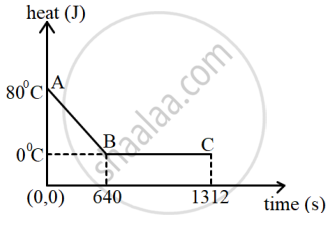
- Calculate specific heat capacity of water.
- Heat released in the region BC.
Match the following
| 1. | Specific heat capacity | a. | Dewar bottle |
| 2. | Calorimeter | b. | Lavoisier and Simon |
| 3. | Vacuum flask | c. | J Kg-1 K-1 |
| 4. | Ice – calorimeter | d. | Heat capacity |
