Advertisements
Advertisements
Question
Sketch the labeled diagram:
Flower with its sexual reproductive organs
Advertisements
Solution
Flower with its sexual reproductive organs

APPEARS IN
RELATED QUESTIONS
What is pollination?
A student while observing an embryo of a pea seed in the laboratory listed various parts of the embryo as given below:
Testa, Tegmen, Radicle, Plumule, Micropyle, Cotyledon.
On examining the list the teacher remarked that only three parts are correct. Select three correct parts from the above list:
(a) Testa, Radicle, Cotyleddon
(b) Tegmen, Radicle, Micropyle
(c) Cotyledon, Plumule, Testa
(d) Radicle, Cotyledon, Plumule
A student identified the various parts of an embryo of a gram seed and listed them as given below :
(I) Testa
(II) Plumule
(III) Radicle
(IV) Cotyledon
(V) Tegmen
Out of these the actual parts of the embryo are :
(A) I, II, III
(B) II, III, IV
(C) III, IV, V
(D) II, IV, V
Mention the changes a flower undergoes after fertilisation.
State the name of the functional unit concerned with sexual reproduction.
Name the swollen lower part of the carpel.
What is the function of a flower?
Fill in the following blank with suitable word :
The ovule becomes a .......... after fertilisation.
Fill in the following blank with suitable word :
The term used to refer to the transfer of pollen from the stamen of one flower to the carpel of another flower of the same species is...........
Give some examples of different modes of fertilisation in nature?
What is meant by 'unisexual flowers' and 'bisexual flowers'? Give two examples of each.
Which of the following statements are true for flowers?
(i) Flowers are always bisexual.
(ii) They contain sexual reproductive organs.
(iii) They are produced in all groups of plants.
(iv) after fertilization they give rise to fruits.
In what ways is fertilisation in a plant similar to fertilisation in a human?
In what ways is fertilisation in a plant different from fertilisation in a human?
Fill in the blanks:
A stamen consists of ______ and ________.
Mention the function of Anther.
Draw a labelled diagram of a bisexual flower.
Draw a diagram of a pistil showing pollen tube growth into the ovule and label the following:
Pollen grain, male gamete, female gamete, ovary.
Distinguish between unisexual and bisexual flowers giving one example of each. Draw a diagram showing process of germination of pollen grains on stigma and label the following parts:
(a) Female germ cell
(b) Male germ cell
(c) Ovary
Explain sexual reproduction in plants.
What is cleistogamy? Write one advantage and one disadvantage of it, to the plant.
__________ is present in unisexual flower.
Find an odd one out.
Write the functions of sepals
The male reproductive part of a flower is ______.
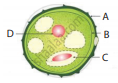
Identify the parts A, B, C, and D?
Write the events involved in the sexual reproduction of a flowering plant.
Discuss the first event and write the types.
Write the events involved in the sexual reproduction of a flowering plant.
a. Discuss the first event and write the types.
b. Mention the advantages and the disadvantages of that event.
The anther wall consists of four wall layers where ______
The ovule of an angiosperm is technically equivalent to ______
Antipodal cells are present towards the ______ in an anatropous ovule.
Conidia are formed endogenously while zoospores are formed endogenously.
State the number of sets of chromosomes present in a zygote.
Sketch and label the essential and accessory whorls of flower.
Give any two examples of agents of pollination.
In a plant flower the female whorl is ______.
What is the structural unit of sexual reproduction in plant?
The figure below shows the concept of double fertilization. Complete the flow chart showing the progress at each step:

