Advertisements
Advertisements
Question
Show that the ▢PQRS formed by P(2, 1), Q(–1, 3), R(–5, –3) and S(–2, –5) is a rectangle.
Advertisements
Solution
Given: P(2, 1), Q(–1, 3), R(–5, –3) and S(–2, –5)
Distance Formula = `sqrt((x_2 - x_1)^2 + (y_2 - y_1)^2)`
PQ = `sqrt((-1 - 2)^2 + (3 - 1)^2)`
= `sqrt((3-)^2 + (2)^2)`
= `sqrt(9 + 4)`
= `sqrt 13` ...(i)
QR = `sqrt([-5 - (-1)]^2 + (-3 - 3)^2)`
= `sqrt((-4)^2 + (-6)^2)`
= `sqrt(16 + 36)`
= `sqrt 52`
= `sqrt(2 xx 2 xx 13)`
= 2`sqrt13` ...(ii)
RS = `sqrt([-2 - (-5)]^2 + [-5 - (-3)]^2)`
= `sqrt((-2 + 5)^2 + (-5 + 3)^2)`
= `sqrt(3^2 + (-2)^2)`
= `sqrt(9 + 4)`
= `sqrt 13` ...(iii)
PS = `sqrt((-2 - 2)^2 + (-5 - 1)^2)`
= `sqrt((-4)^2 + (-6)^2)`
= `sqrt(16 + 36)`
= `sqrt52`
= `sqrt(2 xx 2 xx 13)`
= 2`sqrt 13` ...(iv)
In ▢PQRS,
PQ = RS ...[From (i) and (iii)]
QR = PS ...[From (ii) and (iv)]
∴ ▢PQRS is a parallelogram ...(A quadrilateral is a parallelogram if its opposite sides are equal)
By distance formula,
PR = `sqrt((-5 - 2)^2 + (-3 - 1)^2)`
= `sqrt((-7)^2 + (-4)^2)`
= `sqrt(49 +16)`
= `sqrt 65` ...(v)
QS = `sqrt([-2 - (-1)]^2 + (-5 - 3)^2)`
= `sqrt((-7)^2 + (-4)^2)`
= `sqrt(1 + 64)`
= `sqrt 65` ...(vi)
In parallelogram PQRS,
PQ = QS ...[From (v) and (vi)]
∴ ▢PQRS is a rectangle ...(A parallelogram is a rectangle, if its diagonals are equal.)
P(2, 1), Q(–1, 3), R(–5, –3) and S(–2, –5) are the vertices of a rectangle.
APPEARS IN
RELATED QUESTIONS
Find the distance between the following pairs of points:
(−5, 7), (−1, 3)
If a ≠ b ≠ 0, prove that the points (a, a2), (b, b2) (0, 0) will not be collinear.
ABC is a triangle and G(4, 3) is the centroid of the triangle. If A = (1, 3), B = (4, b) and C = (a, 1), find ‘a’ and ‘b’. Find the length of side BC.
The length of a line segment is of 10 units and the coordinates of one end-point are (2, –3). If the abscissa of the other end is 10, find the ordinate of the other end.
Find the distance between the points:
A(7, –4) and B(–5, 1)
Find the distance between the points:
A(–6, –4) and B(9, –12)
If the point A(x, 2) is equidistant from the points B(8, –2) and C(2, –2), find the value of x. Also, find the length of AB.
For what values of k are the points (8, 1), (3, –2k) and (k, –5) collinear ?
Find the coordinate of O , the centre of a circle passing through A (8 , 12) , B (11 , 3), and C (0 , 14). Also , find its radius.
Find the coordinates of O, the centre passing through A( -2, -3), B(-1, 0) and C(7, 6). Also, find its radius.
The distance between the points (3, 1) and (0, x) is 5. Find x.
Find a point on the y-axis which is equidistant from the points (5, 2) and (-4, 3).
Calculate the distance between A (7, 3) and B on the x-axis whose abscissa is 11.
Calculate the distance between A (7, 3) and B on the x-axis, whose abscissa is 11.
If the distance between the points (x, -1) and (3, 2) is 5, then the value of x is ______.
∆ABC with vertices A(–2, 0), B(2, 0) and C(0, 2) is similar to ∆DEF with vertices D(–4, 0), E(4, 0) and F(0, 4).
The distance of the point (5, 0) from the origin is ______.
|
Tharunya was thrilled to know that the football tournament is fixed with a monthly timeframe from 20th July to 20th August 2023 and for the first time in the FIFA Women’s World Cup’s history, two nations host in 10 venues. Her father felt that the game can be better understood if the position of players is represented as points on a coordinate plane. |
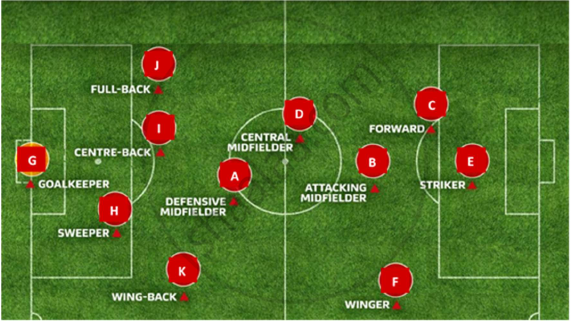
- At an instance, the midfielders and forward formed a parallelogram. Find the position of the central midfielder (D) if the position of other players who formed the parallelogram are :- A(1, 2), B(4, 3) and C(6, 6)
- Check if the Goal keeper G(–3, 5), Sweeper H(3, 1) and Wing-back K(0, 3) fall on a same straight line.
[or]
Check if the Full-back J(5, –3) and centre-back I(–4, 6) are equidistant from forward C(0, 1) and if C is the mid-point of IJ. - If Defensive midfielder A(1, 4), Attacking midfielder B(2, –3) and Striker E(a, b) lie on the same straight line and B is equidistant from A and E, find the position of E.
