Advertisements
Advertisements
Question
Find distance between points O(0, 0) and B(–5, 12).
Advertisements
Solution
Let O(x1, y1) = O(0, 0) and B(x2, y2) = B(–5, 12)
∴ x1 = 0, y1 = 0, x2 = –5, y2 = 12
By distance formula,
d(O, B) = `sqrt((x_2 - x_1)^2 + (y_2 - y_1)^2`
= `sqrt((-5 - 0)^2 + (12 - 0)^2`
= `sqrt((-5)^2 + 12^2`
= `sqrt(25 + 144)`
= `sqrt(169)`
∴ d(O, B) = 13 units
∴ The distance between the points O and B is 13 units.
APPEARS IN
RELATED QUESTIONS
Find the value of x, if the distance between the points (x, – 1) and (3, 2) is 5.
Find the values of x, y if the distances of the point (x, y) from (-3, 0) as well as from (3, 0) are 4.
Find the distance between the points:
P(a + b, a – b) and Q(a – b, a + b)
Find the distance between the points `A((-8)/5, 2)` and `B(2/5, 2)`.
If P(x, y) is equidistant from the points A(7, 1) and B(3, 5), find the relation between x and y.
The perimeter of a triangle with vertices (0, 4), (0, 0) and (3, 0) is ______.
A line segment of length 10 units has one end at A (-4 , 3). If the ordinate of te othyer end B is 9 , find the abscissa of this end.
Find the distance between the points (a, b) and (−a, −b).
Show that (-3, 2), (-5, -5), (2, -3) and (4, 4) are the vertices of a rhombus.
Calculate the distance between the points P (2, 2) and Q (5, 4) correct to three significant figures.
Use distance formula to show that the points A(-1, 2), B(2, 5) and C(-5, -2) are collinear.
AOBC is a rectangle whose three vertices are A(0, 3), O(0, 0) and B(5, 0). The length of its diagonal is ______.
The point which lies on the perpendicular bisector of the line segment joining the points A(–2, –5) and B(2, 5) is ______.
If the distance between the points (4, P) and (1, 0) is 5, then the value of p is ______.
The distance between the points A(0, 6) and B(0, –2) is ______.
Find the points on the x-axis which are at a distance of `2sqrt(5)` from the point (7, – 4). How many such points are there?
If (a, b) is the mid-point of the line segment joining the points A(10, –6) and B(k, 4) and a – 2b = 18, find the value of k and the distance AB.
Find distance between points P(– 5, – 7) and Q(0, 3).
By distance formula,
PQ = `sqrt(square + (y_2 - y_1)^2`
= `sqrt(square + square)`
= `sqrt(square + square)`
= `sqrt(square + square)`
= `sqrt(125)`
= `5sqrt(5)`
Find the distance between the points O(0, 0) and P(3, 4).
Read the following passage:
|
Alia and Shagun are friends living on the same street in Patel Nagar. Shagun's house is at the intersection of one street with another street on which there is a library. They both study in the same school and that is not far from Shagun's house. Suppose the school is situated at the point O, i.e., the origin, Alia's house is at A. Shagun's house is at B and library is at C. |
Based on the above information, answer the following questions.
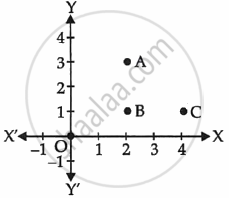
- How far is Alia's house from Shagun's house?
- How far is the library from Shagun's house?
- Show that for Shagun, school is farther compared to Alia's house and library.
OR
Show that Alia’s house, shagun’s house and library for an isosceles right triangle.
