Advertisements
Advertisements
Question
Prove that the points A(1, 7), B (4, 2), C(−1, −1) D (−4, 4) are the vertices of a square.
Advertisements
Solution
The distance d between two points `(x_1, y_1)` and `(x_2, y_2)` is given by the formula
`d = sqrt((x_1 - x_2)^2 + (y_1 - y_2)^2)`
In a square, all the sides are equal in length. Also, the diagonals are equal in length in a square.
Here the four points are A(1, 7), B(4, 2), C(−1, −1) and D(−4, 4).
First, let us check if all the four sides are equal.
`AB = sqrt((1- 4)^2 + (7 - 2)^2)`
`= sqrt((-3)^2 + (5)^2)`
`= sqrt(9 + 25)`
`BC = sqrt34`
`CD = sqrt((-1 + 4)^2 + (-1-4)^2)`
`= sqrt((3)^2 + (-5)^2 )`
`= sqrt(9 + 25)`
`CD = sqrt(34)`
`AD = sqrt((1 +4)^2 + (7 - 4)^2)`
`= sqrt((5)^2 + (3)^2)`
`= sqrt(25 + 9)`
`AD = sqrt34`
Since all the sides of the quadrilateral are the same it is a rhombus.
For the rhombus to be a square the diagonals also have to be equal to each other.
`AC = sqrt((1 + 1)^2 + (7 + 1)^2)`
`=sqrt((2)^2 + (8)^2)`
`=sqrt(4 + 64)`
`AC = sqrt(68)`
`BD = sqrt((4 + 4)^2 + (2 + 4)^2)`
`= sqrt((8)^2 + (-2)^2)`
`= sqrt(64 + 4)`
`BD = sqrt(68)`
Since the diagonals of the rhombus are also equal to each other the rhombus is a square.
Hence the quadrilateral formed by the given points is a square.
APPEARS IN
RELATED QUESTIONS
The x-coordinate of a point P is twice its y-coordinate. If P is equidistant from Q(2, –5) and R(–3, 6), find the coordinates of P.
If the point A(0, 2) is equidistant from the points B(3, p) and C(p, 5), find p. Also, find the length of AB.
If the point (x, y) is equidistant from the points (a + b, b – a) and (a – b, a + b), prove that bx = ay.
Show that the points (1, – 1), (5, 2) and (9, 5) are collinear.
Find the coordinates of the circumcentre of the triangle whose vertices are (8, 6), (8, – 2) and (2, – 2). Also, find its circum radius
Check whether (5, -2), (6, 4) and (7, -2) are the vertices of an isosceles triangle.
Find the distance of the following points from the origin:
(i) A(5,- 12)
Using the distance formula, show that the given points are collinear:
(-1, -1), (2, 3) and (8, 11)
Find the distance between the following pair of points.
R(0, -3), S(0, `5/2`)
Find x if distance between points L(x, 7) and M(1, 15) is 10.
Find the distances between the following point.
P(–6, –3), Q(–1, 9)
Find the distance between the following pair of point in the coordinate plane.
(1 , 3) and (3 , 9)
Find the distance of the following point from the origin :
(0 , 11)
PQR is an isosceles triangle . If two of its vertices are P (2 , 0) and Q (2 , 5) , find the coordinates of R if the length of each of the two equal sides is 3.
Prove that the points A (1, -3), B (-3, 0) and C (4, 1) are the vertices of an isosceles right-angled triangle. Find the area of the triangle.
Show that each of the triangles whose vertices are given below are isosceles :
(i) (8, 2), (5,-3) and (0,0)
(ii) (0,6), (-5, 3) and (3,1).
The distance between points P(–1, 1) and Q(5, –7) is ______.
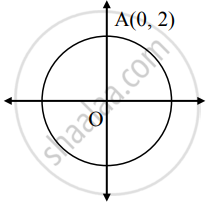
Seg OA is the radius of a circle with centre O. The coordinates of point A is (0, 2) then decide whether the point B(1, 2) is on the circle?
Ayush starts walking from his house to office. Instead of going to the office directly, he goes to a bank first, from there to his daughter’s school and then reaches the office. What is the extra distance travelled by Ayush in reaching his office? (Assume that all distances covered are in straight lines). If the house is situated at (2, 4), bank at (5, 8), school at (13, 14) and office at (13, 26) and coordinates are in km.
Show that points A(–1, –1), B(0, 1), C(1, 3) are collinear.
