Advertisements
Advertisements
Question
Read the following passage:
|
Alia and Shagun are friends living on the same street in Patel Nagar. Shagun's house is at the intersection of one street with another street on which there is a library. They both study in the same school and that is not far from Shagun's house. Suppose the school is situated at the point O, i.e., the origin, Alia's house is at A. Shagun's house is at B and library is at C. |
Based on the above information, answer the following questions.
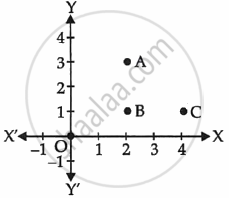
- How far is Alia's house from Shagun's house?
- How far is the library from Shagun's house?
- Show that for Shagun, school is farther compared to Alia's house and library.
OR
Show that Alia’s house, shagun’s house and library for an isosceles right triangle.
Advertisements
Solution
Coordinates of A (2, 3) – Alia's house
Coordinates of B (2, 1) – Shagun's house
Coordfuates of C (4, 1) – Library
i. AB = `sqrt((x_2 - x_1)^2 + (y_2 - y_1)^2`
= `sqrt((2 - 2)^2 + (1 - 3)^2`
= `sqrt((0)^2 + (-2)^2`
AB = `sqrt(0 + 4)`
= `sqrt(4)` unit
= 2 units
Alia's house from shagun's house is 2 units
ii. C(4, 1), B(2, 1)
CB = `sqrt((2 - 4)^2 + (1 - 1)^2`
= `sqrt((-2)^2 + 0^2`
= `sqrt(4 + 0)`
= `sqrt(4)`
= 2 unit
iii. O(0, 0), B(2, 1)
OB = `sqrt((2 - 0)^2 + (1 - 0)^2`
= `sqrt(2^2 + 1^2)`
= `sqrt(4 + 1)`
= `sqrt(5)` units
Distance between Alia's house and Shagun's house, AB = 2 units
Distance between Library and Shagun's house, CB = 2 units
OB is greater than AB and CB,
For shagun, school [O] is farther than Alia's house [A] and Library [C]
OR
C(4, 1), A(2, 3)
CA = `sqrt((2 - 4)^2 + (3 - 1)^2`
= `sqrt((-2)^2 + 2^2`
= `sqrt(4 + 4)`
= `sqrt(8)`
= `2sqrt(2)` units
AC2 = 8
Distance between Alia’s house and Shagun’s house, AB = 2 units
Distance between Library and Shagun’s house, CB = 2 units
AB2 + BC2
= 22 + 22
= 4 + 4
= 8
= AC2
Therefore A, B and C form an isosceles right triangle.
