Advertisements
Advertisements
Question
Show that the points (0, –1), (8, 3), (6, 7) and (–2, 3) are vertices of a rectangle.
Advertisements
Solution
Let the points be P(0, –1), Q(8, 3), R(6, 7), S(–2, 3)
Distance between two points = `sqrt((x_2 - x_1)^2 + (y_2 - y_1)^2`
∴ By distance formula,
d(P, Q) = `sqrt((8 - 0)^2 + [3 - (-1)]^2`
= `sqrt((8 - 0)^2 + (3 + 1)^2`
= `sqrt(8^2 + 4^2)`
= `sqrt(64 + 16)`
= `sqrt(80)` ...(i)
d(Q, R) = `sqrt((6 - 8)^2 + (7 - 3)^2`
= `sqrt((-2)^2 + (4)^2`
= `sqrt(4 + 16)`
= `sqrt(20)` ...(ii)
d(R, S) = `sqrt([(-2) - 6]^2 + (3 - 7)^2`
= `sqrt((-8)^2 + (-4)^2`
= `sqrt(64 + 16)`
=`sqrt(80)` ...(iii)
d(P, S) = `sqrt([(-2) - 0]^2 + [3 - (-1)^2]`
= `sqrt((-2)^2+ (3+ 1)^2`
= `sqrt((-2)^2 + 4^2`
= `sqrt(4 + 16)`
= `sqrt(20)` ...(iv)
In ▢PQRS,
∴ side PQ = side RS ...[From (i) and (iii)]
side QR = side PS ...[From (ii) and (iv)]
∴ ▢PQRS is a parallelogram ...[A quadrilateral is a parallelogram, if both the pairs of its opposite sides are congruent]
d(P, R) = `sqrt((6 - 0)^2 + [7 - (-1)]^2`
= `sqrt((6 - 0)^2 + (7 + 1)^2`
= `sqrt(6^2 + 8^2)`
= `sqrt(36 + 64)`
= `sqrt(100)`
= 10 ...(iv)
d(Q, S) = `sqrt([(-2) - 8]^2 + [3 - 3]^2`
= `sqrt((-10)^2 + (0)^2`
= `sqrt(100 + 0)`
= `sqrt(100)`
= 10 ...(vi)
In parallelogram PQRS,
PR = QS ...[From (v) and (vi)]
∴ ▢PQRS is a rectangle. ...[A parallelogram is a rectangle if its diagonals are equal]
APPEARS IN
RELATED QUESTIONS
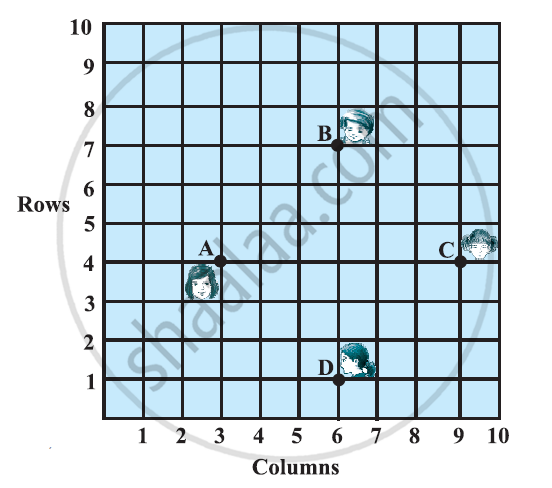
In a classroom, 4 friends are seated at the points A, B, C and D as shown in the following figure. Champa and Chameli walk into the class and after observing for a few minutes, Champa asks Chameli, “Don’t you think ABCD is a square?” Chameli disagrees.
Using distance formula, find which of them is correct.
The value of 'a' for which of the following points A(a, 3), B (2, 1) and C(5, a) a collinear. Hence find the equation of the line.
Find the distance between the following pair of points:
(–6, 7) and (–1, –5)
Find the value of a when the distance between the points (3, a) and (4, 1) is `sqrt10`.
The length of a line segment is of 10 units and the coordinates of one end-point are (2, –3). If the abscissa of the other end is 10, find the ordinate of the other end.
Two opposite vertices of a square are (–1, 2) and (3, 2). Find the coordinates of other two vertices.
Find the distance between the following pair of points.
L(5, –8), M(–7, –3)
Find the distance between the following pair of point in the coordinate plane :
(5 , -2) and (1 , 5)
Find the distance of the following point from the origin :
(5 , 12)
Find the distance of a point (12 , 5) from another point on the line x = 0 whose ordinate is 9.
Find the relation between a and b if the point P(a ,b) is equidistant from A (6,-1) and B (5 , 8).
Show that the points (2, 0), (–2, 0), and (0, 2) are the vertices of a triangle. Also, a state with the reason for the type of triangle.
The length of line PQ is 10 units and the co-ordinates of P are (2, -3); calculate the co-ordinates of point Q, if its abscissa is 10.
The points A (3, 0), B (a, -2) and C (4, -1) are the vertices of triangle ABC right angled at vertex A. Find the value of a.
Find the distance of the following points from origin.
(a+b, a-b)
Show that each of the triangles whose vertices are given below are isosceles :
(i) (8, 2), (5,-3) and (0,0)
(ii) (0,6), (-5, 3) and (3,1).
The coordinates of the point which is equidistant from the three vertices of the ΔAOB as shown in the figure is ______.

The distance between the point P(1, 4) and Q(4, 0) is ______.
The points (– 4, 0), (4, 0), (0, 3) are the vertices of a ______.
The points A(–1, –2), B(4, 3), C(2, 5) and D(–3, 0) in that order form a rectangle.
