Advertisements
Advertisements
Question
Find the distances between the following point.
R(–3a, a), S(a, –2a)
Advertisements
Solution
R(–3a, a), S(a, –2a)
Let R (x1, y1) and S (x2, y2) be the given points.
∴ x1 = –3a, y1 = a, x2 = a, y2 = –2a
By distance formula,
d(R, S) = \[\sqrt{(x_{2}-x_{1})^{2}+(y_{2}-y_{1})^{2}}\]
= \[\sqrt{\left[\mathrm{a-(-3a)}\right]^{2}+\left(-2\mathrm{a-a}\right)^{2}}\]
= \[\sqrt{\left(\mathrm{a + 3a}\right)^{2}+\left(-2\mathrm{a-a}\right)^{2}}\]
= \[\sqrt{\left(\mathrm{4a}\right)^{2}+\left(\mathrm{-3a}\right)^{2}}\]
= \[\sqrt{16\mathbf{a}^{2}+9\mathbf{a}^{2}}\]
= \[\sqrt{25\mathbf{a}^{2}}\]
= 5a
∴ d(R, S) = 5a units
APPEARS IN
RELATED QUESTIONS
Find the distance between two points
(i) P(–6, 7) and Q(–1, –5)
(ii) R(a + b, a – b) and S(a – b, –a – b)
(iii) `A(at_1^2,2at_1)" and " B(at_2^2,2at_2)`
Find the coordinates of the centre of the circle passing through the points (0, 0), (–2, 1) and (–3, 2). Also, find its radius.
Check whether (5, -2), (6, 4) and (7, -2) are the vertices of an isosceles triangle.
Find the point on the x-axis which is equidistant from (2, –5) and (–2, 9).
Find the distance of a point P(x, y) from the origin.
The long and short hands of a clock are 6 cm and 4 cm long respectively. Find the sum of the distances travelled by their tips in 24 hours. (Use π = 3.14) ?
Find the distance between the following pairs of point.
W `((- 7)/2 , 4)`, X (11, 4)
Find the distance of a point (13 , -9) from another point on the line y = 0 whose abscissa is 1.
Prove that the following set of point is collinear :
(5 , 1),(3 , 2),(1 , 3)
Find the distance between the origin and the point:
(-5, -12)
The centre of a circle is (2x - 1, 3x + 1). Find x if the circle passes through (-3, -1) and the length of its diameter is 20 unit.
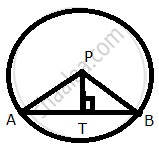
Point P (2, -7) is the centre of a circle with radius 13 unit, PT is perpendicular to chord AB and T = (-2, -4); calculate the length of AB.
Calculate the distance between the points P (2, 2) and Q (5, 4) correct to three significant figures.
Find the point on y-axis whose distances from the points A (6, 7) and B (4, -3) are in the ratio 1: 2.
Show that the quadrilateral with vertices (3, 2), (0, 5), (- 3, 2) and (0, -1) is a square.
Show that P(–2, 2), Q(2, 2) and R(2, 7) are vertices of a right angled triangle.
The points (– 4, 0), (4, 0), (0, 3) are the vertices of a ______.
Find the value of a, if the distance between the points A(–3, –14) and B(a, –5) is 9 units.
If (– 4, 3) and (4, 3) are two vertices of an equilateral triangle, find the coordinates of the third vertex, given that the origin lies in the interior of the triangle.
If (a, b) is the mid-point of the line segment joining the points A(10, –6) and B(k, 4) and a – 2b = 18, find the value of k and the distance AB.
