Advertisements
Advertisements
Question
Shears, used for cutting metals and scissors used for cutting clothes are both examples of levers of the first order. However, whereas the shears always have short blades and long handles, the scissors often have blades much longer than the handles. Explain, why this is so?
Advertisements
Solution
The mechanical advantage of an (ideal) liver equals the ratio between-the effort arm to the load arm.
For the shears (used for cutting metals), the ‘load’ is really a formidable one. Therefore, we need a large mechanical advantage to keep the applied effort within reasonable limits. To ensure this, the shears are made to have short blades (small load arm) and long handles (long effort arm).
For the scissors (used for cutting clothes), the ‘load’ is an almost negligible one. Mechanical advantage, therefore, there may be more or less than one. The scissors, therefore, often have blades much longer than the handles.
RELATED QUESTIONS
A man uses a crowbar of length 1.5 m to raise a load of 75 kgf by putting a sharp edge below the bar at a distance 1 m from his hand.
- Draw a diagram of the arrangement showing the fulcrum (F), load (L) and effort (E) with their directions.
- State the kind of lever.
- Calculate:
- load arm,
- effort arm,
- mechanical advantage and
- the effort needed.
Fig 3.17 below shows a lever in use.
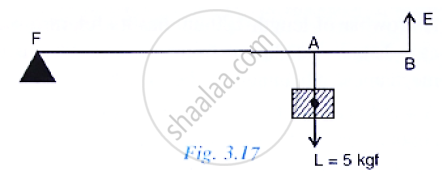
(a) To which class of lever does it belong?
(b) If FA = 80 cm, AB = 20 cm, find its mechanical advantage.
(c) Calculate the value of E.
Give three examples for leavers of second order.
The following belong to which class of lever?
The Physical balance
The following belong to which class of lever?
Pliers Tools
The following belong to which class of lever?
A claw-hammer
The following belong to which class of lever?
Sugar tongs
The following belong to which class of lever?
Knife
The following belong to which class of lever?
Fore-arm
The length of a nut-cracker is 12 cm. A nut, when kept at a distance of 4 cm from its fulcrum, requires an effort of 100 gf to crack it. What force will be required to crack the nut without using the nut-cracker?
