Advertisements
Advertisements
प्रश्न
Shears, used for cutting metals and scissors used for cutting clothes are both examples of levers of the first order. However, whereas the shears always have short blades and long handles, the scissors often have blades much longer than the handles. Explain, why this is so?
Advertisements
उत्तर
The mechanical advantage of an (ideal) liver equals the ratio between-the effort arm to the load arm.
For the shears (used for cutting metals), the ‘load’ is really a formidable one. Therefore, we need a large mechanical advantage to keep the applied effort within reasonable limits. To ensure this, the shears are made to have short blades (small load arm) and long handles (long effort arm).
For the scissors (used for cutting clothes), the ‘load’ is an almost negligible one. Mechanical advantage, therefore, there may be more or less than one. The scissors, therefore, often have blades much longer than the handles.
संबंधित प्रश्न
Name a machine to obtain gain in speed?
State the principle of a lever?
Give one example of a class I lever where mechanical advantage is more than one ?
Fig 3.17 below shows a lever in use.
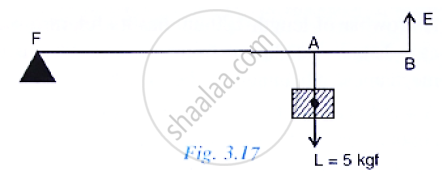
(a) To which class of lever does it belong?
(b) If FA = 80 cm, AB = 20 cm, find its mechanical advantage.
(c) Calculate the value of E.
Which type of levers have mechanical advantage always more than 1? Give reasons.
The following belong to which class of lever?
The Physical balance
The following are an example of levers. State the class of lever to which each one belongs giving the relative positions of Load (L), Effort (E), Fulcrum (F):
(i) Scissors (ii) Sugar tongs (iii) Nutcracker (iv) Pliers.
In the diagram shown alongside a claw hammer, mark the fulcrum (F) and indicate the directions of load (L) and effort (E) with arrows. What class of lever is it? Give one more example of this class of lever.

In the following diagram of a wheelbarrow, mark the fulcrum (F) and indicate the directions of load (L) and effort (E) with arrows.

What class of lever is it? Give one more example of the same class of lever.
State the types (or kinds) of lever, and give two examples of each kind.
