Advertisements
Advertisements
Question
Read the following passage and do the activities.
1. State whether the following sentences are True or false. (2)
- The king’s temperament also changed.
- The king was happy with prediction of the astrologer.
- The courtiers sought an audience with Tenali Raman.
- Courtiers advised the king to regulate his diet.
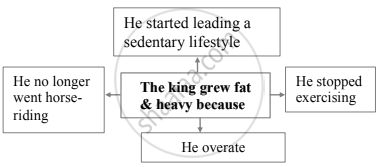
2. Complete the web (2)

|
King Krishnadeva Raya would perform heavy exercises every morning. He regularly applied oil on his body and thereafter worked out till all the oil came out with the sweat. This was followed by a long ride on his horse. Once the king started leading a sedentary lifestyle, and he stopped exercising. He no longer went horse-riding either. The king overate and as a result grew fat and heavy. The king‟s temperament also underwent a sea change. Noticing this, the royal physicians cautioned the king against the ill effects of overeating and explained to him the risks posed by obesity. They advised the king to regulate his diet, exercise, and take care of his health. The repeated advice he got from the physicians to eat less made him so angry that one day he announced a reward for anyone who could find him an easy cure. But there was one condition: those who failed would have their heads off. None dared to advise the king in this regard. The situation became precarious and as usual Tenali Raman was approached by the courtiers for a remedy. Tenali heard the problem and assured the courtiers of a viable solution. The next day, an astrologer predicted that the king had only a month left to live. When the king came to know of this, he was furious. The astrologer was ordered by the king to be imprisoned for a month so that his prediction could be put to test and so the hapless forecaster was sent to prison. |
3. Find out describing words from the passage for the words given below. (2)
- exercise - ________
- lifestyle - ________
- ride - _________
- physician - __________
4. Do as directed. (2)
- King Krishnadeva Raya would perform heavy exercises every morning.
(Use 'used to) - They advised the king to regulate his diet. (Pick out the infinitive)
5. What are the benefits of daily exercise? (2)
Advertisements
Solution
1.
- True
- False
- True
- True
2.
3.
- exercise - Heavy
- lifestyle - Sedentary
- ride - Long
- physician - Royal
4.
- King Krishnadeva Raya used to perform heavy exercises every morning.
- to regulate
5. Daily exercising helps to keep a person fit. It reduces the chances of falling sick. It keeps our body weight under check. It is good for our muscles and bones. It improves our mental health. It improves our energy levels. It helps keep our thinking, learning, and judgment skills sharp as we age.
APPEARS IN
RELATED QUESTIONS
Attempt a character sketch of Mr Gilman as a teacher.
Answer the following in 30-40 words each:
(a) Why do you think the booking clerk refused to accept the money? Why did the narrator get out so fast?
(b) Why could the Russian research vessel, ‘The Akademik Shokaskiy’ not move any further? What did the captain decide then?
(c) What sort of hunts did the Maharaja offer to organize for the high-ranking British officer? What trait of the officer does it reveal?
(d) What did Jo want the wizard to do when Mommy Skunk approached him?
Read the extract given below and answer the questions that follow:
Far far from gusty waves these children's faces.
Like rootless weeds, the hair torn round their pallor;
The tall girl with her weighed-down head.
(a) Who are these children?
(b) Which figure of speech has been used in the first two lines?
(c) Why is the tall girl's head weighed down?
(d) What does the word, 'pallor' mean?
You are Smitha/Sunil, Secretary AVM Housing Society. You are going to organize a yoga camp. Write a notice in not more than 50 words, urging the members of your society to come in large numbers to attend the camp. Invent all the necessary details.
How would you say ‘a dilapidated drum’ in your language?
The significance of reading an autobiography lies in drawing lessons from another life. What is the significance of Kumudini's account for us as readers?
Find evidence from the lesson and write in your own words.
It is time to see ourselves as a developed nation.
Say where . . . . . . .
______ do the cows and sheep stand?
Refer to a good dictionary that carries phonetic transcriptions printed next to words. The word below is familiar to you. Copy the phonetic transcription from the dictionary and say it aloud as you write.
work ........
Akbar wanted to punish the person who pulled his moustache.
Complete the following web diagram.

Have you seen non-commercial advertisements - those that are not ‘selling’ anything but are only giving people useful information?
Think carefully for a minute.
Jog your memory and recall all the things/objects on which you have seen wheels. Write them down
Visit a library:
Read other tales from Shakespeare, for example, Julius Caesar, As You Like It, Macbeth, and The Tempest.
What did the Clean Brigade do?
Gather information about your favourite great historical personality. You may use the internet. You may also gather photographs, pictures, etc. Prepare a collage using the pictures, inspirational quotes, and a brief description of the person’s importance. Hold an exhibition of your collages in the classroom.
Describe the following in one or two lines.
The nest.
List the characters in the play.
Birds and animals
Write what the poet is doing.
Does the poet like the experience?
Write the line which tells us about it.
Read the comic strip and answer the following question.
Do you think that all the information online can be used without any permission?
What does the teak tree give us?
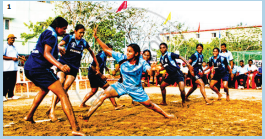
Identify and write the sport's name respectively.
- ______
- ______
- ______
- ______



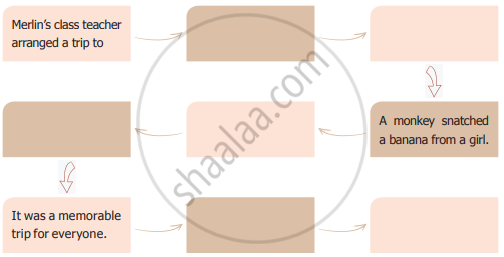
Recall Merlin’s memories and complete the story map.
Why does the poet fly out of the universe?
It is used in the fisher’s _____.
How do we keep our integrity?
| Our national emblem is taken from Ashoka’s pillar at Sarnath. It is found on all government documents, coins, currency notes, postcards, and envelopes. It consists of four lions standing back to back but, we can see only three lions at a time. There is a Dharma chakra in the centre of the base plate, with the figure of a bull in the right and that of a horse in the left. The entire structure is sitting on a lotus. The words ‘Sathyameva Jayate’ is written under it in Devanagari script. These words mean, ‘Truth alone Triumphs’. |
- Where is our national emblem taken from?
- Where is our national emblem found?
- What does ‘Sathyameva Jayate’ mean?
- What are the animals found in the emblem?
Robot asked Vicky to sell him to an ______ master.
Answer using Yes or No and pick sentence from the story to support your answer.
Did Robinson’s ship sink?
______are the real wealth.
Name the character or speaker.
"Did someone scold you?"
Tenzin’s family first lived in ______.
Try your own.

At the end of the festival , Kamali and Senthil saved______.
Name the things that good merchant offered for the plate
What is the best time to water the plants?
Choose the right word.
This famous tree is in ______.
What did the carpenter buy?
Read the passage carefully and complete the activities:
1. Complete the following sentences. (2)
- Female sparrows lay ____________
- Sparrows build their nest out of __________.
- The eggs are ________.
- In cities, sparrows build their nest in ______
|
A sparrow is a small bird which is found throughout the world. There are many different species of sparrows. Sparrows are only about four to six inches in length. Many people appreciate their beautiful songs. Sparrows prefer to build their nests in low places-usually on the ground clumps of grass low trees and low bushes. In cities, they build their nests in building nooks or holes. They rarely build their nests in high places. They build their nests out of twigs grasses and plant fibers. Their nests are usually small and well-built structures. Female sparrows lay four to six eggs at a time. The eggs are white with reddish-brown spots. They hatch within eleven to fourteen days. Both the male and female parents care for the young. Insects are fed to the young after hatching. The large feet of the sparrows are used for scratching seeds. Adult sparrows mainly eat seeds. Sparrows can be found almost everywhere where there are humans. Many people throughout the world enjoy these delightful birds. The sparrows are some of the few birds that engage in dust bathing. Sparrows will first scratch a hole in the ground with their feet then lie in it and fling dirt or sand over their bodies with flicks of their wings. They will also bathe in water or in dry or melting snow. Water bathing is similar to dust bathing with the sparrow standing in shallow water and flicking water over its back with its wings also ducking its head under the water. Both activities are social with up to a hundred birds participating at once and are followed by preening and sometimes group singing. |
2. How do sparrows take bathe? (2)
3. Find out adjectives for the following nouns from the passage. (2)
- ________ Song
- ________ Water
- ________ Bird
- ________ species
4. Do as directed. (2)
- A sparrow is a small bird which is found throughout the world.
(Underline the subordinate clause) - Female sparrows lay four to six eggs at a time.
(Frame a ‘wh’ type question to get the underlined part as an answer.)
5. ‘We have to save the birds.’ Do you agree with this statement? Why? (2)
On the basis of your understanding of the given passage, make notes in any appropriate format.
The Sherpas were nomadic people who first migrated from Tibet approximately 600 years ago, through the Nangpa La pass and settled in the Solukhumbu District, Nepal. These nomadic people then gradually moved westward along salt trade routes. During 14th century, Sherpa ancestors migrated from Kham. The group of people from the Kham region, east of Tibet, was called “Shyar Khamba”. The inhabitants of Shyar Khamba, were called Sherpa. Sherpa migrants travelled through Ü and Tsang, before crossing the Himalayas. According to Sherpa oral history, four groups migrated out of Solukhumbu at different times, giving rise to the four fundamental Sherpa clans: Minyagpa, Thimmi, Sertawa and Chawa. These four groups have since split into the more than 20 different clans that exist today
Sherpas had little contact with the world beyond the mountains and they spoke their own language. AngDawa, a 76-year-old former mountaineer recalled “My first expedition was to Makalu [the world’s fifth highest mountain] with Sir Edmund Hillary’’. We were not allowed to go to the top. We wore leather boots that got really heavy when wet, and we only got a little salary, but we danced the Sherpa dance, and we were able to buy firewood and make campfires, and we spent a lot of the time dancing and singing and drinking. Today Sherpas get good pay and good equipment, but they don’t have good entertainment. My one regret is that I never got to the top of Everest. I got to the South Summit, but I never got a chance to go for the top.
The transformation began when the Sherpa Tenzing Norgay and the New Zealander Edmund Hillary scaled Everest in 1953. Edmund Hillary took efforts to build schools and health clinics to raise the living standards of the Sherpas. Thus life in Khumbu improved due to the efforts taken by Edmund Hillary and hence he was known as ‘Sherpa King’.
Sherpas working on the Everest generally tend to perish one by one, casualties of crevasse falls, avalanches, and altitude sickness. Some have simply disappeared on the mountain, never to be seen again. Apart from the bad seasons in 1922, 1970 and 2014 they do not die en masse. Sherpas carry the heaviest loads and pay the highest prices on the world’s tallest mountain. In some ways, Sherpas have benefited from the commercialization of the Everest more than any group, earning income from thousands of climbers and trekkers drawn to the mountain. While interest in climbing Everest grew gradually over the decades after the first ascent, it wasn’t until the 1990s that the economic motives of commercial guiding on Everest began. This leads to eclipse the amateur impetus of traditional mountaineering. Climbers looked after each other for the love of adventure and “the brotherhood of the rope” now are tending to mountain businesses. Sherpas have taken up jobs as guides to look after clients for a salary. Commercial guiding agencies promised any reasonably fit person a shot at Everest.
