English

What is the best time to water the plants?

Advertisements
Advertisements

Question

What is the best time to water the plants?

One Line Answer
Advertisements

Solution

The best time to water the plants is early in the morning or the evening hour.

shaalaa.com
Reading Skills
  Is there an error in this question or solution?
Chapter 7.1: A Watering Rhyme - A Watering Rhyme [Page 116]

APPEARS IN

NCERT English - Marigold Class 4
Chapter 7.1 A Watering Rhyme
A Watering Rhyme | Q 1. | Page 116

RELATED QUESTIONS

Read the passage given below and answer the questions that follow: 

The term dietary fibres refers collectively to indigestible carbohydrates present in plant foods. The importance of these dietary fibres came into the picture when it was observed that the people having diet rich in these fibres, had low incidence of coronary heart disease, irritable bowel syndrome, dental caries and gall stones.

The foodstuffs rich in these dietary fibres are cereals and grains, legumes, fruits with seeds, citrus fruits, carrots, cabbage, green leafy vegetables, apples, melons, peaches, pears etc.

These dietary fibres are not digested by the enzymes of the stomach and the small intestine whereas most of other carbohydrates like starch and sugar are digested and absorbed. The dietary fibres have the property of holding water and because of it, these get swollen and behave like a sponge as these pass through the gastrointestinal tract. The fibres add bulk to the diet and increase transit time in the gut. Some of these fibres may undergo fermentation in the colon.

In recent years, it has been considered essential to have some amount of fibres in the diet. Their beneficial effects lie in preventing coronary heart disease, and decreasing cholesterol level. The fibres like gums and pectin are reported to decrease postprandial (after meals) glucose level in blood. These types of dietary fibres are recommended for the management of certain types of diabetes. Recent studies have shown that the fenugreek (Methi) seeds, which contain 40 per cent gum, are effective in decreasing blood glucose and cholesterol levels as compared to other gum containing vegetables.

Some dietary fibres increase transit time and decrease the time of release of ingested food in colon. The diet having less fibres is associated with colon cancer and the dietary fibres may play a role in decreasing the risk of it.

The dietary fibres hold water so that stools are soft, bulky and readily eliminated. Therefore high fibre intake prevents or relieves constipation.

The fibres increase motility of the small intestine and the colon and by decreasing the transit time there is less time for exposure of the mucosa to harmful toxic substances. Therefore, there is a less desire to eat and the energy intake can be maintained within the range of requirement. This phenomenon helps in keeping a check on obesity. Another reason in helping to decrease obesity is that the high-fibre diets have somewhat lower coefficients of digestibility.

The dietary fibres may have some adverse effects on nutrition by binding some trace metals like calcium, magnesium, phosphorus, zinc and others and therefore preventing their proper absorption. This may pose a possibility of nutritional deficiency especially when diets contain marginal levels of mineral elements. This may become important constraints on increasing dietary fibres. It is suggested that an intake of 40 grams dietary fibres per day is desirable.

(Extracted from ‘The Tribune’)

(a) On the basis of your reading of the above passage make notes on it in points only, using recognizable abbreviations wherever necessary. Also suggest a suitable title. (5)

(b) Write a summary of the above in about 80 words. (3)


Attempt in 120‒150 words a character sketch of Miss Sullivan.


The author’s grandmother was a religious person. What are the different ways in which we come to know this?


Answer in your own words.

Why did the old man have no need to build the bridge, across the chasm?


Underline the verb in the following sentence and state whether the sentence is in the Active or Passive voice.

England gave Ramanujan great honours.


Draw a picture of the scene described in the poem.


Find four words ending with ‘-ous’ from the story.

Can you add three more words ending with ‘-ous’ to this list? 


Talk about the good qualities of any one person you do not like. (You need not name the person.)


Write the symbol that is used in the poem to represent the following idea.

Some other time.


Guess the meaning of on the wing. 


Read the following line from the poem and answer the question given below.

And so it were wisest to keep our feet
From wandering into Complaining Street;
  1. What is the wisest thing that the poet suggests?
  2. What does the phrase ‘to keep our feet from wandering’ refer to?

Read these lines and answer the question given below.

How cheerful he seems to grin

Who does ‘he’ refer to?


Why did the author help his Grandfather plant trees?


Jaswant was captured alive.


What party is that?


The official and his wife liked______.


Pencil asked him to draw ______.


How did Miss Sullivan help Helen?


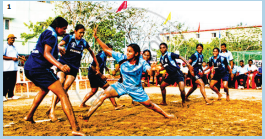
The passage given below is on Kabbadi. Read the passage and complete the activities that follow.

Kabbadi (கபடி - in Tamil) is a contact team sport that originated in Tamil Nadu, India. It is the national sport of Bangladesh. It is also popular in South Asia and is the state game of the Indian states of Tamil Nadu, Kerala, Andhra Pradesh, Bihar, Haryana, Karnataka, Maharashtra, Punjab, and Telangana.

Kabbadi is played between two teams of seven players: the objective of the game is for a single player on offence referred to as a 'raider', to run in to the opposing teams half of a court, tag out as many of their defenders as possible, and return to their own half of the court–all without being tackled by the defenders. Points are scored for each player tagged by the raider, while the opposing team earns a point for stopping the raider. Players are taken out of the game if they are tagged or tackled, but can be 'revived' for each point scored by their team from a tag or tackle. The raider should hold his breath and utter the words like 'kabbadi kabbadi, hututu hututu, chadu kudu' etc. while the opponents try to catch him. If he stops uttering these words, he is considered out.

The game is known by its regional names in different parts of the subcontinent, such as Kabbadi or Chedugudu in Andhra Pradesh, Kabbadi in Kerala and Telangana, Hadudu in Bangladesh, Bhavatik in Maldives, Kauddi or Kabbadi in the Punjab Region, Hu-Tu-Tu in Western India and Hu-Do-Do in Eastern India and Chadakudu in South India. The highest governing body of Kabbadi is the International Kabbadi Federation.

Given below is the visual presentation of the first paragraph.

i) Represent the other paragraphs in a visual form of your choice(flow chart, mind-map, pie-chart, etc.).

ii) Choose the correct option.

1. A contact sport usually involves a ______contact between players.

  1. violent
  2. gentle
  3. physical

2. Kabbadi is a game played between ______.

  1. seven teams of two players
  2. two teams of seven players
  3. four teams of seven players

3. A single ______.

  1. player on offence is referred to as a raider
  2. offence is referred to as a raider
  3. raider is an offence by the player

iii) Answer the following.

  1. How does a raider score points for his team?
  2. When does a raider concede a point to the opponent team?
  3. Can a player be revived when he/she is out of the game? Explain your answer.
  4. Kabbadi is called by different names in different parts of India. Do you know how Pallankuzhi is called in Karnataka, Andhra Pradesh and Kerala?

William Shakespeare was one of the greatest playwrights of all time. He lived in the 16th century. Many Shakespearean plays have been written in the short-story form. Find out the names of at least 5 of Shakespearean plays.

Example: Romeo and Juliet


Share
Notifications

Englishहिंदीमराठी


      Forgot password?
Use app×