Advertisements
Advertisements
Question
On this historic moment, I stand here to thank Pandit Jawaharlal Nehru. India’s present epoch maker has come over here to bless the state of Maharashtra which is definitely going to last forever. On behalf of thousands of common people, I express my deep sense of gratitude to him for blessing us. We Maharashtrians love him, worship him. And once again, I wish to declare that this state of Maharashtra, recently formed, will work for the betterment of the common people of Maharashtra, but if it comes to sacrifice, whatever best and grand we have, it will be done primarily for India. This is so, because, we believe from the beginning, that Maharashtra depends on India; its greatness depends on the greatness of India. All Maharashtrians believe that both India and Maharashtra can progress only when there is oneness of interest. And, therefore, I have made this clear by bringing to your notice the significance of certain symbols, for example, the Himalayas stand for lndia and the Sahyadri, for Maharashtra. The snowy Himalayas with the highest mountain ranges symbolise India and the Sahyadri with the blackest rock structure and with 200-300 inches rainfall symbolise Maharashtra. I promise you that if the Himalayas are in jeopardy, the Sahyadri of Maharashtra will use its black rock structure like a shield to protect the Himalayas.
‘Hard labour’ is the watch word of our times. And, Panditji, you have given us the message of building Maharashtra and our nation by hard labour. We are going to inscribe this valuable message on our minds and try our best to look at your blessings and your guidance, as the blessings and guidance of an epoch maker.
A1 . Read the following statements. Find out the correct statements and write them down : (2)
(i) Both India and Maharashtra can progress if they have different interests.
(ii) Hard work is the only way to build the future of India and Maharashtra.
(iii) The sacrifice of the best and grand in Maharashtra will be made for the state of Maharashtra.
(iv) In times of great calamity the Sahyadri will protect the Himalayas, like a shield.
A2. Complete the following statements : (2)
(i) The interest of Maharashtra and that of India should be one for the progress of Maharashtra state, because ................
(ii) Maharashtra depends on India, because ................
A3.Complete the table : (2)
| The name of the mountain | Stands for | The reason |
| The Himalayas The Sahyadri |
A4. Vocabulary - (2)
Give antonyms of the following words by adding prefixes :
(i) gratitude
(ii) clear
(iii) believe
(iv) significance
A5. Personal response - (2)
Give your suggestions that will help the people to make Maharashtra prosperous.
A6. Grammar - (2)
Rewrite the following sentences in the ways instructed :
(i) India and Maharashtra can progress only when there is oneness of interest.
(Rewrite it using ‘unless’)
(ii) This state of Maharashtra will work for the betterment of the common people of Maharashtra.
(Rewrite it using modal auxiliary showing ‘obligation’)
Advertisements
Solution
A1 .
(ii) Hardwork is the only way to build the future of India and Maharashtra.
(iv) In times of great calamity the Sahyadri will protect the Himalayas, like a sheild.
A2.
(i) The interest of Maharashtra and that of India should be one for the progress of Maharashtra, state because India and Maharashtra can only progress when there is oneness of interest.
(ii) Maharashtra depends on India, because its greatness depends on the greatness of India.
A3.
| The name of the mountain | Stands for | The reason |
| The Himalayas | India | The snowy Himalayas with the highest mountain ranges symbolise India. |
| The Sahyadri | Maharashtra | The blackest rock structure with 200- 300 inches rainfall symbolises Maharashtra. |
A4.
(i) Gratitude – ingratitude
(ii) Clear – Unclear
(iii) Believe – disblieve
(iv) Significance – insignificance
A5.
According to me, Maharashtra can be prosperous if the people or citizens are really willing to work towards it. Few initiative or steps that we can ensure is to see that our cities have basic facilities like food, clothing, shelter, education and health services easily available. For this alongwith the government we citizens have to make a realistic plan and execute the services so that every citizen living gets the benefits which id also his rights. Proper infrastructure also adds to this. Citizen can ensure that their locality is clean & there is greenary so that the city looks beautiful and environment is also taken care. Citizens should support the Swacch Bharat Abhiyaan. Proper education given to every child and most importantly create the awareness among people about their rights and duties both. By following the above points, I am sure we all can contribute towards prosperous Maharashtra.
A6.
(i) Unless there is oneness of interest India and Maharashtra cannot progress.
(ii) This state of Maharashtra must work for the betterment of the common people of Maharashtra.
APPEARS IN
RELATED QUESTIONS
AI. Who said to whom
(i) "Is he going to live, sir?"
(ii) "______ the struggle is too hard at the end ______.”
The doctor said to himself, "If my word can save his life, he shall not die.
The will be damned." He called, "Gopal, listen." This was the first time he was going to do a piece of acting before a patient, simulate a feeling and conceal his Judgement. He stooped over the patient and said, with deliberate emphasis, "Don't worry about the will now. You are going to live. Your heart is absolutely sound."
A new glow suffused the patient's face as he heard it. Be asked in a tone of relief,
"Do you say so? If it comes from your lips it must be true............ . "
The doctor said, "Quite right. You are improving ever second. Sleep in peace. You must not exert yourself on any account. You must sleep very soundly.
I will see you in the morning." The patient looked at him gratefully for a moment and then closed his eyes. The doctor picked up his bag and went out, shutting the door softly behind him.
On his way home he stopped for a moment at his hospital, called out his assistant and said, "That Lawley Extension case. You might expect the collapse any second now. Go there with a tube of .....................................'in hand, and give it in case the struggle is too hard at the end. Hurry up.”
Next morning he was back at Lawley Extension at ten. From his car he made a dash for the sick bed. The patient was awake and looked very well. The assistant reported satisfactory pulse. The doctor put his tube to his heart, listened for a while and told the sick man's wife, "Don't look so unhappy, lady. Your husband will live to be a ninety.’’ When they were going back to the hospital, the assistant sitting beside him in the car asked, "Is he going to live, sir?"
"I will bet on it. He will live to be ninety. He has turned at corner. How he has survived this attack will be a puzzle to me all my life," replied the doctor.
A2. Web
Complete the web:

A3. Personal Response
What is your opinion about the doctor and his behaviour?
The Perfect Dog
In the summer of 1967, when I was ten years old, my father caved into my persistent pleas and took me to get my own dog. Together we drove in the family station wagon far into the Michigan countryside to a farm run by a rough-hewn woman and her ancient mother. The farm produced just one commodity—dogs. Dogs of every imaginable size and shape and age and temperament. They had only two things in common: each was a mongrel of unknown and distinct ancestry, and each was free to a good home.
I quickly decided the older dogs were somebody else’s charity case. I immediately raced to the puppy cage. “You want to pick one that’s not timid,” my father coached. “Try rattling the cage and see which ones aren’t afraid.”
I grabbed the chain-link gate and yanked on it with a loud clang. The dozen or so puppies reeled backward, collapsing on top of one another in a squiggling heap of fur. Just one remained. He was gold with a white blaze on his chest, and he charged at the gate, yapping fearlessly. He jumped up and excitedly licked my fingers through the fencing. It was love at first sight.
I brought him home in a cardboard box and named him Shaun. He was one of those dogs that give dogs a good name. He effortlessly mastered every command I taught him and was naturally well-behaved. I could drop a crust on the floor and he would not touch it until I gave the okay.
Relatives would visit for the weekend and returned home determined to buy a dog of their own, so impressed were they with Shaun – or “Saint Shaun”, as I came to call him. Born with the curse of an uncertain lineage, he was one of the tens of thousands of unwanted dogs in America. Yet by some stroke of almost providential good fortune, he became wanted. He came into my life and I into his – and in the process, he gave me the childhood every kid deserves.
The love affair lasted fourteen years, and by the time he died I was no longer the little boy who had brought him home on that summer day. I was a man, out of college and working across the state in my first real job. Saint Shaun had stayed behind when I moved on. It was where he belonged. My parents, by then retired, called to break the news to me. My mother would later tell me, “In fifty years of marriage, I’ve only seen your father cry twice. The first time was when we lost Mary Ann” – my sister, who was still-born. “The second time was the day Shaun died.”
Saint Shaun of my childhood. He was a perfect dog. At least that’s how I will always remember him. It was Shaun who set the standard by which I would judge all other dogs to come.
(Marley and Me by John Grogan)
1.1 Based on your reading of the passage, complete the following statements.
(a) The dog farm was run by ________________________________.
(b) The author did not want an old dog because ______________________________.
(c) He fell in love with the dog the moment the latter _______________________.
(d) Shaun became so obedient that he ______________________ until the author allowed him.
(e) After visiting them, their relatives wanted ________________________.
(f) When Shaun died even _______________________.
1.2 Find words from the passage which mean the same as the following.
(a) urgent requests (para 1)
(b) falling (para 3)
He holds him with his skinny hand,
“There was a ship,” quoth he.
i. Who does ‘He’ refer to in the above extract?
ii. What do we know about the speaker’s feelings?
iii. Why is his hand called ‘skinny’?
One of the greatest advances in modern technology has been the invention of computers. They are widely used in industries and in universities. Now there is hardly any sphere of human life where computers have not been pressed into service of man. We are heading fast towards the day when a computer will be as much part of man's daily life as a telephone or a calculator.
Computers are capable of doing extremely complicated work in all branches of learning. They can solve the most complex mathematical problems or put thousands of unrelated facts in order. These machines can be put to varied uses. For instance, they can provide information on the best way to prevent traffic jams. This whole process by which machines can be used to work for us has been called 'automation'. In the future 'automation' may enable human beings to enjoy more leisure than they do today. The coming of automation is bound to have important social consequences.
Some years ago an expert on automation, Sir Leon Bagrit, pointed out that it was a mistake to believe that these machines could 'think'. There is no possibility that human beings will be "controlled by machines". Though computers are capable of learning from their mistakes and improving on their performance, they need detailed instructions from human beings to operate. They can never, as it were, lead independent lives or "rule the world" by making decisions of their own.
Sir Leon said that in future, computers would be developed which would be small enough to carry in the pocket. Ordinary people would then be able to use them to obtain valuable information. Computers could be plugged into a national network and be used like radios. For instance, people going on holiday could be informed about weather conditions. Car drivers can be given alternative routes when there are traffic jams. It will also be possible to make tiny translating machines. This will enable people who do not share a common language to talk to each other without any difficulty or to read foreign publications.
a) What is the greatest advancement in modern technology?
b) What complicated works are computers capable of doing?
c) Write one use of computers.
d) Explain automation.
e) Why can't computers lead independent lives or rule the world?
f) How would computers as translating machines help people?
g) What was the prediction of Sir Leon about computers in the future?
h) How can computers help people going on holiday?
Read the following passage carefully:
Gandhiji As a Fund Raiser
Gandhiji was an incurable and irrestible fund raiser. He found special relish in getting jewellery from women. Ranibala of Burdwan was ten years old. One day she was playing with Gandhiji. He explained to her that her bangles were too heavy for her delicate little wrists. She removed the bangles and gave them away to Gandhiji.
He used to talk jokingly to small girls and created distaste for ornaments and created a desire in them to part with the jewellery for the sake of the poor. He motivated them to donate their jewellery for social usage.
Kasturbai didn’t appreciate this habit of Gandhiji. Once she stated calmly, ‘You don’t wear jewels, it is easy for you to get around the boys. But what about our daughters-in-law ? They would surely want them.
“Well!” Gandhiji put in mildly, "our children are young and when they grow up they will not surely choose wives who are found of wearing jewellery.” Kasturbai was very upset with the answer.
Gandhiji was determined to keep the jewels to raise community fund. He was of the opinion that a public worker should accept no costly gifts. He believed that he should not own anything costly, whether given or earned. Kasturbai was a female with a desire to adorn. But Gandhiji moved towards renunciation and donated every penny earned in South Africa to the trustees for the service of South African Indians.
2.1 Answer the questions given below:
(ii) untreatable
(iii) disagreeable
(iv) unbeatable
(ii) emboldened
(iii) incited
(iv) softened
(ii) furious
(iii) confused
(iv) distressed
(ii) disagreement
(iii) opposition
(iv) termination
Read the extract given below and answer the questions that follow:
These meadows aren't worth much to me. They only come to five dessiatins, and are worth perhaps 300 roubles, but I can't stand unfairness. Say what you will, I can't stand unfairness.
(a) Who speaks the above lines and to whom?
(b) How much are the meadows worth?
(c) Find a word in the extract the means 'not based on what is just.'
Read the passage given below :
Kausani is situated at a height of 6,075 feet in the Central Himalayas. It is an unusally attractive little town. It covers just about 5.2 sq. kms. It lies to the north of Almora in Uttarakhand's picturesque kumaon region.
Kausani provides the 300-km wide breathtaking view of the Himalayas. It is the most striking aspect of the place. Snow-capped peaks are spread in a stately row. They stare at you in silvery white majesty. The most famous peak on view is Nanda Devi, the second highest mountain in India. It is situated at a height of 25.645 feet and 36 miles away as the crow files. The other famous peaks on view are choukhamba (23,420 feet) and Trishul (23,360 feet). Then there are also Nilkanth, Nandaghunti, Nandaghat and Nandakot. On a clear day, the blue of the sky makes a splendid background to these peaks. At sunrise and at sunset, when the colour changes to a golden orange, the scene gets etched in your memory.
When Gandhiji visited this place in 1929, its scenic beauty held him spellbound. He named it the 'Switzerland of Indian'. He prolonged his two-day stay to fourteen days, making time to write a book, 'Anashakti Yoga'. The place where he was staying was originally a guest-house of the tea estate. It was renamed 'Anashakti Ashram' after the book.
Kausani is the birthplace of Sumitranandan Pant, India's poet laureate. Its natural surroundings inspired many of his poems. Its tea gardens mingle with dense pine forests and fruit orchards. The area is also host to many fairs and religious caremonies. If Uttaranchal is the abode of gods, Kausani is God's own backyard. There is no traffic, no one is in a hurry. If serenity could be put on a canvas, the picture would resemble Kausani.
On the basis of your reading of the above passage, answer the following questions :
(a) Where is Kausani situated ?
(b) What is the most striking aspect of Kausani ?
(c) Which is the most famous peak on view from Kausani ?
(d) How did Kausani influence Sumitranandan Pant ?
(e) When does the view of peaks become so memorable ?
(f) How can we say that Gandhiji was greatly charmed by the natural beauty of Kausani ?
(g) What makes Kausani a calm and quiet place ?
(h) Why, do you think, is Kausani known as 'God' s own backyard' ?
Read the passage given below:
1. I rested for a moment at the door of Anand Bhawan, on Market Road, where coffee-drinkers and tiffin-eaters sat still at their tables, uttering low moans on seeing me. I wanted to assure them, "Don't mind me, you hugging the cash box − you are a coward, afraid even to breathe. Go on, count the cash, if that is your pleasure. I just want to watch, that's all. If my tail trails down to the street, if I am blocking your threshold, it is because, I'm told, I'm eleven feet tip to tail. I can't help it. I'm not out to kill − I'm too full. I found a green pasture full of food on my way. I won't attack until I feel hungry again. Tigers attack only when they feel hungry, unlike human beings who slaughter one another without purpose or hunger."
2. To the great delight of children, schools were being hurriedly closed. Children of all ages and sizes were running helter-skelter, screaming joyously. "No school, no school. Tiger, tiger!" They were shouting and laughing and even enjoying being scared. They seemed to welcome me. I felt like joining them. So I bounded away from the restaurant door. I walked along with them, at which they cried, 'The tiger is coming to eat us; let us get back to school!"
3. I followed them through their school gate while they ran up and shut themselves in the school hall securely. I climbed up the steps of the school, saw an open door at the far end of a veranda, and walked in. It happened to be the headmaster's room. I noticed a very dignified man jumping on the table and heaving himself up into an attic. I walked in and flung myself on the cool floor, having a special liking for cool stone floors.
4. As I drowsed, I was aware of cautious steps and hushed voices all around. I was in no mood to bother about anything. All I wanted was a little moment of sleep; the daylight was very bright.
On the basis of your reading of the above passage, answer the following questions:
(a) How did the diners at Anand Bhawan react on seeing the tiger?
(b) When do tigers attack? In this context, how are human beings different from tigers?
(c) Why were children happy and even enjoying being scared?
(d) What did the headmaster do on seeing the tiger? What did the tiger like to do in the headmaster's office?
(e) Identify the word which means the same as 'hugging'. (Para 1)
(i) counting
(ii) hiding
(iii) rubbing
(iv) holding tightly in the arms
(f) Identify the word which means the same as 'delight'. (Para 2)
(i) pleasure
(ii) fear
(iii) sorrow
(iv) nervousness
(g) Identify the word which means the same as 'dignified'. (Para 3)
(i) tall
(ii) honourable
(iii) terrified
(iv) tired
(ii) jumped forward
(iii) walked with heavy steps
(iv) ran lazily
Read the passage given below and answer the questions that follow:
1. Thackeray reached Kittur along with a small British army force and a few of his officers. He thought that the very presence of the British on the outskirts of Kittur would terrorise the rulers and people of Kittur and that they would lay down their arms. He was quite confident that he would be able to crush the revolt in no time. He ordered that tents be erected on the eastern side for the fighting forces and a little away on the western slopes tents be put up for the family members of the officers who had accompanied them. During the afternoon and evening of 20thOctober, the British soldiers were busy making arrangements for these camps.
On the basis of your understanding of the above passage complete the statements given below with the help of options that follow:
(ii) army officer
(iii) adviser to Rani of Kittur
(iv) treasury officer
(ii) enjoy life in tents
(iii) stay in the palace
(iv) give company to officers
(c) Why did Thackeray come to Kittur?
(d) Why did the Kittur officials refuse to give the desired assurance to Thackeray?
(e) What happened to the Horse Artillery?
(f) How do we know that the Rani was a noble queen?
(g) How in your opinion would the British women have felt after meeting the Rani?
(h) Why did the Rani refuse to meet Thackeray?
(i) Find words from the passage which mean the same as the following :
ii. aggressive/refusing to obey (para 2)
Read the passage given below and answer the questions that follow:
The most alarming of man’s assaults upon the environment is the contamination of air, earth, rivers, and sea with lethal materials. This pollution is for the most part irrevocable; the chain of evil it initiates is for the most part irreversible. In this contamination of the environment, chemicals are the sinister partners of radiation in changing the very nature of the world; radiation released through nuclear explosions into the air, comes to the earth in rain, lodges into the soil, enters the grass or corn, or wheat grown there and reaches the bones of a human being, there to remain until his death. Similarly, chemicals sprayed on crops lie long in soil, entering living organisms, passing from one to another in a chain of poisoning and death. Or they pass by underground streams until they emerge and combine into new forms that kill vegetation, sicken cattle, and harm those who drink from once pure wells.
It took hundreds of millions of years to produce the life that now inhabits the earth and reached a stage of adjustment and balance with its surroundings. The environment contained elements that were hostile as well as supporting. Even within the light of the sun, there were short wave radiations with power to injure. Given time, life has adjusted and a balance reached. For time is the essential ingredient, but in the modern world is no time.
The rapidity of change and the speed with which new situations are created follow the heedless pace of man rather than the deliberate pace of nature. Radiation is no longer the bombardment of cosmic rays; it is now the unnatural creation of man’s tampering with the atom. The chemicals to which life is asked to make adjustments are no longer merely calcium and silica and copper and all the rest of the minerals washed out of the rocks and carried in the rivers to the sea; they are the synthetic creations of man’s inventive mind, brewed in his laboratories, and having no counterparts in nature.
(a) On the basis of your understanding of the above passage make notes on it using headings and sub-headings. Use recognizable abbreviations (wherever necessary-minimum four) and a format you consider suitable. Also supply a title to it.
(b) Write a summary of the passage in about 80 words.
Read the passage given below:
People tend to amass possessions, sometimes without being aware of doing so. They can have a delightful surprise when they find something useful which they did not know they owned. Those who never have to change house become indiscriminate collectors of what can only be described as clutter. They leave unwanted objects in drawers, cupboards, and attics for years in the belief that they may one day need them. Old people also accumulate belongings for two other reasons, lack of physical and mental energy, and sentiment. Things owned for a long time are full of associations with the past, perhaps with the relatives who are dead, and so they gradually acquire a sentimental value.
Some things are collected deliberately in an attempt to avoid wastage. Among these are string and brown paper, kept by thrifty people when a parcel has been opened. Collecting small items can be mania. A lady cuts out from newspaper sketches of model clothes that she would like to buy if she had money. As she is not rich, the chances are that she will never be able to afford such purchases. It is a harmless habit, but it litters up her desk.
Collecting as a serious hobby is quite different and has many advantages. It provides relaxation for leisure hours, as just looking at one’s treasure is always a joy. One doesn’t have to go out for amusement as the collection is housed at home. Whatever it consists of - stamps, records, first editions of books, china – there is always something to do in connection with it, from finding the right place for the latest addition to verifying facts in reference books. This hobby educates one not only in the chosen subject but also in general matters which have some bearing on it.
There are other benefits also. One gets to meet like-minded collectors to get advice, compare notes, exchange articles, to show off one’s latest find. So one’s circle of friends grows. Soon the hobby leads to traveling, perhaps a meeting in another town, possibly a trip abroad in search of a rare specimen, for collectors are not confined to one country. Over the years one may well become an authority on one’s hobby and will probably be asked to give informal talks to little gatherings and then, if successful, to larger audiences.
(a) On the basis of your understanding of the above passage make notes on it using headings and sub-headings. Use recognizable abbreviations (wherever necessary-minimum four) and a format you consider suitable. Also, supply an appropriate title to it.
(b) Write a summary of the passage in about 80 words.
Read the passage given below carefully :
1. For four days, I walked through the narrow lanes of the old city, enjoying the romance of being in a city where history still lives - in its cobblestone streets and in its people riding asses, carrying vine leaves and palm as they once did during the time of Christ.
2. This is Jerusalem, home to the sacred sites of Christianity, Islam and Judaism. This is the place that houses the church of the Holy Sepulchre, the place where Jesus was finally laid to rest. This is also the site of Christ's crucifixion, burial and resurrection.
3. Built by the Roman Emperor Constantine at the site of an earlier temple to Aphrodite, it is the most venerated Christian shrine in the world. And justifiably so. Here, within the church, are the last five stations of the cross, the 10th station where Jesus was stripped of his clothes, the 11th where he was nailed to the cross, the 12th where he died on the cross, the 13th where the body was removed from the cross, and the 14th, his tomb.
4. For all this weighty tradition the approach and entrance to the church is non-descript. You have to ask for directions. Even to the devout Christian pilgrims walking along the Via Dolorosa - the Way of Sorrows - first nine stations look clueless. Then a courtyard appears, hemmed in by other buildings and a doorway to one side. This leads to a vast area of huge stone architecture.
5. Immediately inside the entrance is your first stop. It's the stone of anointing: this is the place, according to Greek tradition, where Christ was removed from the cross. The Roman Catholics, however, believe it to be the spot where Jesus' body was prepared for burial by Joseph.
6. What happened next ? Jesus was buried. He was taken to a place outside the city of Jerusalem where other graves existed and there, he was buried in a cave. However, all that is along gone, destroyed by continued attacks and rebuilding; what remains is the massive - and impressive - Rotunda (a round building with a dome) that Emperor Constantine built. Under this, and right in the centre of the Rotunda. is the structure that contains the Holy Sepulchre.
7. "How do you know that this is Jesus' tomb ?" I asked one of the pilgrims standing next to me. He was clueless, more interested, like the rest of them, in the novelty of it all and in photographing it, then in its history or tradition.
8. At the start of the first century, the place was a disused quarry outside the city walls. According to the gospels, Jesus' crucifixion occurred 'at a place outside the city walls with graves nearby.....'. Archaeologists have discovered tombs from that era, so the site is compatible with the biblical period.
9. The structure at the site is a marble tomb built over the original burial chamber. It has two rooms, and you enter four at a time into the first of these, the Chapel of the Angel. Here the angel is supposed to have sat on a stone to recount Christ's resurrection. A low door made of white marble, party worn away be pilgrims' hands, leads to a smaller chamber inside. This is the 'room of the tomb', the place where Jesus was buried.
10. We entered in single file. On my right was a large marble slab that covered the original rock bench on which the body of Jesus was laid. A woman knelt and prayed. Her eyes were wet with tears. She pressed her face against the slab to hide them, but it only made it worse.
On the basis of your understanding of this passage answer the following questions with the help of given options:
(a) How does Jerusalem still retain the charm of ancient era?
(i) There are narrow lanes.
(ii) Roads are paved with cobblestones.
(iii) People can be seen riding asses
(iv) All of the above
(b) Holy Sepulchre is sacred to _________.
(i) Christianity
(ii) Islam
(iii) Judaism
(iv) Both (i) and (iii)
(c) Why does one have to constantly ask for directions to the church?
(i) Its lanes are narrow.
(ii) Entrance to the church is non-descript.
(iii) People are not tourist-friendly.
(iv) Everyone is lost in enjoying the romance of the place.
(d) Where was Jesus buried?
(i) In a cave
(ii) At a place outside the city
(iii) In the Holy Sepulchre
(iv) Both (i) and (ii)
Answer the following questions briefly:
(e) What is the Greek belief about the 'stone of anointing'?
(f) Why did Emperor Constantine build the Rotunda?
(g) What is the general attitude of the pilgrims?
(h) How is the site compatible with the biblical period?
(i) Why did the pilgrims enter the room of the tomb in a single file?
(j) Why did 'a woman' try to hide her tears?
(k) Find words from the passage which mean the same as:
(i) A large grave (para 3)
(ii) Having no interesting features/dull (para 4)
Read the following extract and answer the questions given below:
The Jahangir Art Gallery, the State Bank of lndia building and the canteen close by which offered affordable fare, the amazing street fare, bhelpuri and vadapav. The joy of reading Bombay Times with its page 3 people one would never meet but who seemed like old friends. The Strand bookstore where one could browse for hours. And just when a book was longingly but firmly put down from nowhere, Mr Shanbagh would materialise magically at one's elbow with a special price. Not to forget the joys of trawling the booklined pavements at Fountain, where one could watch the world go by. And wherever I chose to go, there was always my friend, the sea, oh. I loved her, in all her moods, but especially in the monsoon when violent and enraged she splattered Worli seaface with walls of sea spray. My friends are lost, some passed away, some moved away, there were many whose names I never found out, though we took the train together, or met in the lift, every day.
Like every migrant, I promise myself, someday I will return. I may, perhaps, return sometime, but even so, I know, "that one cannot step into the same river twice." You seduced me steadily, o Mumbai, with your glamour and bright lights. City of dreams, tinsel town. I pay tribute to you. Today, I say good-bye with a heavy heart.
(1) What does this extract focus on?
(2) Which mood of the sea did the writer like the most?
(3) How would the writer spend her free time?
( 4) According to you, how can you make your locality clean and beautiful?
(5) Rewrite the following sentences in the ways instructed :
(i) She splattered Worli seaface with walls of sea spray.
(Rewrite it using the Simple Present tense.)
(ii) I never found out their names though we took the train together
(Make it a Compound Sentence.)
(iii) I promise myself, someday I will return.
(Rewrite it using the modal auxiliary 'must'.)
(6) Find out the words from the extract which mean -
(i) courageously
(ii) attracted
Read the following extract and answer the questions given below:
But even in a poverty-free world where every man and woman would earn enough to take care of themselves and their family, there would still be situations of temporary poverty due to a sudden catastrophe or misfortune, a bankruptcy or business downturn leading to failure, or some personal disease or disaster.
A poverty-free world might see a whole group of families, locations, or even regions devastated by some shared disasters, such as floods, tire, cyclones, riots, earthquakes or
other disasters. But such temporary problems could be taken care of by the market mechanism through insurance and other self-paying programmes, assisted of course by social-consciousness-driven enterprises.
There would always remain differences in lifestyle between people at the bottom of society and those at the top income levels. Yet that difference would be the difference between the middle-class and luxury class, just as on trains in Europe today you have only first-class and second-class carriages, whereas in the nineteenth century there were third- class and even fourth-class carriages - sometimes with no windows and just hay strewn on the floor.
Can we really create a poverty-free world? A world without third-class or fourth-class citizens, a world without a hungry, illiterate, barefoot under-class?
(1) What is the extract about?
(2) How will the poverty-free world take care of natural disasters?
(3) According to the writer, what would, 'the world without poverty' be like?
(4) What can we do to help the poor in our society?
(5) Rewrite the following sentences in the ways instructed:
(i) Temporary problems could be taken care of by market mechanisms.
(Rewrite the sentence beginning with 'Market mechanism ........ ')
(ii) In the nineteenth century, there were third-class carriages.
(Form a Wh-question to get the underlined part as an answer.)
(iii) There would still be situations of temporary poverty.
(Rewrite it using 'can'.)
( 6) What do the following words in the extract mean -
(i) devastated
(ii) hay
Read the following extract and answer the questions given below:
We commemorate so many special days such as Republic Day, Independence Day, Mother's Day and so on. Well, here is one day that deserves not only a commemoration but our total dedication - Earth Day, 22 April. At Sanctuary, we live our lives like every day is Earth Day, but we all believe that it would be, fantastic to remind our relatives, friends, neighbours, teachers, and elders on this day that protecting Mother Earth can end up making us both happy and safe.
Will you do something this Earth Day? Here's a handy list of things you can do-
(1) Cut Consumption: Consume as little as possible on Earth Day. This 'is a day·when you ca!l Refuse (to buy new things), Repair and Reuse (old stuff), Recycle (what you cannot reuse), Reject (stuff that is toxic or dangerous to the environment) and Renew (your purpose and resolve to protect the planet).
(2) Cut Energy: (a) Ditch the old incandescent bulbs and shift to CFLs or LEDs (Google both to find out more). (b) Walk or use public transport, try not to use private cars to save fuel. Carpool. Cut down on trips. Use Skype· instead of traveling for meetings. (c) Switch off unnecessary gadgets. (don't just use the remote .... walk to the mains!).
(3) Cut Waste: Start a waste segregation system in your building, school or neighbourhood. Compost organic waste, sell what you can to the raddi-wallah and give him a small token of.. appreciation also for he is protecting your world. Collect unused papers from old notebooks and make new ones from them.
(4) Cut out plastic: Speak to at least five shopkeepers in your area and tell them you and your friends will only use their shops if they move away from wasteful plastic packaging, particularly thin plastic bags.
(1) What do you understand from this extract?
(2) What steps can we take to keep our environment clean?
(3) Why should we commemorate Earth Day?
(4) What is your opinion regarding shifting to CFLs or LEDs?
(5) Rewrite the following sentences in the ways instructed :
(i) Earth Day deserves a commemoration and our total dedication.
(Use 'not only - but also'.)
(ii) Start a Waste Segregation System in your building.
(Rewrite it beginning with 'Let'.)
(iii) You can sell waste to the raddi-wallah and give him a
small token of appreciation.
(Replace the modal auxiliary by another showing 'obligation'.)
(6) What do the following words in the extract mean?
(i) resolve
(ii) toxic
Read the following extract and answer the questions given below:
There are some glimmers of hope. I met up young Navdeep. Ahuja who along with another colleague began the innocuously named Graduates Welfare Association, Fazilka. They are bringing about change with the mandate of citizens' participation in governance and are facilitating the creation of physical and social infrastructure across 22 cities in Punjab. They have put in place a network of cycle rickshaws called Eco-cabs which can be booked through a mobile phone. They are also developing car tree zones, food and culture streets in these cities. All this is being done very efficiently and at a low cost. We need many such organizations. However, my idea of a city in 2020 is not a utopian dream. It is achievable. It has streets where people walk on wide footpaths shaded by leafy trees. Streets are usually one-third of a city's area and its most democratic segment. Public space dedicated to pedestrians reduces inequality and should be accorded priority when developing cities. Adjoining the streets should be cycle lanes where bicycles and, rickshaws can sail past smoothly. It'll have a great public transport system with buses, metro and taxis. Parking will be difficult and expensive so people will use public transport rather than cars. There will be parks and gardens and the air will be clean, as pollution levels will have dropped dramatically. And then cities will become areas of graceful living and a charmed way of life.
(1) What is the extract about?
(2) What will happen when parking becomes difficult and expensive?
(3) How has Graduates Welfare Association brought about changes in some cities?
(4) What efforts will you take to make your city a livable place?
(5) Rewrite the following sentences in the ways instructed :
(i) We need many such organizations.
(Frame a ' Wh-question' to get the underlined part as an answer.)
(ii) It reduces inequality.
(Rewrite it using the Present Perfect Tense.)
(iii) The air will be clean, as pollution levels will. have dropped dramatically.
(Rewrite it using 'unless')
(6) Find out the words from the extract which mean:
(i) co-worker
(ii) small signs
(A) Read the following extract and answer the questions given below:
Chronic floods during the monsoon, on average, affect more than 30 million Indians annually Ironically, 60% of India's farmland, 66% of its livestock and its entire forest area depend on rains for survival.
According to a recently released Central Water Commission (CWC) report, on an average, 7·21 million hectares (roughly 72,000 sq. km.) go under floodwater. This water typically ravages 3·78 million hectares of agricultural land, damaging crops worth Rs. 1, 118 crores annually.
Heavy rains and floods account for nearly 1,700 lives lost annually. Apart from this, I ·25 lakh houses are annually damaged by torrential rains that also wipe out nearly 96,000 livestock.
Floods are the most recurrent natural calamity, hitting India almost every year. According to the CWC's report on financial aspects of flood control, anti-sea erosion and drainage projects, it is not possible to provide absolute protection instantly to all flood-prone areas. It says that such an attempt will neither be practical nor economically viable.
The CWC's analysis of floods in India from 1953 to 2011 shows a marginal decline in flood-affected areas over the years, the data shows 1977 1978 and 1979 were the worst-hit. The 1977 floods killed over 11,000 people, six-time the average for the 59 years, between 1953 and 2011. In terms of area and population affected, the floods of 1978 were the most destructive.
In terms off the financial loss, recent floods have been far more destructive. The total loss of crops, houses and public utilities in 2009 was Rs. 32541 crores, the highest for any year.
Question
(1) What is the above extract about?
(2) How do floods adversely affect India?
(3) Why is it not possible to provide absolute protection to all flood-prone areas?
(4) How would you help the flood-affected people?
(5) Rewrite the following sentences in the ways instructed :
(i) The floods of 1978 were the most destructive.
(Change the sentence into the 'positive degree'.)
(ii) Floods are the most recurrent natural calamity hitting India almost every year.
(Make it a complex sentence.)
(iii) Floods have been far more destructive.
(Rewrite the sentence using the Simple Present tense.)
(6) Give the meanings of:
(i) entire
(ii) calamity
(B) Write a brief summary of the above extract with the help of the points given below and suggest a suitable title.
Floods - natural, recurrent calamity in India - destroy life and property - no absolute protection - neither practical nor economically viable- floods in 1977 and 1978.
Read the following extract and answer the questions given below:
So what is a city? It's a dense amalgamation of buildings and people. A city must provide equity and also be sustainable. As an architect who has been closely connected with Delhi and its planning, my wish list is more about the direction we need to take so that future generations don 't end up living in chaotic dysfunctional cities.
The first requirement for a city is a pragmatic plan. Many of our cities such.as Delhi and Bhubaneswar and even Port Blair in the Andamans have reasonably good master plans. Many also have City Development Plans which have been made an essential requirement to draw funds. from the government's Urban Renewal Programme (JNNURM). But they should be updated frequently based on the changing needs of its people.
And let's not forget its citizens - they need to be more pro-actively involved when evolving master plans. But often, there's lack of planning and inadequate implementation systems. This applies to all essential components of a city-streets, public transport system, traffic management, affordable housing, cars and parking, drainage. water supply, sewerage, and garbage. Any deficiency in these will lead to poor quality cities that won't be able to handle the pressure of increased population and changing needs.
The second require1nent of a good city is good social infrastructure such as parks and places for leisure such as rivers and seafronts. It needs to preserve and protect its heritage. We are a nation with a rich diversity in culture, arts, and crafts.
Questions:
(1) What issue is raised in the above extract?
(2) What are the requirements for a good city?
(3) Why is it necessary to update our city development plan?
(4) Do you think unplanned cities make the life of its people
miserable? How?
(5) Rewrite the following sentences in the ways instructed :
(i) A city must provide equity and also be sustainable.
(Rewrite the sentence using 'not only ...... but also'.)
(ii) Many of our cities have good master plans.
(Frame a Wh-question to get the underlined part as its answer.)
(iii) It needs to preserve and protect its heritage.
(Identify the tense used in the sentence.)
(6) Find out from the extract the words which mean:
(i) practical
(ii) blend
Read the following extract and answer the question given below: (11)
Researchers· recently announced the earth could actually
withstand up to 200,000 times the current population. They arrived at this figure by calculating the amount of heat a human body emits. and only at l ·3 million billion would the earth be too hot to be habitable. And though it would feel like being in a can of sardines if that figure were ever reached, the earth is capable of comfortably sustaining a population several times the current 6·5 billion.
In fact, fertility is actually on the decline worldwideThough
population has grown, the rate of growth has fallen sharply. Twenty years ago, the UN projected that population would reach l l · 16 billion in 2050, today they say it will reach only 9·37 billion. Moreover, human population will stabilize at about 11 ·5 billion.While this figure is almost twice the current one, it is hardly claustrophobic.
True, the demands on resources are heavy even now, but this is more due to the manner in which these resources are being used. In fact, figures show that a bigger population does not amount to greater consumption. Over 20% of the world 's people in the highest income countries account for 86% of total private consumption expenditure - the poorest 20% a tiny 1 ·3%. With just 5% of the world's population, the US consumes about 40% of the world's resources. Would you say the US is overpopulated?
Concerns on scarcity of food are equally baseless. In fact, global food production has actually kept up with population growth . If people starve in many countries it is not because food is becoming scarce; it is because those people cannot afford it.
Questions:
(1) What conclusions did the researchers arrive at? (1)
( 2) How does the writer explain that the fertility is on the
decline? (2)
(3) What does the extract predict about the fear-, of scarcity of food? (2)
( 4) How will population become a gift in the global market
scene? (2)
(5) Rewrite the following sentences in the ways instructed:
(i) The earth could withstand upto 200,000 times the
current population.
(Rewrite the sentence using the modal auxiliary showing 'certainty'.) (I)
(ii) The earth would be too hot to be habitable.
(Remove ' too' and rewrite the sentence.) (1)
(iii) These resources are being used.
(Rewrite the sentence beginning with, 'We ............ ') (I)
( 6) Write the antonyms of:
(i) habitable (1/2)
.
(ii) stabilize ( 1/2 )
Read the following extract and answer the questions given
below:
Today, at 29, \.1.ichael has discovered the power of another good idea that has helped him rise in just a few years from teen to tycoon.He has become the fourth largest manufacturerof personal computers in America and the youngest man ever to head Fortune 500 Corporation.
Growing up in Houston, Texas. Michael and his two brothers were imbued by their parents. Alexander and Lorraine - he anorthodontist, she a stockbroker- with the desire to learn and the drive to work hard. Even so, stories about the middle boy began to be told early.
Like the time a saleswoman came asking to speak to "Mr. Michael Dell" about his getting a high school equivalency diploma. Moments later. eight-year-old Michael was explaining that he thought it might be a good idea to get high school out of the way.
A few years later Michael had another good idea, to trade stamps by advertising in stamp magazines. With the $2000 he made, he bought his first personal computer. Then he took it apart to figure out how it worked.
In high school Michael had a job selling newspaper subscriptions. Newlyweds, he figured, were the best prospects, so he hired friends to copy rhe names and addresses of recent recipients of marriage licences. These he entered into his computer, then sent a personalized letter offering each couple a free two-week subscription.
This time Dell made $ 18,000 and bought an expensive BMW car. The car salesman was flabbergasted when the 17-ycar-oJd paid cash.
(I) What details does the writer give about Dell's family in the
extract? (1)
(2) How did Dell succeed in earning S2QOQ? (2)
(3) Why was the car salesman flabbergasted? (2)
(41 What do you think you can learn from Dell's story? (2)
{5) Rewrite the following sentences in the ways instmcted:
{i) "He has discovered the power of another good idea."
(Rewrite it beginning with 'The power of another good
idea ...... ... .'.) (1)
.(if) "If you think you have a good idea, try it. "
(Use 'Unless' .) (1)
(iii) '"This time Dell made $18,000 and bought an expensive
BMW car." (1)
(Make it a simple sentence.)
CM Find out the words from the extract which mean :
(i) filled with a quality. (1/2)
(ii) understand. (1/2)
Read the following extract and answer the questions given below.
| A | B |
| (i) valedictorian | (a) feeling of annoyance |
| (ii) frustration | (b) dunce |
| (c) school topper | |
|
(d) validity
|
Read the following passage and do the activities.
In the early days of farming, people did not understand how plants obtained essential nutrients. It so happened that wood ash, fish remains and slaughterhouse waste were thrown on vacant land just to get rid of them. Then, people started to notice that the grass, bushes and shrubs on this vacant land began to grow very well. They reasoned that if their farmland were similarly treated, the growth of their crops would also improve. People gradually began to realize that the nutrients required by plants came from the soil and that the amount of nutrients could be increased by the application of such organic remains to the soil. Thus started the manuring process in farming.
The practice of manuring has been practised as early since the seventeenth century. However, the importance of manuring was not properly understood until scientists began to study the nutritional needs of plants and gave birth to fertilizers. Thus, gradually, the use of fertilizers became accepted by farmers.
There are many types of manure and fertilizer currently being used. Manure is a substance derived from animals and plants. The most important advantage of using manure is the fact that they not only supply a wide range of plant
nutrients, but also improve the structure of the soil. It cements together the soil particles to form soil crumbs. The crumb structure is a desirable condition of cultivated soil. The addition of manure to soil will increase the inorganic and humus content which helps to prevent soil erosion and loss of plant nutrients when it rains. The common manure used in farming consists of farmyard manure, compost, blood meal, bone meal and fish meal.
Unlike manure, fertilizers are inorganic substances which do not improve the structure of the soil. They only supply extra amounts of nutrients to the growing plants when applied to the soil. The commercial fertilizers commonly used today
can be classified into three major categories; namely, nitrogen (N), phosphate and potash fertilizers.
Besides knowing the type of fertilizer to use, a farmer also needs to know when to apply the fertilizer and how to apply it. The fertilizer should be applied at the time when the plants need a particular nutrient most. The time and method
of application will determine how profitably the fertilizers have been used in farming. Fertilizers which have not been properly applied cannot be absorbed in large quantities by plant roots. These fertilizers may be washed away by rain
or they may kill the plants. This would mean a definite financial loss for the farmer.
(A1) Choose the correct option and rewrite the sentences.
(a) What did the people not understand in the early days of farming ? (1/2)
(i) how farming is done
(ii) how plants obtained essential nutrients
(iii) how grass, shrubs and bushes grow.
(b) What is manure ? (1/2)
(i) a substance derived from animals and plants.
(ii) the soil particles to form soil crumbs.
(iii) a combination of nitrogen, phosphate and potash.
(c) When should fertilizers be applied ? (1/2)
(i) When the plants get dried.
(ii) When the plants need a particular nutrient most.
(iii) In the early days of farming.
(d) What determines the profitability of the fertilizers ? (1/2)
(i) grass, bushes and shrubs
(ii) nitrogen, phosphate and potash.
(iii) The time and method of application.
(A2) How did the process of adding manure to the soil begin? (2)
(A3) Find out similar words from the passage. (2)
(i) necessary (ii) comprise
(iii) step by step (iv) ascertain
(A4)
(i) They supply extra amount of nutrients to the growing plants (Begin the sentence with ‘Extra amount of.......... ’.)(1)
(ii) It cements together the soil particles to form soil crumbs.
(Choose the correct option to name the tense.)(1)
(i) Simple present tense
(ii) Simple past tense
(iii) Simple future tense
(A5) ‘Agriculture plays important role in Indian economy’. Explain. (2)
(B) Read the passage given in Q. 4 (A) and write the summary of it. Suggest a suitable title to your summary. (5)
Read the first activity, read the extract and then do all the activities:
The next year Dell enrolled at the University of Texas. Like most first-year students, he needed to earn spending money. Just about everyone on campus was talking about personal computers. At the time, anyone who didn’t have a PC wanted one, but dealers were selling them at a hefty mark-up. People wanted low-cost machines custom-made to their needs, and these were not readily available. Why should dealers get such a big mark-up for so little added value ? Dell wondered. Why not sell from the manufacturer directly to the end user ?
Dell knew that IBM required its dealers to take a monthly quota of PCs, in most cases more than they could sell. He also knew that holding excess inventory was costly. So he bought dealers’ surplus stock at cost. Back in his dormitory room, he added features to improve performance. The improved models found eager buyers. Seeing the hungry market, Dell placed local advertisements offering his customized computers at 15 percent of retail price. Soon he was selling to businesses, doctors’ offices and law firms. The trunk of his car was his store; his room took on the appearance of a small factory.
During a holiday break, Dell’s parents told him they were concerned about his grades. “If you want to start a business, do it after you get your degree,” his father pleaded. Dell agreed, but back in college he felt the opportunity of a lifetime was passing him by. “I couldn’t hear to miss this chance,” he says. After one month he started selling computers again- with a vengeance.
A1. True / False - (2)
Rewrite the following sentences stating against each of them whether they are true or false :
(i) Dell bought computers directly from the IBM company.
(ii) Dealers were selling computers at high prices.
(iii) Dell’s father wanted Dell to get his degree.
(iv) Dealers disagreed to sell the surplus stock of computers to Dell.
A2. Give reasons - (2)
Dell wanted to stait a business of selling computers because :
(i) ____________
(ii) ____________
A3. Guess : (2)
“I couldn’t bear to miss this chance,” Dell says. Guess. which chance Dell did not want to miss”.
A4. Vocabulary - (2)
Find out the words from the extract which mean :
(i) college hall of residence
(ii) large amount added to the cost price
(iii) quantity of good in stock
(iv) with great intensity
A5. Personal response : (2)
Suggest two strategies businessman to become a successful businessman.
A6. Grammar - (2)
Rewrite the following sentences in the ways instructed :
(i) Seeing the hungry market, Dell placed local advertisement. (Make it a compound sentence)
(ii) He added features to improve performance. (Frame ‘Wh’ question to get the underlined part as an answer.)
(B) Read the extract and do the activities that follows :
“May I come in?” asked the pink lady.
“Please come in,” said my mother. “Do sit down. Do you require a room?”
“Not today, thank you. I’m staying with Padre Dutt. He insisted on putting me up. But I may want a room
for a day or two – just for old times’ sake.”
“You’ve stayed here before.”
“A long time ago. I’m Mrs. Green, you know. The missing Mrs. Green. The one for whom you put up that handsome tombstone in the cementery. I was very touched by it. And I’m glad you didn’t add ‘Beloved wife of Henry Green’, because I didn’t love him any more than he loved me.”
“Then – then – you aren’t the skeleton?” Stammered my mother.
“Do I look like a skaleton?”
“No!”, we said together.
“But we heard you disappeared,” I said, “and when we found that skeleton —”
“You put two and two together.”
“Well, it was Miss Kellner who convinced us,” said my mother. “And you did disappear mysteriously. You
were missing for years. And everyone knew Mr. Green was a philander.”
“Couldn’t wait to get away from him,” said the pink lady. “Couldn’t stand him any more. He was a ladykiller
but not a real killer.”
“But your father came looking for you. Didn’t you get in touch with him?”
“ My father and I were never very close. Mother died when I was very young, and the only relative I had
was a cousin in West Africa. So that’s where I went – Sierra Leone!”
B1. Complete -
Complete the following sentenses :
(i) Mrs. Green couldn’t stand Mr. Green, because ________.
(ii) The relationship between Mrs. Green and her father ________.
(iii) Mrs. Green cousin lived in ________.
(iv) Miss. Kellner convinced the narrator’s mother that the skeleton was of Mrs. Green, because ______.
B2. Convert dialogue into a story :
Convert the above dialogue into a story form in about 50 words.
Read the passage given below and answer the questions that follow:
| 1 | Even before the independence of India, father of the nation, Mahatma Gandhi had said that, “Sanitation is more important than Independence.” He had emphasized the importance of cleanliness and sanitation in daily lives. However, he failed in his aim because of the incomplete participation of the people. After many years of independence of India, a most effective campaign of cleanliness has been launched to call people for their active participation and complete the mission of cleanliness. The President of India, Pranab Mukherjee while addressing the Parliament in June 2014 said, “For ensuring hygiene, waste management and sanitation across the nation, a Swachh Bharat Mission will be launched. This will be our tribute to Mahatma Ghandhi on his 150 birth anniversary to be celebrated in the year 2019.” In order to fulfil the vision of Mahatma Gandhi and make India an ideal country in the world, the Government of India initiated a campaign called ‘Swachh Bharat Abhiyan’ on the birthday of Mahatma Gandhi (2" of October). This campaign aims at completing the mission by 2019. |
| 2 | Through this campaign the Government of India would solve the problem of lack of sanitation by improving the waste management techniques. Clean India movement is completely linked with the economic strength of the country. The basic goal behind the launch of the ‘Swachh Bharat Abhiyan’ is to provide the country with enough sanitation facilities as well as to eliminate all the unhealthy practices of people in their daily routine. The completion of this mission would indirectly draw the attention of business investors to India, enhance the GDP growth, draw tourists from all over the world, create a variety of avenues of employment, reduce health costs, reduce death rate, and reduce fatal disease rate and many more. It has been requested that every Indian devote at least 100 hours per year to cleanliness in India which is sufficient to make this country a clean country by 2019. The cleanliness drive also ensures cleanliness in the official buildings. Spitting paan, gutka and other tobacco products in the government offices has been banned. |
On the basis of your understanding of the above passage, answer any eight of the following questions:
- What is the passage about?
- What was the result of incomplete participation of the people in the mission?
- Why has 2019 been kept as the target year of completion?
- What did Gandhiji say about sanitation?
- How can the problem of lack of sanitation be solved?
- How will it impact our economy?
- What has been banned in the offices?
- What request has been made to Indians to accomplish it?
- What does ‘Swachh Bharat Abhiyan’ aim at?
Read the following extract and answer the questions given below:
To read a lot is essential. It is stupid not to venture outside the examination 'set books' or the textbooks you have chosen for intensive study. Read as many books in English as you can., not as a duty but for pleasure. Do not close the most difficult books you find, with the idea of listing and learning as many new words as possible. choose what is likely to interest you and be sure in advance, that it is not too hard. You should not have to be constantly looking up new words in the dictionary, for that deadens interest and checks real learning. Lookup a word here and there, but as a general policy try to push ahead. guessing what words mean from the context. It is extensive and not intensive reading that normally helps you to get interested in extra reading and thereby improve your English. You should enjoy the feeling which extensive reading gives. As you read, you will become more and more familiar with words and sentence patterns you already know, understanding them better and better as you meet them in more and more contexts, some of which may differ only slightly from others.
Some people say that we cannot learn to speak a language better with the help of a book. To believe that the spoken language and written language are quite different things. This is not so.
Questions:
(1) What does the author tell us about the importance of reading English?
(2) What different steps are suggested to improve reading?
(3) What do some people say about learning the spoken form of a language?
(4) What will you do to improve your English?
(5) Rewrite the following sentences in the ways instructed:
i. To read a lot is essential.
(Rewrite using gerund form of the words underlined.)
ii. Some people say that we cannot learn to speak a language better with the help of a book.
(Rewrite it using 'be able to'.)
iii. It is extensive.
(Make it a Rhetorical question.)
(6) You should not have to be constantly looking up new words in the dictionary, for that deadens interest and checks real learning.
The underlined word here means:
(i) develops
(ii) deprives of
(iii) creates
(B) Write a summary of the above extract with the help of the outline given below and suggest a suitable title.
Read a lot --- outside the textbooks --- for pleasure --- avoid difficult books ---read interesting ones --- avoid dictionary --- guess meanings --- extensive and not intensive reading --- different opinions.
Read the following extract and answer the questions given below :
Reuben arrived at the factory. The sack buyer was about to lock up.
"Mister! Please don't close up yet." The man turned and saw Reuben, dirty and sweat-stained.
"Come back tomorrow, boy."
"Please, Mister. I have to sell the sacks now-please." The man heard a tremor in Reuben's voice and could tell he was close to tears.
"Why do you need this money so badly?"
"It's a secret."
The man took the sacks, reached into his pocket and put four nickels into Reuben's hand. Reuben murmured a quiet thank-you and ran home.
Then, clutching the tin can, he headed for the store.
"I have the money" he solemnly told the owner, pouring his coins onto the counter.
The man went to the window and retrieved Reuben's treasure. He wiped the dust off and gently wrapped it in brown paper. Then he placed the parcel in Reuben's hands.
Racing home, Reuben burst through the front door. His mother was scrubbing the kitchen range. "Here Mum!Here!" Reuben exclaimed as he ran to her side. He placed a small box in her work-roughened hand.
She unwrapped it carefully, to save the paper. A blue-velvet jewel box appeared. Dora lifted the did, tears beginning to blur her vision.
In gold tettering on a small, almond-shaped brooch was the word 'Mother'
It was Mother's Day, 1946
Dora had never received such a gift; she had no finery except her wedding ring. Speechless, she smiled radiantly and gathered her son into her arms.
(1) Why did Reuben insist on the sack buyer to buy his sacks that day only?
(2) How did the mother react when Reuben gave her the gift?
(3) In what way was Reuben's gift special to his mother?
(4) What do you plan to do on Mother's Day?
(5) Rewrite the following sentences in the ways instructed :
(i) I have to sell the sacks.
(Rewrite it replacing the underlined part with the modal auxiliary showing 'compulsion'.)
(ii) She smiled radiantly and gathered her son into her arms. (Use 'As soon as'.)
(iii) She unwrapped it carefully.
(Rewrite the sentences using the noun form of the underlined word.)
(6) Find out the words/phrases from the extract which mean:
(i) showing joy (ii) got back
Read the first activity, read the extract and then do all the activities:
A1. Complete the following sentence choosing the correct alternatives:
He goes for a morning walk at 1 p.m., because -
(1) ______________________________________________
(2) ______________________________________________
(a) He arrives from work past midnight.
(b) He has to stay in bed for a longer time till late morning.
(c) He has a special plan for early morning.
(d) He does not like to join the early birds' club.
|
Some people can just never wake up early. They munch their breakfast on the way to work. They have excuses ready when they reach the office late. They miss trains on a regular basis. They have never seen a sunrise or met the milkman. Until a loved one turned over a new leaf recently, she was one such late riser. Try as she might, she couldn't help pressing the snooze button a hundred times before she finally got up. She felt terrible about this tendency but there was nothing she could do about it. Come morning, She would just not be able to shrug off the desire to sleep a while more. Only when divine intervention answered her prayers recently was she able to join the early bird's club. Another relative has no plans of joining this league through. She is rather unabashed about waking up past noon on a daily basis. To be fair, her husband is a media personality who typically arrives home from work past midnight. That does indeed give them sufficient justification to stay longer in slumberland each morning. This practice does lead to certain oddities through. He goes for his 'morning' walk at 1 pm, heatwaves, and appalled onlookers notwithstanding. They once returned from a night out only to meet the neighbour's son who was off on an early morning jog! Early risers clearly have the edge in life. By the time most of us wake up, they've been through their morning rituals, enjoyed their walk, had their tea and read the daily news. They're also likely to have made long-distance calls before dawn to those similarly inclined. Thus, by the time the sun warms up they're likely to have discussed all varieties of 'men, matters, and affairs' with a dozen people. |
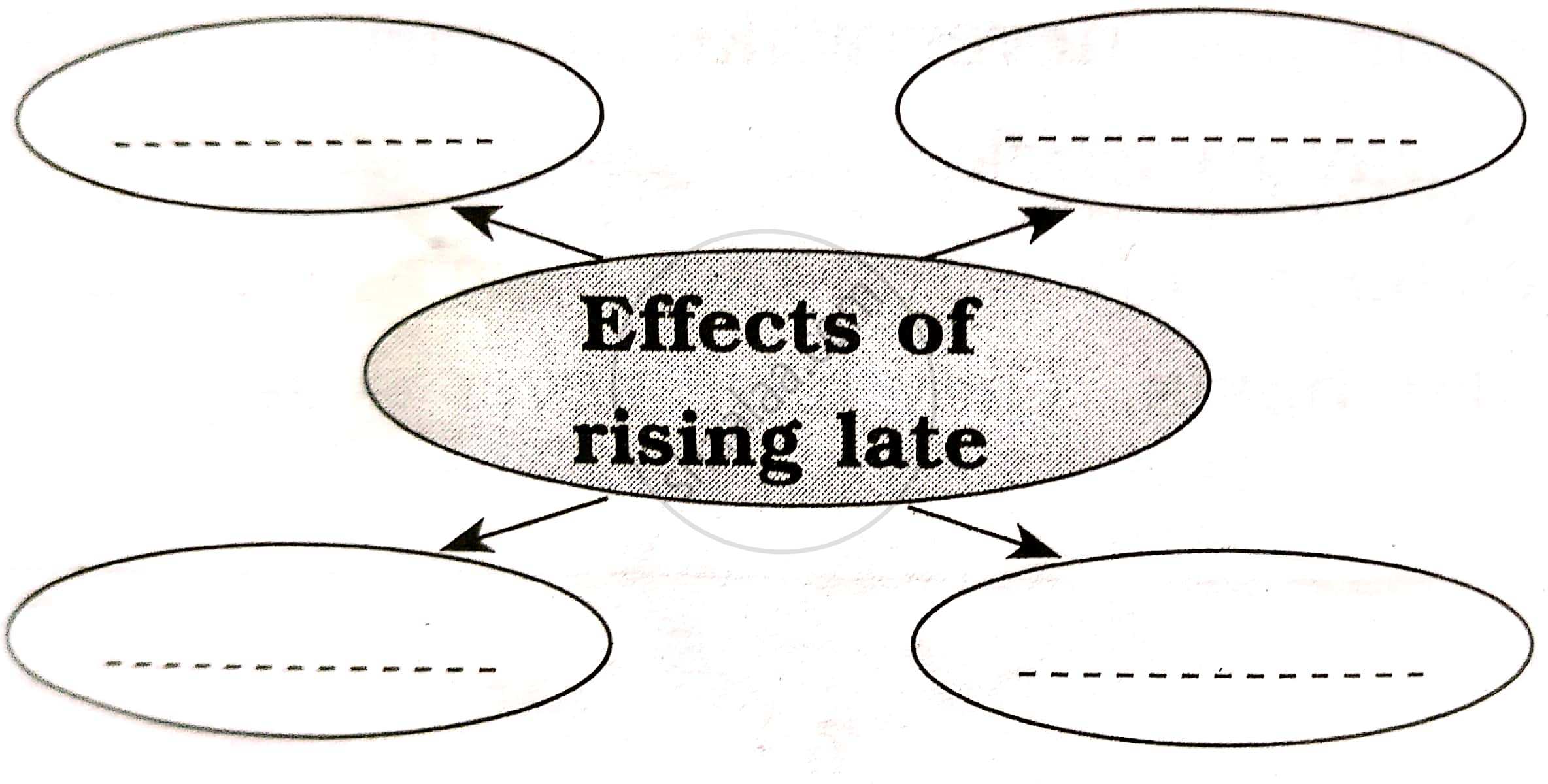
A2. Web :
Complete the following web :
A3. Complete the following statement :
Early risers clearly have the edge in life, because -
(1)
(2)
A4. Vocabulary :
Match the words in column 'A' with their meanings in Column 'B'.
| Column 'A' | Column 'B' |
| (1) justification | (a) dismiss |
| (2) oddities | (b) sleep |
| (3) slumber | (c) strange things |
| (4) shrug off | (d) clarification |
A5. Personal Response:
State two things that you can do to join the early birds' club.
A6. Grammar:
Rewrite the following sentences in the ways instructed :
(1) She felt terrible about this tendency but there was nothing she could do about it. (Rewrite the sentence using 'although'.)
(2) They have never seen a sunrise or met the milkman. (Rewrite using 'neither ... nor'.)
(A) Read the following extract and answer the questions given below:
One afternoon in 1977, as his parents and two brothers fished in the Gulf of Mexico, 12-year old Michael Dell sat on the beach. painstakingly putting together a trotline - a maze of ropes to ''which several fish hooks could be attached."You're wasting your time," the rest of the family called to Michael, as they pulled in fish. "Grab a pole and join in the fun."
Michael kept working. It was dinner time when he finished, and everyone else was ready to call it a day. Still, the youngster
cast the trotline far into the water. anchoring it to a stick that he plunged deep in the sand.
Over dinner, his family teased young Michael about coming away empty-handed. But afterward, Michael reeled in his trotline, and on the hooks were more fish than the others had caught all together!
Michael Dell has always been fond of saying, "If you think you have a good idea, try it!" And today, at 29 he has discovered the power of another good idea that has helped him rise in just a few years from teen to a tycoon. He has become the fourth-largest manufacturer of personal computers in America and the youngest man ever to head a Fortune 500 corporation.
(1) What were Michael Dell’s achievements at his age of 29?
(2) What is the secret of Michael Dell’s Success?
(3) How did Michael surprise his family members?
(4) Do you think trying new ideas can make your life successful? How?
(5) Rewrite the following sentences in the ways instructed:
(i) He has discovered the power of another good idea.
(Rewrite the sentence beginning with 'The power of ...' )
(ii) Michael Dell sat on the beach.
(Rewrite it using past perfect continuous tense.)
(iii) The youngster cast the trotline.
(Frame a Wh-question to get the underlined part as
its answer.)
(6) 'Grab a pole and join in the fun'.
Pick out the contextual meaning of the underlined word from
the options are given below:
(i) smash
(ii) hold firmly
(iii) throw away
Read the following passage carefully:
|
On the basis of your reading of the above passage, answer the following question:
- The Dancing Girl belongs to:
- Mohenjo-Daro
- Greek culture
- Homo sapiens
- Tibet
- In the museum she’s kept among:
- dancing figures
- bronze statues
- terracotta animals
- books
- Which information is not given in the passage?
- The girl is caged behind glass.
- She is a rare artefact.
- School books communicate the wealth of our heritage.
- She cannot be rediscovered as she’s bronze.
- ‘Great Art’ has power because:
- It appeals to us despite the passage of time.
- It is small and can be understood.
- It’s seen in pictures and sketches.
- It’s magnified a million times.
- The jewellery she wears:
- consists of only bangles of shell or ivory or thin metal.
- is a necklace with two pendants.
- both (i) and (ii) are correct.
- neither (i) nor (ii) is correct.
- She reminds us:
- of the never-say-die attitude of humans.
- why museums in our country are exciting.
- why she will make us come into money.
- of dancing figures.
- The synonym of the word “among” in para 1 is ______.
- The size of the dancing girl is equal to the length of the human palm. (True/False)
Read the passage carefully:
|
2.1 On the basis of your understanding of the above passage, answer the following questions in 30-40 words each:
- Write one advantage and one disadvantage of allowing every family member to be part of the decision-making process.
- In today’s world, what are parents asking their kids?
- Which two pieces of advice does the writer give to the parents?
- The passage supports the parents. How far do you agree with the author’s views? Support your view with a reason.
2.2 On the basis of your reading of the above passage, answer the following:
- The synonym of ‘hurt’ as given in paragraph 2 is ______.
- The word, which means the same as a style or method of cooking in paragraph 4, is:
- cuisine
- gourmet
- gastric
- science
- The antonym of ‘agreeable’ as given in paragraph 5 is ______.
- The antonym of ‘simple’ as given in paragraph 6 is:
- difficult
- complicated
- easy
- tricky
Read the passage given below carefully and answer the questions that follow.
1. Overpowering prey is a challenge for creatures that do not have limbs. Some species like Russell's viper inject poison. Some others opt for an alternative non-chemical method – rat snakes, for instance, catch and push their prey against the ground, while pythons use their muscle power to crush their prey to death. But snakes can't be neatly divided into poisonous and non-poisonous categories.
2. Even species listed as non-poisonous aren't completely free of poison. The common Sand Boa, for instance, produces secretions particularly poisonous to birds. So the species doesn't take any chance – it crushes its prey) and injects poison as an extra step.
3. Do vipers need poison powerful enough to kill hundreds of rats with just one drop? After all, they eat only one or two at a time.
4. While hunting animals try their worst to kill most efficiently, their prey uses any trick to avoid becoming a meal, such as developing immunity to poison.) For instance, Californian ground squirrels are resistant to Northern Pacific rattlesnake poison.
5. Competition with prey is not the only thing driving snakes to evolve more and more deadly poison. Snakes also struggle to avoid becoming prey themselves.
6. Some snake killers have partial immunity to poison. Famously, mongooses are highly resistant to cobra poison, and with their speed and agility, kill snakes fearlessly. It would be the death of cobras as a species if they didn't evolve a more deadly poison to stop mongooses.
7. Poison has another important role. It's an extreme meat softener, specific enzymes break up the insides of the prey. Normally, a reptile depends on the sun's warm rays to aid digestion.
8. But I wonder if we cannot use venom in our favour. In remote parts of India, local hospitality often involves leather tough meat. I chew and chew until my jaws ache. If I spit it out or refuse, our hosts would be offended, I swallow like a python stuffing a deer down its throat and hope I don't choke. If only I had poison.
(b) How does Sand Boa kill its prey?
(c) There is a constant tussle between the hunting animal and its prey? Why?
(e) What difficulty does the writer face when he is entertained in the remote parts of India?
2.2 On the basis of your reading of the above passage fill in any two of the following blanks.
b. humans
c. a python
d. prey
b. hardens
c. softens
d. breaks down
iii. Californian squirrels are ______________ rattlesnake poison.
a. afraid of
b. helpless against
c. resistant to
d. indifferent to
a. Liquid substances released from glands (para 2)
c. Particular (para 7)
Read the passage given below.
Then all the windows of the grey wooden house (Miss Hilton used to live here. She expired last week.), were thrown open, a thing I had never seen before.
At the end of the day a sign was nailed on the mango tree: FOR SALE.
Nobody in the street knew Miss Hilton. While she lived, her front gate was always locked and no one ever saw her leave or saw anybody go in. So even if you wanted to, you couldn't feel sorry and say that you missed Miss Hilton.
When I think of her house I see just two colours. Grey and green. The green of the mango tree, the grey of the house, and the grey of the high iron fence that prevented you from getting at the mangoes.
If your cricket ball fell in Miss Hilton's courtyard you never got it back. It wasn't the mango season when Miss Hilton died. But we got back about ten or twelve of our cricket balls.
The house was sold and we were prepared to dislike the new owners ever before they came. I think we were a little worried. Already we had one resident of the street who kept on complaining about us to our parents. He complained that we played cricket on the pavment; and if we were not playing cricket he complained that we were making too much noise anyway.
One afternoon, when I came back from school Pal, said, "Is a man and a woman. She pretty pretty, but he ugly like hell". I didn't see much. The front gate was open, but the windows were shut again. I heard a dog barking in an angry way.
One thing was settled pretty quickly. Whoever these people were they would never be the sort of people to complain that we were making noise and disturbing their sleep.
A lot of noise came from the house that night. The radio was going at full volume until midnight when the radio station closed down. The dog was barking and the man was shouting. I didn't hear the woman.
On the basis of your understanding the above passage complete the following statements :
(a) Nobody went into Miss Hilton's house because her front __________.
(b) Her house had only two colours, (i) __________ and (ii) __________.
(c) High iron fence did not let the boys get __________.
(d) They never got it back if their __________ fell into her courtyard.
(e) The boys were ready to dislike the __________.
(f) One resident of the street always __________.
(g) New owners of Miss Hilton's house were (i) __________ and (ii) __________.
(h) A man was shouting, a dog was barking, only __________.
Read the passage given below and answer the questions that follow:
| 1. | A fisherman, enfeebled with age, could no longer go out to sea so he began fishing in the river. Every morning he would go down to the river and sit there fishing the whole day long. In the evening he would sell whatever he had caught, buy food for himself and go home. It was a hard life for an old man. One hot afternoon while he was trying to keep awake and bemoaning his fate, a large bird with silvery feathers alighted on a rock near him. It was Kaha, the heavenly bird. “Have you no one to care for you, grandpa?” asked the bird. “Not a soul.” “You should not be doing such work at your age,” said the bird. “From now on I will bring you a big fish every evening. You can sell it and live in comfort.” True to her word, the bird began to drop a large fish at his doorstep every evening. All that the fisherman had to do was take it to the market and sell it. As big fish were in great demand, he was soon rolling in money. He bought a cottage near the sea, with a garden around it and engaged a servant to cook for him. His wife had died some years earlier. He had decided to marry again and began to look for a suitable woman. |
| 2. | One day he heard the royal courtier make an announcement. Our king has news of a great bird called Kaha,” said the courtier. “Whoever can give information about this bird and help catch it, will be rewarded with half the gold in the royal treasury and half the kingdom!” The fisherman was sorely tempted by the reward. Half the kingdom would make him a prince! |
| 3. | “Why does the king want the bird,” he asked. “He has lost his sight,” explained the courtier. “A wise man has advised him to bathe his eyes with the blood of Kaha. Do you know where she can be found?” “No…I mean …no, no…” Torn between greed and his sense of gratitude to the bird, the fisherman could not give a coherent reply. The courtier, sensing that he knew something about the bird, informed the king. The king had him brought to the palace. |
| 4. | “If you have information about the bird, tell me”, urged the king. “I will reward you handsomely and if you help catch her, I will personally crown you king of half my domain.” “I will get the bird for you,” cried the fisherman, suddenly making up his mind. “But Kaha is strong. I will need help. The king sent a dozen soldiers with him. That evening when the bird came with the fish, the fisherman called out to her to wait. “You drop the fish and go and I never get a chance to thank you for all that you‘ve done for me," he said. “Today I have laid out a feast for you inside. Please alight and come in. Kaha was reluctant to accept the invitation but the fisherman pleaded so earnestly that she finally gave in, and alighted. The moment she was on the ground, the fisherman grabbed one of her legs and shouted to the soldiers hiding in his house to come out. They rushed to his aid but their combined effort could not keep Kaha down. |
| 5. | She rose into the air with the fisherman still clinging to her leg. By the time he realised he was being carried away, the fisherman was too high in the air to let go. He hung on grimly, and neither he nor Kaha was ever seen again. |
Based on your understanding of the above passage, answer the questions.
- Why did the fisherman start fishing in the river?
- How did the fisherman spend the day before he met Kaha?
- How did the fisherman betray Kaha?
- Why was the fisherman doubtful about revealing information about Kaha to the courtier?
Read the given case-based passage carefully and answer the questions that follow.
|
Case study of museums |
|
| 1. |
We don’t go to museums. We prefer malls, cinema halls, and restaurants. Visiting a museum is best left to schools which makes it mandatory. After all, it is an academic exercise. And what entertainment can these places possibly offer? India doesn’t boast the greatest of museums, but one can’t doubt the collection of artefacts in these repositories of heritage, even for a second. Our eventful history has handed down us numerous masterpieces, but unfortunately, we don’t find them compelling enough. A cultural historian and museologist Jyotindra Jain says that the habit of going to museums has just not been inculcated in us. One of the best museums in the country, the National Museum in Delhi charges a mere Rs. 20. According to Joyoti Roy, outreach consultant, National Museum, it receives between 6,00,000 to 7,00,000 visitors each year and anything between 2,500 and 3,000 per day. The mix includes Indians, foreigners, and school students. For an Indian museum, it is an astounding figure, but still nowhere close to the footfalls museums, we consider the finest, get. |
| 2. | It has not been many days since the National Gallery of Modern Art, Bangalore, hosted A. Ramachandran’s expansive retrospective covering five decades of his artistic journey. As we sat outside the first-floor gallery after Ramachandran walked me through his sketches, sculptures, and paintings, the senior artist, a bit disappointed said, “Had an exhibition of this scale taken place abroad, people would have come in thousands.” There were about three-five visitors inside the gallery at that time. Jain, who has also helmed institutions like the Crafts Museum and Indira Gandhi National Centre for the Arts in Delhi, puts the onus on museums. “We developed the museums but didn’t evolve the infrastructure around it. And it is the museum’s responsibility to do it. When you know, people are not going to come to you, you must go to them. Crafts Museum shares its wall with India Trade Promotion Organisation. It receives lakhs of people during the trade fair. I fought tooth and nail to get that door opened during my tenure (1984-89) so that the visitors spill over to the Crafts Museum as well. Museums need to rethink their strategies and outreach should be a major point of concern for them.” |
| 3. | In 2010, UNESCO brought out a report on the terrible conditions at India’s top eight museums, citing substandard maintenance, lighting, and signage, among other issues. The Ministry of Culture put together a 14 - point museum reforms agenda and things have moved forward since then. Dr Bhau Daji Lad Museum, the oldest museum in Mumbai has received 3,00,000 visitors over the past year. On average, the museum witnesses 500 visitors every day, with an average of 2,000 visitors over weekends. Not big numbers again, but impressive enough in the Indian context. And this is when the museum re-emerged after a revamp in 2008 with an extensive exhibition programme. Collaborations, screenings of movies of different genres, and workshops for adults and children contributed to the increase in the number of footfalls. The public-private partnership model of the museum is unique and can be replicated in other cases as well. |
| 4. | Robust publicity of exhibitions and creating links between different art spaces can also fetch the audience. Different art institutions located in proximity can host a series of events to be held in each one of them simultaneously. Museums also need to transform their cafes, upgrade their museum shops, and most importantly, invest in their human resource. So, what do we do until then? Let’s go and explore these storehouses of history, culture, and knowledge because unless and until we claim them, they will remain indifferent to our needs. |
After studying the case study of museums, answer the following questions.
- What according to the author is the reason for fewer footfalls in the museums in India?
- What measures are suggested in the passage to multiply the visitors to the museums?
- What was the proposition given by A. Ramachandran during his tenure at Crafts Museum?
- Between the National Museum of Delhi and Dr. Bhau Daji Lad Museum, which museum has more footfall on daily basis? Justify using statistics provided in the study.
Read the passage given below.
|
5 |
Technology is making advancements at a rapid rate but at the cost of a valued tradition - the crafts industry. The traditional crafts industry is losing a lot of its trained and skilled craftsmen. With that, the art of embellishing brass and copper utensils with fine engravings is also disappearing. The government has identified around 35 crafts as a languishing craft. |
|
10 |
The speciality of handcrafted items is their design, an association with long traditions belonging to a specific region. The word ‘handcrafted’ does not imply the involvement of dexterous human fingers or an agile mind with a moving spirit anymore. Lessening drudgery, increasing production and promoting efficiency have taken precedence. The labour-saving devices are taking the place of handcrafted tools and this has jeopardized the skills of these artisans. |
|
15 |
Mechanisation has made its way into everything - cutting, polishing, edging, designing etc. Ideally, the use of machinery should be negligible and the handicrafts should be made purely by hand with a distinguishable artistic appeal. However, with the exception of small-scale industries, the export units are mostly operated by machines. The heavily computerised designs contribute to faster production at lower costs. |
|
20 |
Although mechanization of crafts poses a challenge to safeguarding traditional crafts, the artisans are lured with incentives in order to impart handicrafts training. Some makers do see machines as a time-saving blessing since they are now able to accomplish difficult and demanding tasks with relative ease. These machines might give a better 25finesse to these products but they don’t stand out as handcrafted. The quantity has overtaken quality in this industry. |
|
30 |
A need to highlight the importance of the handmade aspect is required by both the government and private sectors, in order to amplify awareness and also support the culture of making handicrafts. A few artisans are still trying their best to rejuvenate and revive their culture and heritage but it’s an uphill task competing with the machine-made goods. A multitude of artisans have changed their professions and are encouraging their progeny to follow suit. There are others who have stayed their ground but are clearly inclined towards buying machines. |
|
35 |
Nearly two decades ago, there were around 65 lakh artisans in the country. Three years ago, when the government started the process of granting a unique number to the artisans based on the Aadhaar card, 25 lakhs were identified. Loss of traditional crafts is clearly a worrying issue, but it stands to reason that forcing any artisan to follow old ways when concerns of livelihood overrule other considerations, is unfair. |
Based on your understanding of the passage, answer the questions given below.
- What does the writer mean by calling handicrafts a ‘valued tradition’?
- Rewrite the following sentence by replacing the underlined phrase with a word that means the same from lines 5-15.
If it continues, the workcation (work + vacation) trend will be a powerful boost to domestic tourism operators failing to make progress in the economic slump caused due to the pandemic. - State any two reasons why artisans are choosing to work via machines rather than handcrafted tools.
- Why do the artisans need to be ‘lured with incentives’ to impart handicrafts training?
- List one likely impact of the support of government and private sectors towards the culture of making handicrafts.
- How does the writer justify an artist’s act of abandoning her/his traditional craft for a more lucrative option?
Read the following passage and do the activities.
|
November 4, 1851. Dear Brother John Honston, When I came to Charleston day before yesterday, I learned that you were anxious to sell the land where you live, and move to Missouri. I have been thinking of this ever since, and cannot but say such an idea is quite foolish. What can you do in Missouri better than here? Is the land any richer? Can you, there, any more than here, raise com and wheat without work? Will anybody there, any more than here, do your work for you? If you intend to go to work, there is no better place than right where you are; if you do not intend to work, you cannot get along anywhere. Crawling about from place to place can do you no good. You have raised no crop this year. What you really want is to sell the land, get the money and spend it. Part with the land you have and my life upon it-never after will you own a spot big enough to bury you. Half of what you will get for the land, you will spend in moving to Missouri, and the other hall you will eat, drink, wear out and no foot of land will be brought. Now I feel it my duty to have no hand in such a piece of foolery. Now do not misunderstand this letter. I do not write it in any unkindness. I write it in order, if possible, to get you to face the truth which truth is, you are poor and needy because you have idled away your time. Your thousand excuses for not getting along better are all nonsense. They deceive nobody but yourself. To go to work is the only cure for your case. Affectionately, |
A1. Answer the following whether True or False:
- Writer came to Charleston
- Writer is Abraham Lincoln
- Letter is for sister Honston
- No crop was raised
A2. How, according to Lincoln, would his brother spend the money coming from selling the land?
A3.
- Find out two words with prefix from the passage.
- Write two different words on your own by using the same prefix.
A4. Do as directed:
- Rewrite the sentence using 'Not only .......... but also'.
She forgot to wish me on my birthday and did not even apologize. - Change the voice:
The workers built the dome.
A5. Lincoln wishes to have no hand in selling the land Justify.
Read the passage and write a summary of it in a paragraph. Suggest a suitable title.
|
Vegetarianism promotes a natural way of life. But despite its implicit message of universal love and nonviolence, it has not spread as it should have. This may be because it usually is an inward looking habit and is best cultivated in the mind. Leading a vegetarian way of life helps the animal kingdom to coexist with man. The animals supply milk, manure and energy. This has been central to Indian culture for thousands of years. A vegetarian lifestyle is natural, multifaceted and helps preservation in a healthy way. Food and health are closely related. Vegetarians are of various types. There are lacto-vegetarians who consume dairy products; Lacto-ovo-vegetarians include eggs in addition to dairy products. Vegans are pure vegetarians who do not consume any food derived from animals. The Western science of food considers food as something to sustain only the human body, whereas Indian science considers food as something which sustains not only the body but also maintains the purity of heart, mind and the soul. Thus, an item of food that is injurious to the mind is not considered to be fit for consumption, even if it is otherwise beneficial to the body or satisfies the taste. Indian food science does not give so much importance to protein or even to a balanced diet but it gives importance to food that increases the strength of the body and its vitality. Vegetarian foods provide an infinite variety of flavours whereas non-vegetarian foods have hardly any taste of their own. In fact, non-vegetarian foods have to be seasoned with ingredients from the vegetable kingdom to make them palatable. |
Read the following passage and do the activities.
A1. Fill in the blanks.
- ______ is the effect of excessive humour.
- ______ and ______ are the qualities of a humorous person.
|
You are endowed with certain naughtiness as a child. Keep it alive. Humour will lighten all tough situations. One who has humour can sail through any conflict. Humour is buffer that saves you from humiliation. Humour brings everyone together, while humiliation tears them apart. In a society tom with humiliation and inSult, humour is like a breath of fresh air. Humour should be coupled with care and concern. Humour can keep the spirit high, yet if overdone, it leaves a bad taste. Humour without wisdom is shallow. Humour without sensitivity is satire-it comes back to you with more problems. The wise use humour to bring wisdom and to lighten situations. The intelligent use humour as a sword to insult others. The irresponsible use humour to escape from responsibility. And fools take humour too seriously! How does one cultivate a sense of humour? Humour is not just words, it is the lightness of your being. You do not have to read and repeat jokes. Humour can be cultivated by taking life not too seriously (because you will never come out of it alive), having a sense of belonging with everybody, including those who are not friendly, practising Yoga and meditation, having unshakable faith in the Divine and in the laws of Karma, being in the company of those who live in knowledge and have a sense of humour. |
A2. How does humour help in building harmony in society?
A3. State the meaning of the following:
- Satire
- To be shallow
A4. Add a question tag to the following sentences.
- You are endowed with certain naughtiness as a child.
- Humour can be cultivated by taking life not too seriously.
A5. How do you think can humour help you to develop a better personality?
Read the passage given below and answer the questions that follow:
|
1. The Higgs boson has been called, or miscalled, the God particle, enabling it to pass into the realm of popular scientific lore, like the discovery of the smallpox vaccine, the structure of DNA, or the theory of relativity. It would be difficult for most people to understand its significance, just as it would be to comprehend the notion of relativity, but such problems are overcome by locating science in personalities as well as cultural and national traditions. The first thing that you and I know about the Higgs boson is that it’s named after Peter Higgs, a physicist at Edinburgh University who made the discovery - although the original insight, in one of those recurrent back stories of science, was Philip Anderson’s. 2. Still, we have Higgs, and Edinburgh, and western civilisation to fall back on. The rest - “the Higgs boson is a hypothetical elementary particle predicted by the Standard Model of particle physics. It belongs to a class of particles known as bosons ...” - we needn’t worry too much about. But maybe we should worry just enough to ask, “What is a boson?” since the word tends to come up as soon as Higgs does. Is it, an ignoramus such myself would ask, akin to an atom or a molecule? It is, in fact, along with the fermion (named after Enrico Fermi), one of the two fundamental classes of subatomic particles. 3. From Bose The word must surely have some European genealogy. In fact, “boson” is derived from Satyendra Nath Bose, an Indian physicist from Kolkata who, in 1924, realised that the statistical method used to analyse most 19th-century work on the thermal behaviour of gases was inadequate. He first sent off a paper on quantum statistics to a British journal, which turned it down. He then sent it to Albert Einstein, who immediately grasped its immense importance, and published it in a German journal. Bose’s innovation came to be known as the Bose-Einstein statistics and became a basis of quantum mechanics. Einstein saw that it had profound implications for physics; that it had opened the way for this subatomic particle, which he named, after his Indian collaborator, “boson.” Still, science and the West are largely synonymous and coeval: they are words that have the same far-reaching meaning. Just as Van Gogh and Toulouse-Lautrec’s paintings digest the Japanese prints they were responding to so we don’t need to be aware of Japanese prints when viewing the post-impressionists, western science is pristine, and bears no mark of what’s outside itself. 4. Other Indian contributions The last Indian scientific discovery that is universally acknowledged is zero. Indians are very strong at maths, and the only modern Indian who’s remotely part of the western mythology of science is Srinivasa Ramanujan, equally well known for his Hindu idiosyncrasies and his agonised stay in Cambridge as he is for his mathematical genius. 5. Indians can be excellent geeks, as demonstrated by the tongue-tied astrophysicist Raj Koothrappalli in the U.S. sitcom Big Bang Theory; but the Nobel prize can only be aspired to by Sheldon Cooper, the super-geek and genius in the series, for whom Raj’s country of origin is a diverting enigma, and miles away from the popular myth of science on which Big Bang Theory is dependent. Bose didn’t get the Nobel Prize; nor did his contemporary and namesake, J.C. Bose, whose contribution to the fashioning of wireless predates Marconi’s. The only Indian scientist to get a Nobel Prize is the physicist C.V. Raman, for his work on a light at Kolkata University. Other Indians have had to become Americans to get the award. 6. Conditions have always been inimical to science in India, from colonial times to the present day; and despite that, its contributions have occasionally been huge. Yet non-western science (an ugly label engendered by the exclusive nature of western popular imagination) is yet to find its Rosalind Franklin, its symbol of paradoxical success. Unlike Franklin, however, scientists were never in a race that they lost; they simply came from another planet. |
Based on your reading of the passage, answer twelve out of fifteen questions that follow:
(a) What is the first thing which the narrator knows about Higgs Boson?
(b) What is Bose-Einstein statistics?
(c) How does Sheldon view Raj’s country of origin?
(d) What do Van Gogh’s paintings do to Japanese prints?
(e) Has India always got credit for its merit?
(f) What do Higgs Boson have in common with Smallpox vaccine?
- Both are used in medical radiography.
- Both are part of scientific myth and legends now.
- Both were met with scepticism on their discovery.
- Both fetched their teams a Nobel prize.
(g) Which statement is not true about Boson?
- They were not discovered by Enrico Fermi.
- They constitute one class of subatomic particle.
- It is named after an Indian Physicist.
- It was discovered by Satyendra Nath Bose.
(h) Choose the word which is an apt synonym of the word Ignoramus. (used in para 2)
- Idiot
- Intelligent
- Idealist
- Ingenious
(i) How are esoteric scientific concepts made understandable for people?
- By printing short introductory courses.
- By comparing it with other scientific discoveries.
- By locating science in personalities, social and cultural traditions. iv. By revising the country’s educational structure.
(j) Based on the reading of the passage, which statements are correct about Higgs Boson.
- They are called God’s particle.
- Philip Anderson’s study provided the original insight.
- This concept is easily understood by common people.
- A physicist from Edinburgh University made the discovery.
- It was discovered by Albert Einstein.
- 1, 2 & 3
- 2, 3 & 5
- 1, 4 & 5
- 1, 2 & 4
(k) Which field of Physics was SN Bose working on?
- Quantum Mechanics
- Electromagnetism
- Geophysics
- Acoustic
(l) Which scientist/mathematician out of the following won the Nobel prize?
- J C Bose
- C V Raman
- Srinivasa Ramanujan
- S N Bose
(m) What is Srinivasa Ramanujan known for in popular culture?
- Mathematical genius.
- For formulation of game theory.
- Hindu Idiosyncrasies.
- Troubled stay in Cambridge.
- For devising another explanation for chaos theory.
- 1, 2 & 3
- 1, 3 & 5
- 1, 3 & 4
- 1, 4 & 5
(n) The conclusion of third paragraph highlights that ______.
- Western art grants recognition to all its inspirations.
- Van Gogh painted Japanese prints.
- Western art subsumes all the influences under it.
- Van Gogh and Toulouse-Lautrec are post-impressionist painters.
(o) Why did JC Bose deserve a Nobel?
- He was an Indian physicist.
- He was the only one researching on wireless.
- His research & findings on wireless started before Marconi.
- He acquired American citizenship.
Read the passage given below.
| 1 | It is generally accepted that leadership development should be a part of the education system's responsibility for preparing individuals to participate in a democratic and progressive society. Many schools, colleges and universities, across nations, provide their students with leadership courses, curricular programs and co-curricular programs that are designed to develop students’ formal knowledge about leadership as well as opportunities and experiences to develop students as leaders and actually practise leadership. Yet, only a handful of studies have sought to understand leader development from the students’ point of view, with students describing their own experiences and what they learned from them in their own words. | ||||||||||||||||||||||||||||||||||||||||||||||||||||||||
| 2 |
A 2014 descriptive study sought to understand student leadership with research through key events via the following research questions:
|
||||||||||||||||||||||||||||||||||||||||||||||||||||||||
| 3 | This study described the rich array of leadership lessons that students are learning through their experiences. It revealed that student leaders are learning foundational leadership skills and competencies that have positively impacted how to accomplish work, how to work with others and how to be both supported by and support others. |
Based on your understanding of the passage, answer the questions given below.
(i) Does the following statement agree with the information given in paragraph 1? (1)
The researcher believes that educational institutions have ideal resources to study impact of leadership skills on young adults.
Select from the following:
- True - if the statement agrees with the information
- False - if the statement contradicts the information
- Not Given - if there is no information on this
(ii) Do you think the researchers of the study aimed to change the students’ outlook towards the development of leadership skills, directly or indirectly? Support your answer with reference to the text. (1)
(iii) Select the option that displays the most likely reason for including Research Question 3 in the 2014 study. (1)
In order to find out if...
- learning opportunities shape students’ overall personality.
- leadership lessons are the result of the designed learning opportunities.
- all learning opportunities cater to a specific lesson.
- certain lessons are common in more than one learning opportunity.
(iv) Complete the sentence based on the following statement. (1)
More than 50% of the identified student respondents were keen to participate in the 2014 study.
We can say this because ______.
(v) Select the option that displays the key event designed with “Balancing Roles” (Table 1) as the objective. (1)
- Students will be able to debate the issue at hand, with different teams.
- Students will be able to manage the responsibilities of a mentor, planner researcher and presenter.
- Students will be able to surmount minor problems and focus on the final goal.
- Students will be able to explain concepts and clarify them for peers.
(vi) Complete the given sentence by selecting the most appropriate option. (1)
The 2014 study attempts to understand student leadership by focussing on ______
- experiences that shaped students’ overall personality.
- lessons gained by students as they grew up.
- relationship of key events with particular lessons.
- students in leadership roles.
(vii) The lessons for ‘Individual competencies’ had a range of responses. (1)
Give one reason why having the least number of responses for ‘Decision Making’, is a matter that needs attention.
(viii) Complete the given sentence by selecting the most appropriate option. (1)
The concluding sentence of the text makes a clear case for ______ by listing it as a core competency for student leadership.
- collaboration
- flexibility
- hard work
- observation
(ix) Complete the sentence appropriately with one/two words. (1)
In the context of “Working with Others” in Table 1, the lesson of ‘Conflict’ refers to ______.
(x) Based on the reading of the text, state a point to challenge the given statement. (1)
When theoretical knowledge about leadership suffices, it is a waste of funds by educational organisations, to organise leadership camps and programmes.
Read the passage given below-
| (1) | Milkha Singh, also known as The Flying Sikh, was an Indian track and field sprinter who was introduced to the sport while serving in the Indian Army. He is the only athlete to win gold in 400 metres at the Asian Games as well as the Commonwealth Games. He also won gold medals in the 1958 and 1962 Asian Games. He represented India in the 1956 Summer Olympics in Melbourne, the 1960 Summer Olympics in Rome and the 1964 Summer Olympics in Tokyo. He was awarded the Padma Shri, India's fourth-highest civilian honour, in recognition of his sporting achievements. |
| (2) | The race for which Singh is best remembered is his fourth-place finish in the 400 metres final at the 1960 Olympic Games. He led the race till the 200 m mark before easing off, allowing others to pass him. Singh's fourth-place time of 45.73 seconds was the Indian national record for almost 40 years. |
| (3) | From beginning that saw him orphaned and displaced during the partition of India, Singh became a sporting icon in the country. In 2008, journalist Rohit Brijnath described Singh as "the finest athlete India has ever produced". |
| (4) | He was disappointed with his debut performance at the 1956 Melbourne Olympics. "I returned to India, chastened by my poor performance in Melbourne. I had been so excited by the prospects of being part of the Indian Olympics team, but, hadn't realized how strong and professional the competition would be. My success in India had filled me with a false sense of pride and it was only when I was on the track that I saw how inconsequential my talents were when pitted against superbly fit and seasoned athletes. It was then that I understood what competition actually meant, and that if I wanted to succeed on the international arena, I must be prepared to test my mettle against the best athletes in the world." |
| (5) | Then he decided to make sprinting the sole focus of his life. "Running had thus become my God, my religion and my beloved". "My life during those two years was governed by strict rules and regulations and a self-imposed penance. Every morning I would rise at the crack of dawn, get into my sports kit and dash off to the track, where I would run two or three miles cross-country in the company of my coach." |
| (6) | On how he pushed himself through the tough days of vigorous training. "I practiced so strenuously that often I was drained of all energy, and there were times when I would increase my speed to such an extent that after my rounds, I would vomit blood or drop down unconscious through sheer exercise. My doctors and coaches warned me, asked me to slow down to maintain my health and equilibrium but my determination was too strong to give up. My only focus was to become the best athlete in the world. But then images of a packed stadium filled with cheering spectators, wildly applauding me as I crossed the finishing line, would flash across my mind and I would start again, encouraged by visions of victory." |
Based on your reading answer any five questions from the six given below: (5)
- What is Milkha Singh known as? What realization did Milkha Singh have when he was on the track during the Melbourne Olympics?
- List any two of Milkha Singh's achievements.
- What strict rules and regulations did Milkha Singh follow?
- State two consequences of his hard and strenuous practice.
- What motivated Milkha Singh to become the best athlete in the world?
- Explain the phrase 'I would start again' in the last sentence.
Read the passage given below:
| (1) | Ratan, a global brand in Dairy products, works on a business model popularly known as, 'The Ratan Model'. This model aims to provide value for money to the customers and protect the interests of farmers simultaneously. | ||||||||||
| (2) | The Ratan model is a three-tiered structure that is implemented in its Dairy production: Firstly, Ratan acts as a direct link between milk producers and consumers that removes the middlemen. Secondly, farmers (milk producers) control procurement, processing and marketing. Thirdly, it is a professionally managed organization. | ||||||||||
| (3) | One can understand the Ratan Model better by taking cognizance of 'Ratan's Target Audience', where it has targeted the mass market of India with no premium offerings and works on providing the best quality products at affordable prices. | ||||||||||
| (4) | So Ratan formulates its pricing policy on the low cost price strategy which has attracted a lot of customers in the past and it continues to do so. | ||||||||||
| (5) | Another stance used by Ratan's Target Audience is based on customer-wise targeting and industry wise targeting. This strategy divides the target audience on the following two bases : | ||||||||||
| (6) |
The above table showcases how Ratan has a diversified customer base. |
||||||||||
| (7) | Industry Based Target Audience: Ratan has segmented milk for various industries such as ice-cream manufacturers, restaurants, coffee shops, and many similar industries. Further, it has segmented butter, ghee and cheese for bakeries, snack retailers, confectioneries, and many more. | ||||||||||
| (8) | The target audience study tells us that Ratan has a strong presence in both Business to Business and Businessto-Customers. | ||||||||||
| (9) | Ratan's marketing campaigns and strategies are implemented in a very attractive way. For example, the story of the 'Ratan Girl' is a popular 'ad' icon. It is a hand drawn cartoon of a young girl. | ||||||||||
Based on your understanding of the passage answer any Six out of the Seven questions given below:
- What does 'The Ratan Model' aim at?
- In dairy production how many tiers are there?
- Ratan acts as a direct link...? Explain.
- "Ratan Target audience is described as a diversified market. Explain with reference to the given table.
- Name the two basis on which Ratan divides the target audience.
- In which two spheres does Ratan have a strong presence?
- Which is the most loved ad icon of Ratan?
Read the following passage and do the activities:
|
Sachin Ramesh Tendulkar who was born on 24th April 1973 in Mumbai is a former Indian International Cricketer and a former captain of the Indian National Team. He is regarded as one of the greatest batsmen of all time and is often referred as the ‘God of cricket’ by Indian Cricket followers. He made his debut on 15th November 1989 against Pakistan in ‘Karachi’ at the age of sixteen. He is the only player to have scored one hundred international centuries and only player to complete more than 30,000 runs in international cricket. He was trained under the able guidance of Ramakant Achrekar Sir. He received the Arjuna Award in 1994, Rajiv Gandhi Khel Ratna Award in 1997, Padma Shri and Padma Vibhushan Awards in 1999 and 2008 respectively, fourth and second highest civilian awards of India. He was also awarded the Bharat Ratna, highest civilian award of India in 2013. He is a devotee of the deity Ganesha. |
A1. Complete the following sentences from the passage: (2)
- Sachin was born on _____.
- Sachin is a devotee of the deity ______.
- He was trained under the able guidance of ______.
- He made debut on ______.
A2. Complete the web diagram: (2)
A3. Match the ‘Synonyms’: (2)
| ‘A’ | ‘B’ | ||
| i. | debut | a. | previous |
| ii. | received | b. | God |
| iii. | former | c. | got |
| iv. | deity | d. | first performance |
A4. Do as directed: (2)
- He made his debut. (Make ‘Simple Future Tense’.)
- He received the Arjuna Award. (Choose the correct Q-tag.)
- did he?
- didn’t he?
- doesn’t he?
A5. Do you like to play games? Why? (2)
Read the following extract and complete the activities given below:
|
The government of India is encouraging medical tourism in the country by offering tax benefits and export incentives to the participating hospitals. Medical visas are being cleared quickly without any hassles. With a view to facilitating the growth of medical tourism industry, the Ministry of Health and Family Welfare along with the Ministry of Tourism has set up a task force to evaluate the opportunities in the industry. Efforts are being made to standardise procedures and to guide foreign patients to select the hospitals most suited to their needs. Meanwhile, several private hospitals are seeking to take advantage of the booming medical tourism industry and are investing hugely in acquiring equipments and skills. However, medical tourism carries some risks that locally provided medical care does not. Some countries like India, Malaysia and Thailand have very different infectious diseases rarely found in Europe and North America. Exposure to disease without having built-up natural immunity can be a hazard for weak individuals specially with respect to gastrointestinal diseases like Hepatitis A, amoebic dysentery etc., which could slow down the recovery process. Also, medical tourists may be at risk from mosquito-transmitted diseases, influenza and tuberculosis. The quality of post-operative care can also vary dramatically depending on the hospital and the country. Finally, after returning home, a patient has limited contact with their surgeon. This may make it difficult to deal with any complications that may arise later, such as a delayed infection. The concept of medical tourism raises some important questions regarding accessibility, affordability and ethics in medical care. It is unfortunate that a large section of the Indian population has little or no access to private health care. Public health care system is inadequate and lacks proper infrastructure and facilities. One wonders if it is sensible to make provisions for medical tourism in a democratic country like India, which has failed to provide nourishment, sanitation and health care to its masses. |
A1. Complete the web: (2)

A2. Complete the following statements with the help of information provided in the extract: (2)
- Building up natural immunity is must for all because ______.
- The concept of medical tourism can not be much successful in India because _______.
A3. Complete the following table with reference to the statement ‘Medical Tourism is a mixed blessing’: (2)
| Positive aspects of Medical Tourism | Hazard/Nagative aspects of Medical Tourism |
||
| 1. | 1. | ||
| 2. | 2. | ||
A4. ‘We need to promote the concept of Wildlife Tourism in India’. State whether you agree or disagree with the statement. Mention any two arguments. (2)
A5. Language study: (2)
(i) ‘Govt. of India is encouraging medical tourism in the country’. ...(Choose the correct present perfect form of the given statement.)
- Govt. of India is encouraged medical tourism in the country.
- Govt. of India had encouraged medical tourism in the country.
- Govt. of India has been encouraged medical tourism in the country.
- Govt. of India has encouraged medical tourism in the country.
(ii) ‘This may make it difficult to deal with any complication’. ...(Identify the replaced version of the statement using the auxiliary of certainty or definiteness.)
- This can make it difficult to deal with any complication.
- This might make it difficult to deal with any complication.
- This will make it difficult to deal with any complication.
- This have made it difficult to deal with any complication.
A6. Identify the words from the passage with the following meaning: (2)
- growing immensely
- threat
- obtaining
- able to approach/possible to approach
Read the passage given below:
|
- Infer one reason for the following based on information in paragraph 1. (1)
The 'blackout' phase is significant ______. - Choose the appropriate option to fill in the blank. (1)
From paragraph 1 & 2, we can infer that there will be ______.
1. no communication with the people.
2. blackout phase.
3. satellite will get no communication.
4. the moon will block the earth.
5. the communication break will be for 15 days.- 1, 2 & 3
- 1, 3 & 4
- 2, 3 & 5
- 3, 4 & 5
- The communication with the satellite will break for approximately ______ days. (1)
- 10
- 15
- 20
- 25
- Complete the following analogy correctly with a word/phrase from paragraph 2: (1)
aroma : cooking : : ______ : space research
(Clue - just like aroma is integral to cooking, similarly __ is/are integral to space research.) - According to ISRO official till 8th July, when Sun will block Mars, ______ signal/signals per day will be sent to the spacecraft. (1)
- no
- considerable
- indefinite
- only for few
- Select the correct option to complete the following sentence: (1)
The ISRO officials are ______ about their control over the spacecraft after the blackout phase.
- doubtful
- apprehensive
- confident
- jittery
- The spacecraft's life was extended by six months because of ______. (1)
- extra fuel
- incomplete work
- lack of communication amongst ISRO officials
- technical problems in its landing
- Read the following sentences: (1)
(A) The blackout was a sudden development.
(B) Because of this, the officials are very nervous about the success of the spacecraft.
- Both (A) & (B) are true.
- Both (A) & (B) are false.
- (A) is true and (B) is false.
- (A) is false and (B) is true.
- Substitute the word 'nonpareil' with one word similar in meaning in the following sentence from paragraph 5. (1)
India managed to get into the nonpareil club of Mars spacecraft in orbit. - The word 'fascination' in the opening sentence means the same as: (1)
- enchantment
- boredom
- disinterest
- ugliness
Read the following passage.
| A | Dirshti was young woman who had always been fascinated by the supernatural. She had read countless books and watched numerous documentaries about ghosts and otherworldly beings. So, when she heard about an abandoned hotel on the outskirts of town that was said to be haunted, she knew she had to investigate. |
| B | One night, Dirshti decided to sneak into the dilapidated hotel with a few of her friends. As they made their way through the dark, eerie corridors, they heard strange noises and felt cold spots. They were convinced that they were not alone. |
| C | Suddenly, they came across a room that was different from the rest. It was filled with old cooking equipment and strange symbols etched into the walls. Drishti felt a chill run down her spine as she entered the room. She knew that this was where the most paranormal activity occurred. As they were examining the room, they heard a loud bang coming from the hallway. They froze in fear, not knowing what was coming their way. They could hear footsteps approaching, and they knew they had to hide. |
| D | They quickly ducked behind some old shelves as the footsteps grew louder. The sound of breathing was getting closer and closer until finally, they saw a figure appear in the doorway. It was a man wearing a chef’s hat, with a face that was twisted in a sinister smile. Drishti and her friends felt their blood run cold as the man approached them. They could feel his cold breath on their faces as he leaned in, whispering in a deep voice, "You shouldn't be here." |
| E | Dirshti and her friends were frozen with fear as they stared into the chef's eyes. But suddenly, the lights flickered on and the figure disappeared. They looked around the room, and everything seemed normal. They had been so scared that they hadn't realized they were in a room with faulty wiring |
| F | Disappointed, they realized that their ghost hunt had been a bust. They left the hotel feeling deflated and let down. They had hoped for an exciting, spine-tingling adventure, but all they got was a scary moment caused by faulty wiring. As they drove home, they couldn't help but feel foolish for getting so worked up over nothing. They had been so convinced that they would find evidence of the paranormal that they had overlooked the simple explanation for the noises they had heard. |
| G | Dirshti learned an important lesson that night. Sometimes, the scariest things are the ones that we create in our own minds. She realized that she didn't need to chase after the supernatural to experience thrills and excitement. The world around her was full of mystery and wonder, and she was content to experience it without the need for ghosts and ghouls. |
Answer the following questions, based on the passage above.
(i) How does the setting contribute to the overall mood and atmosphere of the story? (1)
-
- It creates a sense of nostalgia.
- It provides a sense of false security.
- It adds to the suspense in the story.
- It presents a contrast with the real world.
(ii) List two ways, how the disappointment that Drishti and her friends felt after their ghost hunt is analogous to the feeling of waking up from a dream. Answer in 30 -40 words. (2)
(iii) What is the main flaw in Drishti's approach to investigating the haunted hotel? (1)
- She was too focused on finding evidence of the paranormal.
- She was too skeptical and refused to believe in the possibility of ghosts.
- She relied too heavily on other people's accounts of the supernatural.
- She didn't take enough precautions to ensure her safety.
(iv) After which paragraph of the story, would the following paragraph most likely be placed? (1)
They commenced walking through the hotel, Drishti’s torchlight barely illuminating the darkness around her. Suddenly, they heard a loud creaking noise behind them. Drishti whipped around, pointing her flashlight in the direction of the noise. Nothing. Shaken, they all quickened their pace.
(v) Briefly explain (in 30-40 words) any two elements that classify the story as scary (2)
(vi) Substitute the underlined word in the following sentence with a word/ phrase from paragraphs 4- 6, that means the same. (1)
The sound of the footsteps outside the door left her petrified and the rasping breathing added to her horror.
(vii) What is the most significant lesson that Drishti learns from her experience in the haunted hotel? (1)
- The importance of avoiding risk-taking.
- The need to be more sceptical of the supernatural.
- The value of evaluating your weaknesses
- The power of imagination to create suspense.
(viii) Complete the following appropriately. (1)
Based on the use of the word "dilapidated" to describe the hotel in Paragraph 2, we can infer that its condition was ______.
(ix) Complete the sentence appropriately. (1)
If the title, The Hotel Haunting is given to this passage, it would be an inappropriate title, as compared to The Unsettling Encounter at the Abandoned Hotel because ______.
(x) State whether the given assertion is TRUE or FALSE. (1)
The reason Drishti and her friends visited the abandoned hotel was to prove the existence of ghosts.
Read the following text.
| (1) | As a high school student, studying poetry can be a rollercoaster ride. This journey is punctuated by moments of profound appreciation for simpler pieces and intermittent frustration with more complex works. Let's be real here -some poems are just plain confusing and no amount of re-reading seems to help decipher the intended meaning. The puzzlement that results from such instances can be both vexing and demotivating. If solving a riddle is what was intended, then playing Sudoku is a better option. One is led to ponder if obscurity was the goal. |
| (2) | Conversely, some pieces resonate with the reader's soul. Stirring feelings of warmth, happiness, and connection to the world. Often, these compositions centre on themes that are universally understood, such as love, nature, or faith. Being able to actually understand what the poet is trying to say can feel like a little victory and is a welcome relief after grappling with more perplexing poetry. |
| (3) | Then there are poems that are emotionally charged; the ones that make the reader curl up in a ball and cry or jump up and down with joy. One is left in awe of the poet's ability to convey emotion through words. Let’s not forget the downright weird poems. These are the ones that defy categorization and leave the reader to their own devices in attempting to interpret meaning. The author's use of figurative language and unconventional imagery can create a sense of bewilderment that is either intriguing or off-putting. Regardless, the reader can appreciate the uniqueness of the work. |
| (4) | Despite the wide range of emotions and reactions that come with studying poetry, it can be a rewarding pursuit. Not only does reading poetry allow one to appreciate the artistic beauty of the written word but also enables one to develop crucial critical thinking and analytical skills. The process of unlocking a poem's meaning can feel like cracking a code or solving a puzzle but the sense of accomplishment derived from mastering a challenging piece can be deeply gratifying. Finally, impressing an English teacher with a well-analysed poem can be a source of pride and validation. |
| (5) | Overall, studying poetry is like a box of mixed chocolates, you never know what you're going to get. But whether it's complex, emotional, simple, or just downright weird, there's always something to be gained from the experience. So, let's applaud all the poets out there, for making us laugh, cry, scratch our heads, and occasionally feel like a genius. |
Answer the following questions based on the passage above.
i. Which of the following statements best describes the author's attitude towards studying poetry? (1)
-
- Finds poetry to be a frustrating and meaningless endeavor.
- Believes that the emotional rollercoaster of studying poetry is not worth the effort.
- Recognizes the challenges of studying poetry but also acknowledges the rewards it offers.
- Feels that poetry is too obscure and abstract for the average person to appreciate.
ii. What is the tone of the writer in the given lines from paragraph (1)? Rationalise your response in about 40 words. (2)
If solving a riddle is what was intended, then playing Sudoku is a better option. One is led to ponder if obscurity was the goal.
iii. Complete the sentence appropriately. (1)
The author's use of vivid imagery in the paragraph (3), such as "curl up in a ball and cry" and "jump up and down with joy", greatly affects the reader because ______.
iv. The passage includes some words that are opposites of each other. From the sets (a) - (e) below, identify two sets of antonyms: (1)
| (a) intriguing and off-putting | (b) deciphering and interpreting |
| (c) appreciate and applaud | (d) simple and challenging |
| (e) emotions and feelings | |
v. Complete the sentence appropriately. (1)
We can say that the author's tone becomes more neutral and objective when discussing weird poems, compared to other types of poetry because ______.
vi. Based on the reading of the passage, examine, in about 40 words, how studying poetry can be like exploring a new city. (2)
vii. What is the message conveyed by Hina’s experience, in the following case? (1)
Hina spends hours trying to analyze a poem for her assignment and finally feels a sense of accomplishment and pride, once she understands.
- Only those with natural talent for poetry should engage with it.
- Persistence makes studying poetry a rewarding pursuit.
- Study of poetry is guaranteed to impress others.
- The efforts of studying poetry is inversely proportional to the rewards gained.
viii. State whether the following lines display an example of a simple/complex/emotionally charged/downright weird poem. (1)
| The sun rises in the east, A new day begins, a fresh start. Birds chirp, nature wakes up, A peaceful feeling in my heart. |
Read the passage given below:
|
- Infer one reason for the following based on information in paragraph 1. (1)
The 'blackout' phase is significant ______. - Choose the appropriate option to fill in the blank. (1)
From paragraph 1 & 2, we can infer that there will be ______.
1. no communication with the people.
2. blackout phase.
3. satellite will get no communication.
4. the moon will block the earth.
5. the communication break will be for 15 days.- 1, 2 & 3
- 1, 3 & 4
- 2, 3 & 5
- 3, 4 & 5
- The communication with the satellite will break for approximately ______ days. (1)
- 10
- 15
- 20
- 25
- Complete the following analogy correctly with a word/phrase from paragraph 2: (1)
aroma : cooking : : ______ : space research
(Clue - just like aroma is integral to cooking, similarly __ is/are integral to space research.) - According to ISRO official till 8th July, when Sun will block Mars, ______ signal/signals per day will be sent to the spacecraft. (1)
- no
- considerable
- indefinite
- only for few
- Select the correct option to complete the following sentence: (1)
The ISRO officials are ______ about their control over the spacecraft after the blackout phase.
- doubtful
- apprehensive
- confident
- jittery
- The spacecraft's life was extended by six months because of ______. (1)
- extra fuel
- incomplete work
- lack of communication amongst ISRO officials
- technical problems in its landing
- Read the following sentences: (1)
(A) The blackout was a sudden development.
(B) Because of this, the officials are very nervous about the success of the spacecraft.
- Both (A) & (B) are true.
- Both (A) & (B) are false.
- (A) is true and (B) is false.
- (A) is false and (B) is true.
- Substitute the word 'nonpareil' with one word similar in meaning in the following sentence from paragraph 5. (1)
India managed to get into the nonpareil club of Mars spacecraft in orbit. - The word scarcity in the passage means the opposite of: (1)
- excess
- plenty
- inadequacy
- surplus
Read the passage given below and answer the questions that follow:
| 1. | The man with the white face entered the carriage at Rugby. He moved slowly in spite of the urgency of his porter, and even while he was still on the platform I noted how ill he seemed. He dropped into the corner over against me with a sigh, made an incomplete attempt to arrange his travelling shawl and became motionless, with his eyes staring vacantly. Presently he was moved by a sense of my observation, looked up at me, and put out a spiritless hand for his newspaper. Then he glanced again in my direction. I feigned to read. I feared I had unwittingly embarrassed him, and in a moment I was surprised to find him speaking. |
| 2. | "I beg your pardon?" said I. "That book," he repeated, pointing a lean finger, "is about dreams." "Obviously," I answered, for it was Fortnum Roscoe's Dream States, and the title was on the cover. He hung silent for a space as if he sought words. "Yes," he said at last, "but they tell you nothing." I did not catch his meaning for a second. "They don't know," he added. I looked a little more attentively at his face. "There are dreams," he said, "and dreams." That sort of proposition I never dispute. "I suppose--" he hesitated. "Do you ever dream? I mean vividly." "I dream very little," I answered. "I doubt if I have three vivid dreams in a year." "Ah!" he said and seemed for a moment to collect his thoughts. "Your dreams don't mix with your memories?" he asked abruptly. "You don't find yourself in doubt; did this happen or did it not?" "Hardly ever. Except just for a momentary hesitation now and then. I suppose few people do." "Does he say--?" He indicated the book. "Says it happens at times and gives the usual explanation about intensity of impression and the like to account for its not happening as a rule. I suppose you know something of these theories--" "Very little--except that they are wrong." |
| 3. | His emaciated hand played with the strap of the window for a time. I prepared to resume reading, and that seemed to precipitate his next remark. He leant forward almost as though he would touch me. "Isn't there something called consecutive dreaming--that goes on night after night?" "I believe there is. There are cases given in most books on mental trouble." "Mental trouble! Yes. I daresay there are. It's the right place for them. But what I mean--" He looked at his bony knuckles. "Is that sort of thing always dreaming? Is it dreaming? Or is it something else? Mightn't it be something else?" |
| 4. | I should have snubbed his persistent conversation but for the drawn anxiety of his face. I remember now the look of his faded eyes and the lids red stained--perhaps you know that look. "I'm not just arguing about a matter of opinion," he said. "The thing's killing me." "Dreams?" "If you call them dreams. Night after night. Vivid!—so vivid . . . this--" (he indicated the landscape that went streaming by the window) "seems unreal in comparison! I can scarcely remember who I am, what business I am on . . . ."He paused. "Even now--" "The dream is always the same--do you mean?" I asked. "It's over." "You mean?" "I died." "Died?" |
| 5. | "Smashed and killed, and now, so much of me as that dream was, is dead. Dead forever. I dreamt I was another man, you know, living in a different part of the world and in a different time. I dreamt that night after night. Night after night I woke into that other life. Fresh scenes and fresh happenings--until I came upon the last--" "When you died?" "When I died." "And since then--" "No," he said. "Thank God! That was the end of the dream.. . " |
| 6. | It was clear I was in for this dream. And after all, I had an hour before me, the light was fading fast, and Fortnum Roscoe has a dreary way with him. "Living in a different time," I said: "do you mean in some different age?" "Yes." "Past?" "No, to come--to come." "The year three thousand, for example?" "I don't know what year it was. I did when I was asleep, when I was dreaming, that is, but not now--not now that I am awake. There's a lot of things I have forgotten since I woke out of these dreams, though I knew them at the time when I was--I suppose it was dreaming. They called the year differently from our way of calling the year . . . What did they call it?" He put his hand to his forehead. "No," said he, "I forget." He sat smiling weakly. For a moment I feared he did not mean to tell me his dream. As a rule, I hate people who tell their dreams, but this struck me differently. I proffered assistance even. "It began--" I suggested. |
| 7. | "It was vivid from the first. I seemed to wake up in it suddenly. And it's curious that in these dreams I am speaking of I never remembered this life I am living now. It seemed as if the dream life was enough while it lasted. Perhaps--But I will tell you how I find myself when I do my best to recall it all. I don't remember anything clearly until I found myself sitting in a sort of loggia looking out over the sea. I had been dozing, and suddenly I woke up--fresh and vivid--not a bit dreamlike—because the girl had stopped fanning me." |
On the basis of your reading of the above excerpt, choose the correct option to answer the following questions:
- How did the man with the white face behave as he entered the carriage? (1)
- Excited and enthusiastic
- Scared
- Excited and nervous
- showed no enthusiasm
- What was the name of the book which the narrator was reading? (1)
- Fortnum Roscoe's Dream States
- Dream States
- Dreams of the States
- State of the Dream
- What was the man’s opinion about the theory of dreams given in the narrator’s book? (1)
- He felt that it was all correct.
- He felt the book painted a wrong picture.
- He felt that the book explained nothing.
- He felt that the book was confusing.
- Statement 1: The narrator couldn’t snub the man’s conversation.
Statement 2: The man with the white face looked anxious. (1)
- Both 1 & 2 are correct and 2 is the reason for 1.
- Both 1 & 2 are correct and 2 is not the reason for 1.
- 1 is correct and 2 is incorrect.
- Both 1 & 2 are incorrect.
- What is NOT the reason for narrator being interested in listening to the man’s description of his last dream? (1)
- The man’s dream was about an alien.
- It was getting dark.
- The narrator had still an hour’s journey left.
- His book was getting boring.
- What did the man NOT say about the last dream which he had? (1)
- It was a dream which wasn’t clear.
- He was sitting in the loggia.
- His last dream was very clear.
- He would wake up in these dreams suddenly.
- Which of the following is NOT true for the Man with the white face? (1)
- He moved around slowly.
- He looked sickly.
- He didn’t want to talk about his dream.
- He didn’t believe in theories of Fortnum Roscoe's Dream States.
- "I dream very little," I answered. "I doubt if I have three vivid dreams in a year. This line highlights that the narrator did not – (1)
- Have normal dreams.
- Good sleep pattern.
- Give much importance to the science behind dreams.
- like talking to the man with the white face.
- How does the use of vivid and descriptive language in the passage enhance the reader's understanding of the man's experience? (1)
- Complete the sentence appropriately. (1)
It is fair to say that the man's experience of consecutive dreaming is similar with being lost in a maze because ______. - Choose the right answer which explains the phrase: (1)
He hung silent for a space as if he sought words.
- he was at a loss of words.
- he was indecisive.
- he was left hanging because of his indecisiveness.
- he stayed silent for some time as if he searched for words.
- State whether the following opinion is TRUE or FALSE. (1)
The author implies that memory and consciousness are not objective, but rather are shaped by our subjective experiences and perceptions. - What does the man with the white face, most likely mean by "there are dreams, and dreams"? (Reference - paragraph 2) (1)
- What do the man's "vacant" stare and "spiritless" hand suggest about his condition? (1)
- In paragraph 2, the narrator says, “I did not catch his meaning for a second.”
Which of the following expressions correctly display the usage of “catch”? (1)- catch a glimpse
- catch a hunger
- catch an anger
- catch a skill
Read the following passage carefully:
|
(1) Plastic pollution has become one of the most pressing environmental issues, as rapidly increasing production of disposable plastic products overwhelms the world’s ability to deal with them. Plastic pollution is most visible in developing Asian and African nations, where garbage collection systems are often inefficient or nonexistent. But the developed world, especially in countries with low recycling rates, also has trouble properly collecting discarded plastics. Plastic trash has become so ubiquitous that it has prompted efforts to write a global treaty negotiated by the United Nations. (2) Plastics made from fossil fuels are just over a century old. Production and development of thousands of new plastic products accelerated after World War II. It transformed the modern age so much that life without plastics is unrecognizable today. Plastics revolutionized medicine with life-saving devices, made space travel possible, lightened cars and jets-saving fuel and pollution- and saved lives with helmets, incubators, and equipment for clean drinking water. (3) The conveniences plastics offer, however, led to a throw-away culture that reveals the material’s dark side: today, single-use plastics account for 40 percent of the plastic produced every year. Many of these products, such as plastic bags and food wrappers, have a lifespan of mere minutes to hours, yet they may persist in the environment for hundreds of years. (4) Most of the plastic trash in the oceans, Earth’s last sink, flows from land. Trash is also carried to sea by major rivers, which act as conveyor belts, picking up more and more trash as they move downstream. Once at sea, much of the plastic trash remains in coastal waters. But once caught up in ocean currents, it can be transported around the world. (5) Millions of animals are killed by plastics every year, from birds to fish to other marine organisms. Nearly 700 species, including endangered ones, are known to have been affected by plastics. Nearly every species of seabirds eats plastics. Most of the deaths of animals are caused by entanglement or starvation. Seals, whales, turtles, and other animals are strangled by abandoned fishing gear or discarded six-pack rings. (6) The solution is to prevent plastic waste from entering rivers and seas in the first place, many scientists and conservationists – including the National Geographic Society – say. This could be accomplished with improved waste management systems and recycling, better product design that takes into account the short life of disposable packaging, and reduction in manufacturing of unnecessary single-use plastics. |
Answer the following questions, based on the above passage:
- Which of the following statements best describes the reason why plastic pollution has become one of the most pressing environmental issues?
- Plastic trash collection systems have become inefficient or nonexistent.
- Rapidly increasing production of disposable plastic products overwhelms the world’s ability to deal with them.
- Some plastics have a lifespan of mere minutes to hours, yet they may persist in the environment for hundreds of years.
- The developed world, especially in countries with low recycling rates, has trouble properly collecting plastics.
- What is the tone of the writer in the given lines from paragraph 2? Rationalise your response in about 40 words.
‘It transformed the modern age so much that life without plastics is unrecognizable today.' - The passage includes some words that are opposites of each other. From the sets (A) – (E) below, identify two sets of synonyms.
- garbage and trash
- starvation and strangled
- disposable and reductio
- persist and downstream
- transformed and revolutionized
- Complete the sentence appropriately:
The writer says that most of the plastic trash is found in the Earth’s last sink and the reason it is transported around the world is _______. - Based on the reading of the passage, examine, in about 40 words, the downside of the convenience that plastic offers.
- Complete the sentence appropriately:
According to conservationists, the two ways in which most of the deaths of animals are caused are _______. - Based on the passage, how can we contribute to the reduction of plastic waste?
- by internationalising the waste management system
- by minimizing the use of single-use plastics
- by not abandoning fishing gear
- by not using helmets made of plastic
- State one reason why plastic pollution is most visible in developing Asian and African nations.
Read the following passage carefully:
|
(1) Rotation of crops is a universal phenomenon which is practised by most of the farmers of the tropical and temperate countries. The main objective of rotation of crops is to obtain higher agricultural returns on the one hand, and to maintain the soil fertility on the other. (2) In other words, the rotation of crops helps in making agriculture more sustainable. The importance of crop rotation is more in the areas where farmers grow two, or more than two crops in the same field in a year. Irrigation facilities have also been appreciably developed in the country during the last three decades. The availability of water to the arable land has helped in the intensification of agriculture. (3) In the areas such as Punjab and Haryana, where the Green Revolution is a big success, one soil exhaustive crop (rice) is followed by another soil exhaustive crop (wheat). Subsequently, the field vacated by wheat is devoted to either rice or maize or cotton. Thus, in one year, the farmers are harvesting three soil exhaustive crops from the same field. Such a rotation of crops may fetch more income to the farmers, but depletes the soil fertility at a faster pace. (4) A number of field studies were conducted to assess the traditional crop rotation pattern. One such field study about the changes in the rotation of crops was conducted in the village Banhera (Tanda), Haridwar district. The main rotation of crops of the village is shown in the table below. |
| Traditional Rotation of Crops (1960-65) in Banhera (Tanda) | ||||
| Year | Kharif (mid-June to mid-October) | Rabi (mid-October mid-April) | Zaid (April to June) | No. of days land left fallow |
| 1960 | Millet/fodder/rice | Gram | Fallow | 90 |
| 1961 | Fallow | Wheat | Fallow | 210 |
| 1962 | Millet/fodder/rice | Gram | Fallow | 90 |
| 1963 | Fallow | Wheat | Fallow | 210 |
| 1964 | Millet mixed with urad/fodder/rice | Gram | Fallow | 90 |
| 1965 | Fallow | Wheat | Fallow | 210 |
Answer the following questions, based on the above passage:
- Fill in the blanks with the appropriate option from those given in brackets, based on your understanding of para 2.
One of the reasons that there has been an intensification of agriculture in the country is the development of irrigation facilities is a/an ______ (fact/opinion) because it is a/an ______ (subjective judgement/objective detail). - Based on your understanding of paras 1 and 2, state whether the following statement is true or false.
If proper irrigation facility is provided, higher agricultural returns can be obtained by making crop rotation more sustainable. - Justify the following in about 40 words.
Crop rotation may fetch more income to the farmers, but depletes the soil fertility at a faster pace. - Based on the table, mention the years when the land was left fallow for maximum number of days.
- The study conducted in village Banhera (Tanda) reflects that during the years 1960 to 1965, from April to June, the land was left fallow or uncultivated throughout. State any one inference that can be drawn from this.
- Select the option that correctly states the significance of crop rotation as given below:
- Crop rotation is done to obtain higher agricultural returns.
- Higher agricultural returns can be obtained by harvesting soil-exhaustive crops.
- Crop rotation demands that land should be left fallow for a few months to increase the fertility of soil.
- Better irrigation facility to the arable land has helped in the intensification of agriculture.
- If crops to be harvested are chosen wisely, crop rotation can help in maintaining fertility of soil.
- (1), (2) and (4)
- (1) only
- (3) and (5)
- (1) and (5)
- Crop rotation is helping in making agriculture more sustainable. Mention one benefit and one drawback of crop rotation. (Answer in about 40 words)
- Which of the following is the main takeaway from the study mentioned in the passage?
- The study needs to include more valid data to support the practice of crop rotation
- Crop rotation is a sustainable practice that can transform the agricultural sector.
- The impact of crop rotation on farmer’s upliftment has been thoroughly explained.
- Crop rotation is independent of the type of crops harvested and availability of water for irrigation.
Read the following passage and do the activities:
A1. Complete the following sentences from the passage: (2)
- Kalam earned a degree in ______ engineering.
- DRDO stands for ______.
- Kalam was ______ of the SLV-III, the first satellite launch vehicle.
- Kalam served as lecturer at ______.
|
A.P.J. Abdul Kalam, in full Avul Pakir Jainulabdeen Abdul Kalam, (born October 15, 1931, Rameshwaram, India - died July 27, 2015, Shillong), Indian scientist who played a leading role in the development of India's missile and nuclear weapons programmes. He was President of India from 2002 to 2007. Kalam earned a degree in aeronautical engineering from the Madras Institute of Technology and in 1958 joined the Defence Research and Development Organisation (DRDO). In 1969, he moved to the Indian Space Research Organisation, where he was project director of the SLV-III, the first satellite launch vehicle that was both designed and produced in India. Rejoining DRDO in 1982, Kalam planned the programme that produced a number of successful missiles, which helped earn him the nickname “Missile Man”. Among those successes was Agni, India's first intermediate-range ballistic missile, which incorporated aspects of the SLVIII and was launched in 1989. Kalam remained committed using science and technology to transform India into a developed country and served as lecturer at several universities. Kalam wrote several books, including an autobiography, Wings of Fire (1999). He received the Padma Bhushan (1981), Padma Vibhushan (1990), Indira Gandhi award for National Integration (1997) and the India's highest civilian award Bharat Ratna (1997). |
A2. Complete the web diagram: (2)

A3. Fill in the blanks by using the suitable phrases/words from the bracket: (2)
[moved to, served as, launched, autobiography]
- Mr. Gunaji has ______ a Principal in this college.
- “The Story of My Experiments with Truth” is the ______ of Mahatma Gandhi.
- My teacher ______ to England for further studies.
- ISRO successfully ______ Chandrayaan-3 mission.
A4. Do as directed: (2)
- Kalam wrote several books. (Frame a Wh-type question to get the underlined part as answer)
- Kalam earned a degree in aeronautical engineering. (Begin the sentence with “A degree in…….)
A5. Who is your role model? Write few lines about him/her. (2)
