Advertisements
Advertisements
Question
Read the following paragraph and answer the questions.
If heat is exchanged between a hot and cold object, the temperature of the cold object goes on increasing due to gain of energy and the temperature of the hot object goes on decreasing due to loss of energy.
The change in temperature continues till the temperatures of both the objects attain the same value. In this process, the cold object gains heat energy and the hot object loses heat energy. If the system of both the objects is isolated from the environment by keeping it inside a heat resistant box (meaning that the energy exchange takes place between the two objects only), then no energy can flow from inside the box or come into the box.
i. Heat is transferred from where to where?
ii. Which principle do we learn about from this process?
iii. How will you state the principle briefly?
iv. Which property of the substance is measured using this principle?
Advertisements
Solution
(i) Heat is transferred from the object at higher temperature to the object at lower temperature.
(ii) We learn the principle of heat exchange from this process.
(iii) Principle of heat exchange states that the heat energy lost by hot object is always equal to heat gained by cold object provided that the system of both the objects is isolated.
(iv) Specific heat of an object can be measured using this principle.
RELATED QUESTIONS
50 g of metal piece at 27°C requires 2400 J of heat energy so as to attain a temperature of 327°C . Calculate the specific heat capacity of the metal.
A liquid X has the maximum specific heat capacity and is used as a coolant in Car Radiators. Name the liquid X.
Find the time taken by a 500 W heater to raise the temperature of 50 kg of material of specific heat capacity 960 J kg-1K-1, from 18°C to 38° C. Assume that all the heat energy supplied by the heater is given to the material.
Why do bottled soft drinks get cooled, more quickly by the ice cubes than by the iced water, both at 0℃?
What is the specific heat capacity of boiling water?
What is the unit of heat capacity in CGS system?
A substance is heated at a constant rate from a low temperature to a high temperature. A graph of temperature against time is shown in the figure. Which part or parts of the graph correspond(s) to the substance existing in two states?
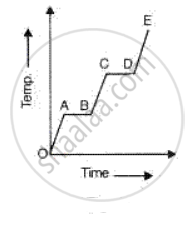
What are other units of heat? Name and define them.
Does the specific heat capacity of a substance depend upon its mass and rise in temperature only?
Explain, Why is it advisabile to pour cold water over burns, caused on human body, by hot solids?
Specific heat capacity of substance A is 3.8 J g-1 K-1whereas the specific heat capacity of substance B is 0.4 J g-1 K-1. Which of the two is a good conductor of heat? How is one led to this conclusion?
The cold object the hot object enclosed in one box of heat-resistant material.
- What changes will occur in the two objects when temperature flows from those objects?
- Which principle can show that the energy exchange takes place between two objects only when kept in isolated system?
If 'Cp' and 'Cv' are molar specific heats of an ideal gas at constant pressure and volume respectively. If 'λ' is the ratio of two specific heats and 'R' is universal gas constant then 'Cp' is equal to ______.
J/Kg °C is the unit of specific heat capacity.
Conductors have generally high specific heat capacities and insulators have low specific heat capacities.
We would like to make a vessel whose volume does not change with temperature (take a hint from the problem above). We can use brass and iron `(β_(vbrass) = (6 xx 10^(–5))/K and β_(viron) = (3.55 xx 10^(–5))/K)` to create a volume of 100 cc. How do you think you can achieve this.
The specific heat capacity of ______ is maximum.
The difference between the two molar specific heats of gas is 9000 J/kg K. If the ratio of the two specific heats is 1.5, calculate the two molar specific heats.
