Advertisements
Advertisements
Question
Read the following extract and answer the questions given below:
That day Reuben fold two sacks, which he took to the rambling wooden factory and sold to the man in charge of packing nails. The boy's hand tightly clutched the small five-cent pieces as he ran two kilometres home.
Near his house stood the ancient barn that housed the family's goats and chickens. Reuben found a rusty baking- soda tin and dropped his coins inside. Then he climbed into the loft of the barn and hid the can beneath a pile of sweet-smelling hay.
It was supper time when Reuben got home. His father sat at the big kitchen table, working on a fishing net. Dora was at the black kitchen range, ready to serve dinner as Reuben took his place at the table.
He looked at his mother and smiled. Sunlight from the window gilded her, shoulder-length blond hair. Five foot three, slim and beautiful, she was the centre of the home, the glue that held it together.
Her chores were never-ending. Sewing clothes for her family on the old Singer treadle machine, cooking meals and baking bread, planting a vegetable garden. milking the goats and scrubbing soiled clothes on a washboru·d. But she was happy. Her family and their wellbeing were her highest priority.
Every day after chores and school, Reuben scoured the town, collecting the burlap nail bags. On the day the two-room schoolhouse closed for the summer, no student was more delighted than Reuben. Now he would have more time to devote to his mission.
(1) What is the main theme of the extract? (1)
(2) Where did Reuben keep his savings? Why? (2)
(3) Describe Reuben's mother and her daily chores. (2)
(4) What would you like to present to your mother on Mother's Day? Why? (2)
(5) Rewrite the following sentences in the ways instructed :
(i) He looked at his mother and smiled.
(Rewrite it as a Simple Sentence.) (1)
(ii) Her family and their well-being were her highest priority.
(Rewrite it in the Positive Degree.) (1)
(iii) She was the centre of the home. (1)
(Make it a Rhetorical Question)
(6) Find out the words from the extract which mean -
(i) dried grass (1/2)
(ii) routine tasks (1/2)
Advertisements
Solution
(1) Ans. The main theme of the extract is to learn from the little boy who has a mission of giving a surprise gift to his mother. The hru-dwork, dedication & feelings that has been expressed is worth learning.
(2) Ans. Reuben had an ancient barn near his house. He found a rusty baking-soda tin and used to drop his coins inside. Then he climbed into the lost of the barn & hid the can beneath a pile of sweet - smiling hay. He had to hide the saved money like this so that he can collect the amount for buying the surprise gift for his mother.
(3) Ans. Reuben's mother had shoulder length blond hair. Five foot three, slim & beautiful, she was the centre of the home. Her chores were never-ending. Sewing clothes for her family on the old Singer-treadle machine, cooking meals & baking bread, planting a vegetable garden, milking the goats and scrubbing soiled clothes on a washboard. Her family & their well being were here highest priority.
(4) Ans. I would like to treat her special not only on Mother's Day infact all days of the year. But certain things I would like to do to make her feel special on this occasion is to surprise her with a bouquet & thank you note on her bed, make a slide show or video of our special moments, cook special meal for her, book a spa to make her feel relaxed as she works for all of us everyday & then plan a movie or a day trip with mom & dad.
(5)
(i) Ans. Looking at his mother, he smiled.
(ii) Ans. For her family & their well-being was on high priority.
(iii) Ans. Was she the centre of the home?
(6)
(i) Ans. hay
(ii) Ans. chores
APPEARS IN
RELATED QUESTIONS
 During the devastating July 2005 floods that hit Mumbai, Rajen Dutia received an urgent call from a relative, Lopa Vyas late in the evening. “A friend’s mother is stranded near your home, Rajen. Can you please take her home? Her name is Rashmi,” Vyas told him.
Mumbai had come to a halt and people were trapped everywhere. Despite power failure and raging rain, Dutia stepped out and made his way to the spot, where he found Rashmi as well as a dozen other people. They were stranded in the dark, shivering in the rain. They all lived far away and had no place to go for the night.
Rajen took all of them to his one-bedroom flat, where he served them dinner and invited them to spend the night.
"By doing so," says Rajen, "I was simply fulfilling my karma, paying the universe back for the good it had done for me."
"God is kind. My daughter had just started her new job that day, and had gone for her training. She was stranded too. While she was trying to get to our relatives, she almost drowned, but a young stranger saved her. He and his friends even dropped her to my relative's place and phoned me to say she was safe. One good turn deserves another."
A2. Order
Look at the following sentences from the passage and put them in the correct sequence: (2)
(a) He took them to his one-bedroom flat.
(b) Rajen found Rashmi as well as a dozen other people shivering in the rain.
(c) Mumbai had come to a halt and people were trapped everywhere.
(d) Rajen Dutia received an urgent call.
A3
During the devastating July 2005 floods that hit Mumbai, Rajen Dutia received an urgent call from a relative, Lopa Vyas late in the evening. “A friend’s mother is stranded near your home, Rajen. Can you please take her home? Her name is Rashmi,” Vyas told him.
Mumbai had come to a halt and people were trapped everywhere. Despite power failure and raging rain, Dutia stepped out and made his way to the spot, where he found Rashmi as well as a dozen other people. They were stranded in the dark, shivering in the rain. They all lived far away and had no place to go for the night.
Rajen took all of them to his one-bedroom flat, where he served them dinner and invited them to spend the night.
"By doing so," says Rajen, "I was simply fulfilling my karma, paying the universe back for the good it had done for me."
"God is kind. My daughter had just started her new job that day, and had gone for her training. She was stranded too. While she was trying to get to our relatives, she almost drowned, but a young stranger saved her. He and his friends even dropped her to my relative's place and phoned me to say she was safe. One good turn deserves another."
A2. Order
Look at the following sentences from the passage and put them in the correct sequence: (2)
(a) He took them to his one-bedroom flat.
(b) Rajen found Rashmi as well as a dozen other people shivering in the rain.
(c) Mumbai had come to a halt and people were trapped everywhere.
(d) Rajen Dutia received an urgent call.
A3(i). Fill in the blanks :
Select the words given in the passage (1)
(i) Thousands Of pilgrims were …………….. due to the cloud burst in Uttarakhand.
(ii) The tiger was ……………… by the hunter.
(ii). Antonyms:
Select the correct antonyms for the given words from the alternatives :
(1) Please :
(a) unplease (b) displease (c) misplease
(2) Safe: '
(a) insafe (b) safeless (c) unsafe
A4(i) Tags :
Select the correct tag for the alternatives given below :
One good turn deserves another.
(a) Doesn’t it? (b) don’t it (c) does it?
(ii). Guess:
Choose the correct answer : (1)
Rajen can you please take her home? ‘Can’ indicates :
(a) Obligation (b) ability (c) permission
A5. Personal Response :
‘ one good turn
Deserves another.’
Explain with an
example of your own.
B1. Choose
Choose the correct alternatives and complete the sentences (2)
(1) The narrator is :
(a) an astronaut
(b) an engineer studying in BITS Pilani
(c) in the team of astronauts.
(2) Armstrong said, 'That's one small step for a man, one giant leap for mankind which means:
(a) one step on the moon means, many steps on the earth.
(b) he felt like a giant on the moon.
(c) one moon mission had opened up many avenues in science and technology for mankind.
It was late evening of July 20. 1969, when we turned up the hostel radio. I was an engineering student at BITS, Pilani. I still remember the feverish excitement that gripped us from July 16 when Apollo 11. the US space rocket, took off from Cape Kennedy, Florida. Neil Armstrong and his team of astronauts, Edwin "Buzz" Aldrin and Michael Collins, were to land on moon, for the first time in human history. We listened 'with rapt attention when Armstrong declared: "That's one small step for a man, one giant leap for mankind."
His death on Saturday, August 25, is a moment to salute the romance of space science that Apollo 11 unleashed. It has changed forever the way we look at our planet Earth and its satellite, the moon.
Standing on powdery moondust, Armstrong put up his thumb, shut one eye and found his thumb blotting out the Earth. "It suddenly struck me that that tiny pea, pretty and blue, was the Earth” he said later. "I felt very, very small." But behind that humbling realisation stood a giant truth:
The effort to explore the universe united mankind in technology and knowledge. Each moon mission, about 110 till date, provided more confidence to take on bolder projects.
B2. Complete (2)
(1) Armstrong describes the earth as ……………
(2) The effort to explore the universe has ………………
(3) Apollo 11 unleashed and changed forever ………………
(4) The author came to know about Apollo 11 mission when he …………..
B3. Solve
Solve the crossword with the clues given below. Refer to the passage for your answers: (2)

Down : (1) The area beyond the earth's atmosphere .
(2) The name of the spacecraft that Armstrong travelled.
Across : (3) A person trained to travel in space.
(4) Y A natural satellite of the earth.
B4. Begin the sentence
(i) With-For the first time .......and rewrite [1]
Neil Armstrong, Edwin Aldrin and Michael Collins were, to land on the moon for the first time.
(ii) Insert 'that' appropriately and rewrite. [1]
Armstrong found his thumb blotting out the Earth.
B5. Personal Response
Would you like to be an astronaut? Give reasons.
The natural life span of a domesticated horse is about 25 – 30 years, 10 years down from what it was in the wild. You can tell a horse’s age from the number of teeth he has. They get all their teeth by the age of 5, after which those teeth just get longer. Horses have close to 360 degree all round vision. The only place they cannot see is directly behind or right in front of themselves, which is why it’s dangerous to stand behind a horse. If they later I it also means that they cannot see a jump once they are about four feet from it, and have to rely on memory as to its height and shape! Each of the horse’s two eyes work independently wherever a horse’s ear points is where the horse is looking. A horse is able to sleep standing up as he is able to lock his leg muscles so that he dosen’t fall asleep. Nor do all horses in the same field ever lie down at once – one animal always stands “on look out” duty.
1) What is the life span of a wild horse?
(2) Why do the horse owners cover their horse’s eyes with blinkers?
(3) What prevents a horse from falling while asleep?
(4)
(a) Falls /shorter/ the mane/ on the/ side/ legged.[Rearrange the words to make a meaningful sentence]
(b) Form antonyms by adding a prefix :
(i) able
(ii) direct
(5)
(a) They get all their teeth by the age of five. [Pick out the prepositions]
(b) If they feel something behind them they may kick. [Rewrite using ‘unless’]
(6) How have horses helped man through the ages?
One of the greatest advances in modern technology has been the invention of computers. They are widely used in industries and in universities. Now there is hardly any sphere of human life where computers have not been pressed into service of man. We are heading fast towards the day when a computer will be as much part of man's daily life as a telephone or a calculator.
Computers are capable of doing extremely complicated work in all branches of learning. They can solve the most complex mathematical problems or put thousands of unrelated facts in order. These machines can be put to varied uses. For instance, they can provide information on the best way to prevent traffic jams. This whole process by which machines can be used to work for us has been called 'automation'. In the future 'automation' may enable human beings to enjoy more leisure than they do today. The coming of automation is bound to have important social consequences.
Some years ago an expert on automation, Sir Leon Bagrit, pointed out that it was a mistake to believe that these machines could 'think'. There is no possibility that human beings will be "controlled by machines". Though computers are capable of learning from their mistakes and improving on their performance, they need detailed instructions from human beings to operate. They can never, as it were, lead independent lives or "rule the world" by making decisions of their own.
Sir Leon said that in future, computers would be developed which would be small enough to carry in the pocket. Ordinary people would then be able to use them to obtain valuable information. Computers could be plugged into a national network and be used like radios. For instance, people going on holiday could be informed about weather conditions. Car drivers can be given alternative routes when there are traffic jams. It will also be possible to make tiny translating machines. This will enable people who do not share a common language to talk to each other without any difficulty or to read foreign publications.
a) What is the greatest advancement in modern technology?
b) What complicated works are computers capable of doing?
c) Write one use of computers.
d) Explain automation.
e) Why can't computers lead independent lives or rule the world?
f) How would computers as translating machines help people?
g) What was the prediction of Sir Leon about computers in the future?
h) How can computers help people going on holiday?
Read the following passage:
In India, eating organic food is more of a style statement than due to health worries because the stuff is expensive. But people who can, do indulge in not only organic vegetables but even organic eggs laid by 'happy hens', who are allowed to roam around freely whereas 'unhappy hens' are kept in coops. Then there are companies that have installed music channels in their cowsheds and the milk from those sheds are sold at a marked up price since it has more nutritional value because the animals are happy thanks to lilting 24×7 music. We don't know yet any farmer using music to improve his crop quality, but then you never know : plants are known to respond to music.
Why such pickiness about food ? These days, the huge number of TV shows and articles that we see and read on food provide bread and butter for the specialist. But instead of decoding food, its sources and what has gone into growing it, isn't it much better to enjoy what's on the plate ?
Complete the statements given below by choosing the correct options from those that follow:
(a) According to a Stanford University study, organic food in relation to conventional food is________.
(i) less nutritious
(ii) more nutritious
(iii) very conventional
(iv) as nutritious
(b) The study will not be welcomed by _________.
(i) farmers of conventional food
(ii) makers of pesticides
(iii) all sectors
(iv) exporters of organic food
(c) We can save some hard cash by _________.
(i) buying organic food
(ii) not buying organic food
(iii) going to the shop
(iv) not buying food with pesticides
(d) Music channels are installed in the cowshed because the _________.
(i) cows then give more milk
(ii) milk is sold at a higher price
(iii) milk becomes more pure
(iv) workers becomes happy
(e) In the second paragraph, the author's attitude to the people who eat food sourced from 'happy' animals is that he _________.
(i) is happy with them
(ii) is unhappy with them
(iii) is laughing at them
(iv) wants crops to be grown similarly
(f) One benefit of organic food is that __________.
(i) it is fashionable to eat
(ii) only rich people can afford it
(iii) it is less contaminated with pesticides
(iv) even poor people can afford it
(g) The word 'contaminated' means ________.
(i) adulterated
(ii) for adults
(iii) containing
(iv) not healthy
Read the passage given below and answer the questions that follow:
If you are addicted to coffee, and doctors warn you to quit the habit, don’t worry and just keep relishing the beverage, because it’s not that bad after all! In fact, according to a new study, the steaming cup of Java can beat fruits and vegetables as the primary source of antioxidants. Some studies state that coffee is the number one source of antioxidants in American diet, and both caffeinated and decaf versions appear to provide similar antioxidant levels.
Antioxidants in general have been linked to a number of potential health benefits, including protection against heart diseases and cancer, but Vinson, a dietitian said that their benefits ultimately depend on how they are absorbed and utilized in the body. The research says that coffee outranks popular antioxidant sources like tea, milk, chocolate and cranberries. Of all the foods and beverages studied, dates actually have the most antioxidants based solely on serving size, but since dates are not consumed anywhere near the level of coffee, the drink comes as the top source of antioxidants, Vinson said.
Besides keeping you alert and awake, coffee has been linked to an increasing number of potential health benefits, including protection against liver and colon cancer, type 2 diabetes, and Parkinson’s disease, according to some recently published studies. The researchers, however, advise that one should consume coffee in moderation, because it can make you jittery and cause stomach pains
(a) What do doctors advise us about the habit of drinking coffee?
(b) What are the two versions of coffee that are drunk in America?
(c) State any two benefits of antioxidants.
(d) What does Vinson say about the consumption of antioxidants?
(e) Name any two popular sources of antioxidants.
(f) How does coffee outrank dates in the level of antioxidants?
(g) Mention any two benefits of coffee.
(h) What do researchers warn us about the excessive use of coffee?
Read the passage given below:
1. I rested for a moment at the door of Anand Bhawan, on Market Road, where coffee-drinkers and tiffin-eaters sat still at their tables, uttering low moans on seeing me. I wanted to assure them, "Don't mind me, you hugging the cash box − you are a coward, afraid even to breathe. Go on, count the cash, if that is your pleasure. I just want to watch, that's all. If my tail trails down to the street, if I am blocking your threshold, it is because, I'm told, I'm eleven feet tip to tail. I can't help it. I'm not out to kill − I'm too full. I found a green pasture full of food on my way. I won't attack until I feel hungry again. Tigers attack only when they feel hungry, unlike human beings who slaughter one another without purpose or hunger."
2. To the great delight of children, schools were being hurriedly closed. Children of all ages and sizes were running helter-skelter, screaming joyously. "No school, no school. Tiger, tiger!" They were shouting and laughing and even enjoying being scared. They seemed to welcome me. I felt like joining them. So I bounded away from the restaurant door. I walked along with them, at which they cried, 'The tiger is coming to eat us; let us get back to school!"
3. I followed them through their school gate while they ran up and shut themselves in the school hall securely. I climbed up the steps of the school, saw an open door at the far end of a veranda, and walked in. It happened to be the headmaster's room. I noticed a very dignified man jumping on the table and heaving himself up into an attic. I walked in and flung myself on the cool floor, having a special liking for cool stone floors.
4. As I drowsed, I was aware of cautious steps and hushed voices all around. I was in no mood to bother about anything. All I wanted was a little moment of sleep; the daylight was very bright.
On the basis of your reading of the above passage, answer the following questions:
(a) How did the diners at Anand Bhawan react on seeing the tiger?
(b) When do tigers attack? In this context, how are human beings different from tigers?
(c) Why were children happy and even enjoying being scared?
(d) What did the headmaster do on seeing the tiger? What did the tiger like to do in the headmaster's office?
(e) Identify the word which means the same as 'hugging'. (Para 1)
(i) counting
(ii) hiding
(iii) rubbing
(iv) holding tightly in the arms
(f) Identify the word which means the same as 'delight'. (Para 2)
(i) pleasure
(ii) fear
(iii) sorrow
(iv) nervousness
(g) Identify the word which means the same as 'dignified'. (Para 3)
(i) tall
(ii) honourable
(iii) terrified
(iv) tired
(ii) jumped forward
(iii) walked with heavy steps
(iv) ran lazily
Read the extract given below and answer the questions that follow :
When I got to New Mullion, my eager expectations of a sweet and simple country village were severely disappointed. Its streets were rivers of mud, with rows of wooden shops, either painted a sour brown, or bare of any paint at all.
(a) Who is 'I'?
(b) Why was 'I' disappointed?
(c) What does the word 'expectations' mean ?
Read the passage given below:
Keeping cities clean is essential for keeping their residents healthy. Our health depends not just on personal hygiene and nutrition, but critically also on how clean we keep our cities and their surroundings. The spread of dengue and chikungunya are intimately linked to the deteriorating state of public health conditions in our cities.
The good news is that waste management to keep cities clean is now getting attention through the Swachh Bharat Mission. However, much of the attention begins and stops with the brooms and the dustbins, extending at most to the collection and transportation of the mixed waste to some distant or not so distant place, preferably out of sight.
The challenge of processing and treating the different streams of solid waste, and safe disposal of the residuals in scientific landfills, has received much less attention in municipal solid waste management than is expected from a health point of view.
One of the problems is that instead of focusing on waste management for health, we have got sidetracked into "waste for energy". If only we were to begin by not mixing the biodegradable component of solid waste (close to 60 percent of the total) in our cities with the dry waste, and instead use this stream of waste for compositing and producing a gas called methane.
City compost from biodegradable waste provides an alternative to farmyard manure (like cow-dung). It provides an opportunity to simultaneously clean up our cities and help improve agricultural productivity and quality of the soil. Organic manure or compost plays a very important role as a supplement to chemical fertilisers in enriching the nutrient-deficient soils. City compost can be the new player in the field.
Benefits of compost on the farm are well-known. The water holding capacity of the soil which uses compost helps with drought-proofing, and the requirement of less water per crop is a welcome feature for a water-stressed future. By making the soil porous, use of compost also makes roots stronger and resistant to pests and decay. Farmers using compost, therefore, need less quantity of pesticides. There is also evidence to suggest that horticulture corps grown with compost have better flavour, size, colour and shelf-life.
City compost has the additional advantage of being weed-free unlike farmyard manure which brings with it the seeds of undigested grasses and requires a substantial additional labour cost for weeding as the crops grow. City compost is also rich in organic carbon, and our soils are short in this.
Farmers clearly recognize the value of city compost. If city waste was composted before making it available to the farmers for applying to the soil, cities would be cleaned up and the fields around them would be much more productive.
Quite apart from cleaning up the cities of biodegradable waste, this would be a major and sustainable contribution to improving the health of our soil without further damage by excessive chemical inputs. What a marvellous change from waste to health!
The good news is that some states are regularly laying plastic roads. Plastic roads will not only withstand future monsoon damage but will also solve a city's problem of disposing of non-recyclable plastic. It is clear that if the mountains of waste from our cities were to be recycled into road construction material, it would tackle the problem of managing waste while freeing up scarce land.
(a) On the basis of your understanding of the above passage, make notes on it using headings and sub-headings. Use recognisable abbreviations wherever necessary (minimum four) and a format you consider suitable. Also supply an appropriate title to it.
(b) Write a summary of the passage in about 80 words.
Read the passage given below and answer the questions that follow:
The most alarming of man’s assaults upon the environment is the contamination of air, earth, rivers, and sea with lethal materials. This pollution is for the most part irrevocable; the chain of evil it initiates is for the most part irreversible. In this contamination of the environment, chemicals are the sinister partners of radiation in changing the very nature of the world; radiation released through nuclear explosions into the air, comes to the earth in rain, lodges into the soil, enters the grass or corn, or wheat grown there and reaches the bones of a human being, there to remain until his death. Similarly, chemicals sprayed on crops lie long in soil, entering living organisms, passing from one to another in a chain of poisoning and death. Or they pass by underground streams until they emerge and combine into new forms that kill vegetation, sicken cattle, and harm those who drink from once pure wells.
It took hundreds of millions of years to produce the life that now inhabits the earth and reached a stage of adjustment and balance with its surroundings. The environment contained elements that were hostile as well as supporting. Even within the light of the sun, there were short wave radiations with power to injure. Given time, life has adjusted and a balance reached. For time is the essential ingredient, but in the modern world is no time.
The rapidity of change and the speed with which new situations are created follow the heedless pace of man rather than the deliberate pace of nature. Radiation is no longer the bombardment of cosmic rays; it is now the unnatural creation of man’s tampering with the atom. The chemicals to which life is asked to make adjustments are no longer merely calcium and silica and copper and all the rest of the minerals washed out of the rocks and carried in the rivers to the sea; they are the synthetic creations of man’s inventive mind, brewed in his laboratories, and having no counterparts in nature.
(a) On the basis of your understanding of the above passage make notes on it using headings and sub-headings. Use recognizable abbreviations (wherever necessary-minimum four) and a format you consider suitable. Also supply a title to it.
(b) Write a summary of the passage in about 80 words.
Read the passage given below and answer the questions that follow:
The most alarming of man’s assaults upon the environment is the contamination of air, earth, rivers, and sea with lethal materials. This pollution is for the most part irrevocable; the chain of evil it initiates is for the most part irreversible. In this contamination of the environment, chemicals are the sinister partners of radiation in changing the very nature of the world; radiation released through nuclear explosions into the air, comes to the earth in rain, lodges into the soil, enters the grass or corn, or wheat grown there and reaches the bones of a human being, there to remain until his death. Similarly, chemicals sprayed on crops lie long in soil, entering living organisms, passing from one to another in a chain of poisoning and death. Or they pass by underground streams until they emerge and combine into new forms that kill vegetation, sicken cattle, and harm those who drink from once pure wells.
It took hundreds of millions of years to produce the life that now inhabits the earth and reached a stage of adjustment and balance with its surroundings. The environment contained elements that were hostile as well as supporting. Even within the light of the sun, there were short wave radiations with power to injure. Given time, life has adjusted and a balance reached. For time is the essential ingredient, but in the modern world is no time.
The rapidity of change and the speed with which new situations are created follow the heedless pace of man rather than the deliberate pace of nature. Radiation is no longer the bombardment of cosmic rays; it is now the unnatural creation of man’s tampering with the atom. The chemicals to which life is asked to make adjustments are no longer merely calcium and silica and copper and all the rest of the minerals washed out of the rocks and carried in the rivers to the sea; they are the synthetic creations of man’s inventive mind, brewed in his laboratories, and having no counterparts in nature.
(a) On the basis of your understanding of the above passage make notes on it using headings and sub-headings. Use recognizable abbreviations (wherever necessary-minimum four) and a format you consider suitable. Also supply a title to it.
(b) Write a summary of the passage in about 80 words
Read the following extract and answer the questions given below:
The Jahangir Art Gallery, the State Bank of lndia building and the canteen close by which offered affordable fare, the amazing street fare, bhelpuri and vadapav. The joy of reading Bombay Times with its page 3 people one would never meet but who seemed like old friends. The Strand bookstore where one could browse for hours. And just when a book was longingly but firmly put down from nowhere, Mr Shanbagh would materialise magically at one's elbow with a special price. Not to forget the joys of trawling the booklined pavements at Fountain, where one could watch the world go by. And wherever I chose to go, there was always my friend, the sea, oh. I loved her, in all her moods, but especially in the monsoon when violent and enraged she splattered Worli seaface with walls of sea spray. My friends are lost, some passed away, some moved away, there were many whose names I never found out, though we took the train together, or met in the lift, every day.
Like every migrant, I promise myself, someday I will return. I may, perhaps, return sometime, but even so, I know, "that one cannot step into the same river twice." You seduced me steadily, o Mumbai, with your glamour and bright lights. City of dreams, tinsel town. I pay tribute to you. Today, I say good-bye with a heavy heart.
(1) What does this extract focus on?
(2) Which mood of the sea did the writer like the most?
(3) How would the writer spend her free time?
( 4) According to you, how can you make your locality clean and beautiful?
(5) Rewrite the following sentences in the ways instructed :
(i) She splattered Worli seaface with walls of sea spray.
(Rewrite it using the Simple Present tense.)
(ii) I never found out their names though we took the train together
(Make it a Compound Sentence.)
(iii) I promise myself, someday I will return.
(Rewrite it using the modal auxiliary 'must'.)
(6) Find out the words from the extract which mean -
(i) courageously
(ii) attracted
(A) Read the fo llowing extract and answer the questions given below :
Kalpana Chawla was extremely proud other birth-place and made every effort to bring it into the lime-light. During space flights she vit, (mid prondk point it out to her Fellow-astronauts. Once, during the second Hight she remembered her closest friend, Dais Chawla, who died in a road accident. In fact, despite her celebrity status, she took pains to track down her former teachers, classmates and friends in India and showed a keen desire to stay in touch with them.
Her affectionate and humble nature won the hearts of all who came in contact with her. Although Kalpana had a strong desire to go to Mars, fly over its canyons she was equally concerned about the well-being of the earth. She always urged young people to listen to the sounds of nature and take care of our fragile planet. During, her space trips, she took many breatlitakilig photographs of the earth for various terrestrial studies later on the ground. When she was in space, she always felt a sense of connection with everyone on the earth.
It was Kalpana's cherished desire to visit India again. But that was not to be. A few months after her tragic death, Harrison visited India. He went to her school and college, met her family, teachers and friends and scattered her ashes over the Himalayas.
(1) What is the extract about? (1)
(2) How was Kalpana connected with India and Indians? (2)
(3) How was Kalpana concerned about the well-being of the earth? (2)
(4) What would you like to do For India? (2)
(5) Rewrite the following sentences in the ways instructed:
(i) She took many breathtaking photographs of the earth.
(Rewrite it using the Present Perfect Continuous tense.) (1)
(ii) He scattered her ashes over the Himalayas.
(Rewrite it beginning with 'Her ashes ...... ')(1)
(iii) Kalpana was extremely proud of her birth-place and made every effort to bring it into limelight.
(Rewrite it using 'not only ...... but also'.)(1)
( 6) Give the antonyms from the extract for -
(i) collected (1/2)
(ii) forgot (1/2)
(B) Summary :
Write a summary of the above extract with the help of the following
points and suggest a suitable title :
Points : Kalpana's affection towards India and Indians her humble - nature her love for the earth Harrison's visit to India. (4)
Read the following extract and answer the questions given below :
One day, I saw the tree was being cut. I rushed to the site and begged the tree cutters to spare the trunk as it wast the home of many a parrot. But I was laughed at and the tree fell with a great thud. I ran to the top end to see two just hatched chicks thrown out of their nest and smashed to death. I looked into all the nests and saw smashed eggs in two of them and one little chick in the other one. Fortunately, the little one survived the fall. I brought it home. The chick can be identified as a parrot only by the shape and colour of its beak. No feathers had come out. 1 carefully fed it with milk and within two weeks it began to eat bananas; and two months later, it started to fly and I let him fly away. But he would not fly long. He used to liner on the coconut trees in our compound and when I reached home from school, he would fly down and land on my head!
I would show him my finger and he would jump on to it from my head and drink the milk I offered him in a little plate. By putting the sharp end of the upper beak stationaty in the plate, he would drink the milk by moving his tongue and lower beak to and fro. Then he would fly on to my shoulder and eat paddy from mypahn.
(1) What is the extract about? (1)
(2) Describe how did the boy save the life of a chick ? (2)
(3) What was the parrot's daily routine at the author's home? (2)
(4) Do you think, we have deprived the birds of their natural habitats? What are its effects? (2)
(5) Rewrite the following sentences in the ways instructed :
(i) I rushed to the site. (Rewrite the sentence using 'used to'.) (1)
(ii) The tree was being cut. (Rewrite it beginning with 'They .... .' (1)
(iii) I looked into all the nests and saw smashed eggs in two of them. (Rewrite the sentence using the word 'when'. (1)
(6) Find out the words from the extract which mean -
(i) neatly (1/2)
(ii) stay for longer (1/2)
Read the following extract and answer the questions given below:
We commemorate so many special days such as Republic Day, Independence Day, Mother's Day and so on. Well, here is one day that deserves not only a commemoration but our total dedication - Earth Day, 22 April. At Sanctuary, we live our lives like every day is Earth Day, but we all believe that it would be, fantastic to remind our relatives, friends, neighbours, teachers, and elders on this day that protecting Mother Earth can end up making us both happy and safe.
Will you do something this Earth Day? Here's a handy list of things you can do-
(1) Cut Consumption: Consume as little as possible on Earth Day. This 'is a day·when you ca!l Refuse (to buy new things), Repair and Reuse (old stuff), Recycle (what you cannot reuse), Reject (stuff that is toxic or dangerous to the environment) and Renew (your purpose and resolve to protect the planet).
(2) Cut Energy: (a) Ditch the old incandescent bulbs and shift to CFLs or LEDs (Google both to find out more). (b) Walk or use public transport, try not to use private cars to save fuel. Carpool. Cut down on trips. Use Skype· instead of traveling for meetings. (c) Switch off unnecessary gadgets. (don't just use the remote .... walk to the mains!).
(3) Cut Waste: Start a waste segregation system in your building, school or neighbourhood. Compost organic waste, sell what you can to the raddi-wallah and give him a small token of.. appreciation also for he is protecting your world. Collect unused papers from old notebooks and make new ones from them.
(4) Cut out plastic: Speak to at least five shopkeepers in your area and tell them you and your friends will only use their shops if they move away from wasteful plastic packaging, particularly thin plastic bags.
(1) What do you understand from this extract?
(2) What steps can we take to keep our environment clean?
(3) Why should we commemorate Earth Day?
(4) What is your opinion regarding shifting to CFLs or LEDs?
(5) Rewrite the following sentences in the ways instructed :
(i) Earth Day deserves a commemoration and our total dedication.
(Use 'not only - but also'.)
(ii) Start a Waste Segregation System in your building.
(Rewrite it beginning with 'Let'.)
(iii) You can sell waste to the raddi-wallah and give him a
small token of appreciation.
(Replace the modal auxiliary by another showing 'obligation'.)
(6) What do the following words in the extract mean?
(i) resolve
(ii) toxic
Read the following extract and answer the questions given below:
Questions :
(2) What sort of patients did the doctor have?
(3) What were the reasons for the doctor's indigestion?
(4) “A doctor should have a pleasing personality and good manners.” Do you agree? Explain.
(ii) unsewn
Read the following extract and answer the questions given below:
So what is a city? It's a dense amalgamation of buildings and people. A city must provide equity and also be sustainable. As an architect who has been closely connected with Delhi and its planning, my wish list is more about the direction we need to take so that future generations don 't end up living in chaotic dysfunctional cities.
The first requirement for a city is a pragmatic plan. Many of our cities such.as Delhi and Bhubaneswar and even Port Blair in the Andamans have reasonably good master plans. Many also have City Development Plans which have been made an essential requirement to draw funds. from the government's Urban Renewal Programme (JNNURM). But they should be updated frequently based on the changing needs of its people.
And let's not forget its citizens - they need to be more pro-actively involved when evolving master plans. But often, there's lack of planning and inadequate implementation systems. This applies to all essential components of a city-streets, public transport system, traffic management, affordable housing, cars and parking, drainage. water supply, sewerage, and garbage. Any deficiency in these will lead to poor quality cities that won't be able to handle the pressure of increased population and changing needs.
The second require1nent of a good city is good social infrastructure such as parks and places for leisure such as rivers and seafronts. It needs to preserve and protect its heritage. We are a nation with a rich diversity in culture, arts, and crafts.
Questions:
(1) What issue is raised in the above extract?
(2) What are the requirements for a good city?
(3) Why is it necessary to update our city development plan?
(4) Do you think unplanned cities make the life of its people
miserable? How?
(5) Rewrite the following sentences in the ways instructed :
(i) A city must provide equity and also be sustainable.
(Rewrite the sentence using 'not only ...... but also'.)
(ii) Many of our cities have good master plans.
(Frame a Wh-question to get the underlined part as its answer.)
(iii) It needs to preserve and protect its heritage.
(Identify the tense used in the sentence.)
(6) Find out from the extract the words which mean:
(i) practical
(ii) blend
Read the following extract and answer the questions given
below:
Today, at 29, \.1.ichael has discovered the power of another good idea that has helped him rise in just a few years from teen to tycoon.He has become the fourth largest manufacturerof personal computers in America and the youngest man ever to head Fortune 500 Corporation.
Growing up in Houston, Texas. Michael and his two brothers were imbued by their parents. Alexander and Lorraine - he anorthodontist, she a stockbroker- with the desire to learn and the drive to work hard. Even so, stories about the middle boy began to be told early.
Like the time a saleswoman came asking to speak to "Mr. Michael Dell" about his getting a high school equivalency diploma. Moments later. eight-year-old Michael was explaining that he thought it might be a good idea to get high school out of the way.
A few years later Michael had another good idea, to trade stamps by advertising in stamp magazines. With the $2000 he made, he bought his first personal computer. Then he took it apart to figure out how it worked.
In high school Michael had a job selling newspaper subscriptions. Newlyweds, he figured, were the best prospects, so he hired friends to copy rhe names and addresses of recent recipients of marriage licences. These he entered into his computer, then sent a personalized letter offering each couple a free two-week subscription.
This time Dell made $ 18,000 and bought an expensive BMW car. The car salesman was flabbergasted when the 17-ycar-oJd paid cash.
(I) What details does the writer give about Dell's family in the
extract? (1)
(2) How did Dell succeed in earning S2QOQ? (2)
(3) Why was the car salesman flabbergasted? (2)
(41 What do you think you can learn from Dell's story? (2)
{5) Rewrite the following sentences in the ways instmcted:
{i) "He has discovered the power of another good idea."
(Rewrite it beginning with 'The power of another good
idea ...... ... .'.) (1)
.(if) "If you think you have a good idea, try it. "
(Use 'Unless' .) (1)
(iii) '"This time Dell made $18,000 and bought an expensive
BMW car." (1)
(Make it a simple sentence.)
CM Find out the words from the extract which mean :
(i) filled with a quality. (1/2)
(ii) understand. (1/2)
Read the following extract and answer the questions given below.
| A | B |
| (i) valedictorian | (a) feeling of annoyance |
| (ii) frustration | (b) dunce |
| (c) school topper | |
|
(d) validity
|
Read the following extract carefully. (4)
Read the following passage and do the activities.
The Delhi Metro is a metro system serving Delhi and its satellite cities of Bahadurgarh, Ballabhgarh, Faridabad, Ghaziabad, Gurgaon and Noida in the National Capital Region of India. Delhi Metro Rail Corporation Limited
(DMRC), a State-owned company with equal equity participation from the Government of India and the Government of Delhi, built and operates the Delhi
Metro. It is the second oldest metro in India after the Kolkata Metro.
The Delhi Metro is the largest and busiest metro in India, and the world’s 9th longest metro system in length and 16th largest in ridership. A member of CoMET, the network consists of eight colour-coded regular lines, with a total
length of 317 kilometres, serving 231 stations including 6 on Airport Express line and interchange stations. The system has a mix of underground, at-grade, and elevated stations using both broad-gauge and standard-gauge. DMRC operates over 2,700 trips daily. In the financial year 2016–17, the Delhi Metro had an average daily ridership of 2.76 million passengers and served 100 crore (1.0 billion) riders.
The Delhi Metro Rail Corporation was certified by the United Nations in 2011 as the first metro rail and rail-based system in the world to get “carbon credits for reducing greenhouse gas emissions” and helping in reducing pollution levels in the city by 630,000 tonnes every year. Planning for the metro started in 1984 when the Delhi Development Authority and the Urban Arts Commission came up with a proposal for developing a multi-modal transport system for the city. Delhi Metro Rail Corporation (DMRC) was incorporated in May 1995, construction started in 1998, and the first section, on the Red Line, opened in 2002. The development of the network was divided into phases, Phase I containing 3 lines was completed by 2006, and Phase II in 2011. Phase III is scheduled to be mostly complete by 2018.
(A1) Name the following.
(a) The Government authority which built and operates the Delhi Metro -
(b) The first and the oldest Metro in India -
(c) The satellite cities nearby Delhi -
(d) The largest and busiest metro in India -
(A2) The salient features of Delhi Metro are -
(A3) Find out antonyms from the passage for the following.
(i) shortest ´ (ii) increasing ´
(iii) irregular ´ (iv) ended ´
(A4) The Delhi Metro is the largest and busiest metro in India.
(Complete the following sentences with the help of the given sentence.)
(i) No other metro................................
(ii) The Delhi Metro is larger.......................
(A5) “Transportation is the backbone of Indian economy’’ - Elaborate
(B) Read the passage given in Q. 4 (A) and write the summary of it. Suggest a suitable title to your summary.
On this historic moment, I stand here to thank Pandit Jawaharlal Nehru. India’s present epoch maker has come over here to bless the state of Maharashtra which is definitely going to last forever. On behalf of thousands of common people, I express my deep sense of gratitude to him for blessing us. We Maharashtrians love him, worship him. And once again, I wish to declare that this state of Maharashtra, recently formed, will work for the betterment of the common people of Maharashtra, but if it comes to sacrifice, whatever best and grand we have, it will be done primarily for India. This is so, because, we believe from the beginning, that Maharashtra depends on India; its greatness depends on the greatness of India. All Maharashtrians believe that both India and Maharashtra can progress only when there is oneness of interest. And, therefore, I have made this clear by bringing to your notice the significance of certain symbols, for example, the Himalayas stand for lndia and the Sahyadri, for Maharashtra. The snowy Himalayas with the highest mountain ranges symbolise India and the Sahyadri with the blackest rock structure and with 200-300 inches rainfall symbolise Maharashtra. I promise you that if the Himalayas are in jeopardy, the Sahyadri of Maharashtra will use its black rock structure like a shield to protect the Himalayas.
‘Hard labour’ is the watch word of our times. And, Panditji, you have given us the message of building Maharashtra and our nation by hard labour. We are going to inscribe this valuable message on our minds and try our best to look at your blessings and your guidance, as the blessings and guidance of an epoch maker.
A1 . Read the following statements. Find out the correct statements and write them down : (2)
(i) Both India and Maharashtra can progress if they have different interests.
(ii) Hard work is the only way to build the future of India and Maharashtra.
(iii) The sacrifice of the best and grand in Maharashtra will be made for the state of Maharashtra.
(iv) In times of great calamity the Sahyadri will protect the Himalayas, like a shield.
A2. Complete the following statements : (2)
(i) The interest of Maharashtra and that of India should be one for the progress of Maharashtra state, because ................
(ii) Maharashtra depends on India, because ................
A3.Complete the table : (2)
| The name of the mountain | Stands for | The reason |
| The Himalayas The Sahyadri |
A4. Vocabulary - (2)
Give antonyms of the following words by adding prefixes :
(i) gratitude
(ii) clear
(iii) believe
(iv) significance
A5. Personal response - (2)
Give your suggestions that will help the people to make Maharashtra prosperous.
A6. Grammar - (2)
Rewrite the following sentences in the ways instructed :
(i) India and Maharashtra can progress only when there is oneness of interest.
(Rewrite it using ‘unless’)
(ii) This state of Maharashtra will work for the betterment of the common people of Maharashtra.
(Rewrite it using modal auxiliary showing ‘obligation’)
Read the extract and do the activities that follow :
‘Your father was my enemy,’ said Frederick. ‘I would have been better pleased by your brave deed if you had told me of another father?’
‘I am proud to be Sir Rowland's son,’ answered Orlando angrily,’ and I would not change my place to be the heir of this dukedom.’
The Duke and his lords went away, leaving Orlando alone with Rosalind and Celia. Celia was angry with her father for speaking so unkindly to Orlando. ‘Would I have done this in my father’s place?’ she said to Rosalind.
‘My father loved Sir Rowland as much as his own soul,’ Rosalind said to Celia, ‘and all the world agreed with him. If I had known that his young man was Sir Rowland’s son I should have begged him with tears not to take so great a risk.’
‘Let us go and speak to Orlando,’ said gentle Celia. ‘I am ashamed of my father’s rude and angry words.’
The two girls went up to Orilando and praised him for his bravery. Rosalind took a gold chain from her neck and gave it to him. ‘I would like to give you more’, she said, ‘but I am not rich.’ Then she and Celia went away.
Orlando, however, could not forget them. He had already fallen in love with the fair Rosalind, but he could not stay at the Duke’s palace. His friends warned him that Frederick was angry and jealous of him. They told Orlando to leave the dukedom, because the Duke meant to do him harm.
A1. Match -
Match the characters and their attributes:
| A | B | ||
| i. | Celia | a. | fair |
| ii. | Orlando | b. | rude and unkind |
| iii. | Frederick | c. | gentle |
| iv. | Rosalind | d. | brave |
A2. Write an imaginary paragraph:
Write an imaginary paragraph in about 50 words in continuation with the given extract.
(A) Read the extract and do the activities that follows :
“Pluck the flowers off”, said the other boy and the daisy trembled for fear, for to be pulled off meant death
to it; and it wished so much to live, as it was to go with the square of turf into the poor captive lark’s cage.
“No, let it stay,” said the other boy, “it looks so pretty.” And so it stayed, and was brought into the lark’s cage. The poor bird was lamenting its lost liberty, and beating its wings against the wires; and the little daisy could not speak or utter a consoling word, much as it would liked to do so. So the forenoon passed. “I have no water,” said the captive lark, “they have all gone out and forgotten to give me anything to drink. My throat is dry and burning. I feel as if I had fire and ice within me and the air is so oppressive. Alas! I must die, and part with the warm sunshine, the fresh green meadows, and all the beauty that God has created.” And it thrust its beak into the piece of grass, to refresh itself a little. Then it noticed the little daisy, and nodded to it, and kissed it with its beak and said : “You must also fade in here, poor little flower. You and the piece of grass are all they have given me in exchange for the whole world, which I enjoyed outside. Each little blade of grass shall be a green tree for me, each of your white petals a fragrant flower. Alas! You only
remind me of what I have lost .
A1. True / False -
State whether the following statements are true or false :
(i) The boys had kept water in the cage for the lark.
(ii) The daisy had a desire to console the poor lark.
(iii) The lark was reminded of its lost liberty.
(iv) The daisy did not want to go into the lark’s cage.
A2. Write an imaginary ending :
Write an imaginary paragraph in about 50 words to give a different ending to the above extract.
(B) Read the extract and do the activities that follows :
“May I come in?” asked the pink lady.
“Please come in,” said my mother. “Do sit down. Do you require a room?”
“Not today, thank you. I’m staying with Padre Dutt. He insisted on putting me up. But I may want a room
for a day or two – just for old times’ sake.”
“You’ve stayed here before.”
“A long time ago. I’m Mrs. Green, you know. The missing Mrs. Green. The one for whom you put up that handsome tombstone in the cementery. I was very touched by it. And I’m glad you didn’t add ‘Beloved wife of Henry Green’, because I didn’t love him any more than he loved me.”
“Then – then – you aren’t the skeleton?” Stammered my mother.
“Do I look like a skaleton?”
“No!”, we said together.
“But we heard you disappeared,” I said, “and when we found that skeleton —”
“You put two and two together.”
“Well, it was Miss Kellner who convinced us,” said my mother. “And you did disappear mysteriously. You
were missing for years. And everyone knew Mr. Green was a philander.”
“Couldn’t wait to get away from him,” said the pink lady. “Couldn’t stand him any more. He was a ladykiller
but not a real killer.”
“But your father came looking for you. Didn’t you get in touch with him?”
“ My father and I were never very close. Mother died when I was very young, and the only relative I had
was a cousin in West Africa. So that’s where I went – Sierra Leone!”
B1. Complete -
Complete the following sentenses :
(i) Mrs. Green couldn’t stand Mr. Green, because ________.
(ii) The relationship between Mrs. Green and her father ________.
(iii) Mrs. Green cousin lived in ________.
(iv) Miss. Kellner convinced the narrator’s mother that the skeleton was of Mrs. Green, because ______.
B2. Convert dialogue into a story :
Convert the above dialogue into a story form in about 50 words.
Read the following passage and do the given activities :
A1. Fill up the blanks with virtues of dogs : (2)
(1) __________
(2) __________
(3) __________
(4) __________
| Human and dogs are inseparable for thousands of years and they are dependent on each other for protection and survival. Relationship between humans and dogs is often characterized by strong emotional bonds which run both way. Dogs are very popular as pets and companions. Dog is the ‘Man’s Best Friend’ and a family member. The dog is one of the most loyal, faithful and devotee animal. In earlier days dogs were kept mainly for hunting and guarding; now they are kept for companionship, protection and showmanship. There are millions of people all over the world who are dog lovers Puppies need more attention at the, early age. As much as possible try many methods of socialization, such as playing with them, taking them for walk, expose them to crowds, make them to obey the orders etc. |
A2. Methods of socialization of puppies are : (2)
(1) …......................
(2) …......................
(3) …......................
(4) …......................
A3. Cross out the odd man : (2)
(i) Inseparable, dependent, protection, popular.
(ii) Hunting. guarding, playing, petting.
(iii) Earlier, human, relationship, family
(iv) Often, mainly, now, emotional
A4.
(1) There are millions of people all over the world. (1)
(Pick out the determiners and write them)
(2) Puppies need more attention. (1)
(Rewrite the sentence without changing its meaning beginning with : Puppies don’t ….....)
A5. Should we ban keeping pets ? Justify. (2)
Read the following extract and complete the table given below:
Children are perpetually asking questions. As adults, we are awkward with questions. We link the act of asking questions to ignorance. It indicates that we do not know; hence, we may look stupid while asking questions.
Children have no shame, whereas adults suffer from layers and layers of shame. Because children have no shame, they are more capable of failing at something and moving on from it. Our sense of shame makes us inhibited. So we do not try new things at work.
Children quickly make friends with strangers. Put two small kids alongside a few toys and they will start playing before they care to know about each other’s antecedents. As adults, we seek the false comfort of known relationships before we agree to play with each other.
Children freely express their emotions; adults learn to suppress their emotional side. We come to the workplace and are frequently counselled, “Do not get emotional.”
Children play. They find play in everything. Adults shun play and consider it the opposite of “serious work”. To a child, every act is an act of play.
Traits Delinking Childhood and Adulthood:
| Traits | Children | Adults | |
| 1 |
Asking Questions |
Perpetually ask questions freely |
(1) Feet awkward with questions (2) ___________ |
| 2 |
Feeling Shame |
(1) Feel no shame (2) ____________ |
(1) Suffer from shame (2) Inhibited to try new things at work |
| 3 |
Making friends |
(1) Quick in making friendship without knowing each other |
(1) ____________ |
| 4 |
Expressing emotions |
(1) ____________ |
(1) Suppress emotions. |
Read the following extract and answer the questions given below:
Organic farming is the form of agriculture that relies on ecological processes, biodiversity, and cycles adapted to local conditions. Organic farmers ensure soil fertility with the help of crop rotation, compost, and other biologically-induced soil amendments. A healthy soil structure increases and insects and there is no need to depend on synthetic fertilizers, synthetic pesticides, plant growth regulators, livestock feed additives and genetically modified organisms, all of which are extremely harmful to the plants as well as human beings who consume them.
According to the International Federation of Organic Agriculture Movements: "Organic agriculture combines tradition, innovation, and science to benefit the shared environment and promote fair relationships and good quality of life for all involved.... ." In India,
the Green Revolution, which was water-intensive and involved a heavy dose of chemical fertilizers, has not been a boon. Many farmers have seen the effects of chemical farming - soil erosion and loss of soil nutrients, loss of nutrition in food, and human diseases resulting from the chemicals that seep into the water table.
But organic farming is often hard for the farmers who have to invest considerable time, energy and resources to regenerate the soil and reestablish the delicate balance between soil, water, air, animals and plants. further, the lack of support on maintaining such a balance makes the products more expensive, putting the burden on consumers who choose to eat healthy.
(1) What does the first paragraph focus on?
(2) Why was the Green Revolution not a boon for Indian farmers?
(3) How is organic farming advantageous to farmers?
(4) What agricultural problems, according to you, do farmers face?
(5)
Rewrite the following sentences in the ways instructed:
(i) Organic farmers ensure soil fertility with the help of crop rotation.
(Rewrite the beginning of the sentences with 'Soil fertility'.)
(ii) A healthy soil structure increases its ability to hold water. (Frame a 'Wh-question' to get the underlined part as its answer.)
(iii) Chemical fertilizers are extremely harmful to the plants as well as human beings.
(Rewrite the sentence using 'not only..... but also'.)
(6)
Find out the words from the extract which mean:
(i) leak slowly (ii) substance added to improve something.
Read the first activity, read the extract and then do all the activities:
A1. Correct the following statements with the help of the facts from the extract :
(1) Everybody in every part of the globe would have access to administration and social care services because he or she would not be able to afford them.
(2) We would avoid boom and bust cycles and be able to surmount natural disaster with great ease.
|
To me, a world without poverty means that every person would have the ability to take care of his or her own basic life needs. In such a world, nobody would die of hunger or suffer from malnutrition. This is a goal world leaders have been calling for decades, but have never set out any way of achieving it. Today 40,000 children die each day around the world from hunger-related diseases. In a poverty-free world, no children would die of such causes. Everybody in every part of the globe would have access to education and health-care services because he or she would be able to afford them. Unlike today, the state would not be required to provide free or subsidized health-care or schooling. All state organizations created to provide free or subsidized services for the poor would no longer be required and welfare agencies, or the national welfare department. No free schools, no free hospital care, no begging in the streets. State-run safety-net programmers would have no rationale for existence because no one would live on charity anymore. State-run social security programmers, income-support programmes would be unnecessary. Social structures in a poverty-free world would, of course, be quite different from those that exist in a poverty-ridden world. But nobody would be at the mercy of anyone else, and that is what would make all the difference between a world without poverty and one riddled with it. Finally, a poverty-free world would be economically much Stronger and far more stable than the world today. one-fifth of the world's inhabitants who today live a life of extreme poverty would become income earners and income spenders. They would generate extra demand in the market to make the world economy grow. They would bring their creativity and innovations into the market-place to increase the world's productive capacity. Since nobody would ever become poor, except on a temporary and limited basis, the economy would probably not go through extreme swings. We would avoid boom-and-bust cycles and be able to surmount man-made disasters with greater ease. |
A2.
Complete the following statement :
The situation in the world without poverty would be different, because -
(1) the state need not ___________
(2) nobody __________
A3. Find out :
Find and write in the blank boxes :
One-fifth of the world's inhabitants today live a life of extreme poverty. How would they economically Stand in a poverty-free world?
| They would be income earners and income spenders |
A4. Vocabulary :
Find out the words from the extract that mean the following :
(1) calamity (2) overcome
(3) bringing new ideas (4) financially
A5. Personal Response :
Suggest at least four solutions to overcome the problems of increasing poverty.
A6. Grammar :
Rewrite the following sentences in the ways instructed :
(1) Nobody would die of hunger or suffer from malnutrition.
(Remove the negative and rewrite.)
(2) Everybody in every part of the globe would have accessed education and health-care services.
(Rewrite the above sentences beginning with 'Education'.)
Read the extract and do the activities that follow :
Two weeks later, I wrote: "Dear Mum, thanks for the socks. But I wish you had sent me a food parcel instead. How about some guava cheese? And some mango pickle. They don't give us pickle in school. Headmaster's wife says it heats the blood."
"About that skeleton. If a dead body was hidden in that cupboard after 1930- must have been, if the newspapers of that year were under the skeleton - it must have been someone who disappeared around that time or a little later. Must have been before Tirloki joined the hotel, or he'd remember. What about the registers- would they give us a clue?"
Received a parcel containing guava cheese, strawberry jam, and mango pickle. HEadmaster confiscated the pickle. Maybe he needed it to heat his blood.
A note enclosed with parcel read: "Old hotel registers missing. Must have been thrown out. Or perhaps Mr. Green took them away when he left. Tirloki says a German spy stayed in the hotel just before the War broke out. The spy used to visit the Gurkha Lines and the armaments factory. He was passing information on to a dentist who visited Germany every year. When war broke out, the dentist was kept in a prisoner-of-war camp. The spy disappeared-some say to Tibet. Could the spy have been silenced and put away in the cupboard? But I keep forgetting it was a woman's skeleton. Tirloki says the spy was a man. But a clever spy may have been a woman dressed as a man. But a clever spy may have been a woman dressed as a man. what do you think? "
It was the football season, and I wasn't doing much thinking. Chasing a football in the monsoon mist and slush called for single-minded endurance, especially when we were being beaten 5-0 by Simla Youngs, a team of junior clerks from the government offices. Not the ideal training for a boy-detective. The winter holidays were still four months distant, and the case of the unidentified skeleton appeared to be resolving itself with a little help from my mother and her friends.
B1. Complete :
Complete the following sentences :
(1) The narrator's football team was beaten 5-0 by ___________ .
(2) Headmaster's wife says that ___________ .
(3) Things that the narrator received in the parcel are __________ .
(4) The German spy was passing information ___________ .
B2. Write a gist :
Write a gist of the extract in about 50 words.
Read the following extract and answer the questions given below :
I was 33 at the time, a doctor in the West End of London. I had been lucky)' in advancing through severed arduous Welsh mining assistantships to my own practice- acquired on the installment plan from a dear old family physician who, at our first interview, gazed at my cracked boots and frayed cuffs and trusted me.
I think I wasn't a bad doctor. My patients seemed to like me not only 1he nice old ladies with nothing wrong with them, who lived near the Park and paid handsomely for my cheerful bedside manner but the cabbies, porters, and deadbeats in the mews and back streets of Bayswater, who paid nothing and often had a great deal wrong with them. Yet there was something- though I treated everything that came my way, read all Ille medical journals, attended scientific meetings, and even found time to take complex postgraduate diplomas - I wasn't quite sure of myself. I didn't stick at anything for long. I had successive ideas of specializing in dermatology, in aural surgery, in pediatrics, but discarded them all. While I worked all day and half of most nights, I really lacked perseverance, stability. One day I developed indigestion. After resisting my wife's entreaties for several weeks, I went casually to consult a friendly colleague. I expected a bottle of bismuth and an invitation to a bridge. I received instead of the shock of my life: a sentence to six months' complete rest in the country on a milk diet. I had a gastric ulcer.
(I) What does the doctor tell us about his profession?
(2) What sort of patients did the doctor handle?
(3) What shock of life did the doctor receive when he visited his doctor colleague?
(4) What qualities of the doctor appeal you the most?
(5) Rewrite the following sentences in the ways instructed:
(i) I read all the medical journals.
(Rewrite it using the past perfect continuous tense.)
(ii) I treated everything that came n1y way.
(Rewrite the sentence beginning with "Everything ... ")
(iii) I received the shock of my life.
(Make it a Rhetorical question.)
(6) Find out the words from the extract which mean :
(i) involving a lot of effort and energy.
(ii) serious requests
Read the following extract and answer the questions given
below:
So what is a city? It's a dense amalgamation of buildings and people. A city must provide equity and also be sustainable. As an architect who has been closely connected with Delhi and its planning, my wish list is more about the direction we need to take
so that future generations don't end up living in chaotic dysfunctional cities.
The first requirement for a city is a pragmatic plan. Many of our cities such as Delhi and Bhubaneshwar and even Port Blair in the Andamans have reasonably good master plans. Many also have City Development Plans which have been made an essential
requirement to draw funds from the government's Urban Renewal Programme (JNNURM). But they should be updated frequently based on the changing needs of its people.
And let's not forget its citizens-they need to be more proactively involved when evolving master plans. But often, there's a lack of planning and inadequate implementation systems. This applies to all essential components of city-streets, public transport system, traffic management, affordable housing, cars and parking, drainage, water supply, sewerage, and garbage. Any deficiency in these will lead to poor quality cities which won't be able to handle the pressure of increased population and changing needs.
The second requirement of a good city is good social infrastructure such as parks and places for leisure such as river and sea fronts. It needs to preserve and protect its heritage.
(1) What does a city require to emerge as a good city?
(2) What is the second requirement of a good city?
(3) What are the basic requirements to draw funds from the government's-Urban Renewal programme (JNNURM)?
(4) What suggestions will you give to make your city ideal?
(5) Rewrite the following sentences in the ways instructed:
(i) It's a dense amalgamation of buildings and people.
(Rewrite it using 'as well as'.)
(ii) A city must provide equity and also be sustainable.
(Rewrite it using another modal auxiliary showing "advice".)
(iii) The first requirement for a city is a pragmatic plan.
(Frame a 'Wh' ·question to get the underlined part as an answer.)
(6) Match the words in column 'A' with their meaning in 'B':
| Column A | Column B |
| 1 pragmatic | 1 blend |
| 2 amalgamation | 2 fantastic |
| 3 realistic | |
| 4 ancient |
Read the passage given below :
Success
Everybody wants to succeed in life. For some, success means achieving whatever they desire or dream. For many, it is the name, fame, and social position. Whatever be the meaning of success, it is a success that makes a man popular.
All great men have been successful. They are remembered for their great achievements. But it is certain that success comes to those who are sincere, hardworking, loyal, and committed to their goals.
Success has been man's greatest motivation. It is very important for all. Success has a great effect on life. It brings pleasure and pride. It gives a sense of fulfillment. It means all-around development. Everybody hopes to be successful in life. But success smiles on those who have a proper approach, planning, vision, and stamina. A proper and timely application of all these things is bound to bear fruit. One cannot be successful without cultivating these certain basic things in life. It is very difficult to set out on a journey without knowing one's goals and purposes. The clarity of the objective is a must to succeed in life. A focused approach with proper planning is certain to bring success. Indecision and insincerity are big obstacles on the path to success.
One should have the capability, capacity, and resources to turn one's dreams into reality. Mere desire cannot bring you success. The desire should be weighed against factors like capability and resources. This is the basic requirement of success. The next important thing is the eagerness, seriousness, and the urge to be successful. It is the driving force that decides success. It is the first step on the ladder of success.
One needs to pursue one's goals with all one's sincerity and passion. One should always be in high spirits. Lack of such spirit leads to an inferiority complex which is a big obstruction on the path to success. Time is also a deciding factor. Only the punctual and committed have succeeded in life. The lives of great men are examples of this. They had all these qualities in plenty which helped them rise to the peak of success.
Hard labor is one of the basic requirements of success. There is no substitute for hard labor. It alone can take one to the peak of success. Every success has a ratio of five percent inspiration and ninety-five percent perspiration. It is patience, persistence, and perseverance which play a decisive role in achieving success. Failures are the pillars of success as they are our stepping-stones and we must get up and start again and be motivated.
2.1 On the basis of your reading of the passage, answer any four of the following questions in 30-40 words each:
(a) To whom does success come certainly?
(b) What are the basic things in life we need to achieve success?
(c) What did great men have in plenty to rise to the peak of success? Give any two examples
(d) What is the one basic requirement of success?
(e) Explain: "Failures are pillars of success."
2.2 On the basis of your reading of the passage, fill in any two of the following blanks with appropriate words/phrase :
(a) ________________ plays a decisive role in achieving success.
(b) Goals have to be pursued with ________________ and ________________
(c) Ratio of success is ________________ inspiration.
2.3 Find out the words from the passage that mean the same as the following :
(a) endurance (para 2)
(b) obstruction (para 4)
(c) motivation (para 5)
Read the following passage carefully.
1. Few guessed that this quiet, parentless girl growing up in New York City would one day become the First Lady of the United States. Even fewer thought she would become an author and lecturer and a woman much admired and loved by people throughout the world.
2. Born Anna Eleanor Roosevelt in 1884 to wealthy, but troubled parents who both died while she was young, Roosevelt was cared for by her grandmother and sent to school in England. In 1905, she married her distant cousin, Franklin Delano Roosevelt. She and her husband had six children. Although they were wealthy, her life was not easy and she suffered several personal tragedies. Her second son died when he was a baby. In 1921, her strong athletic husband was stricken with polio, which left him physically disabled for life.
3. Eleanor Roosevelt was a remarkable woman who had great intelligence and tremendous strength of character. She never let things get her down. She nursed her husband back to good health and encouraged him to remain in politics. She then helped him to become Governor of New York, and in 1933, President of the United States.
4. While her husband was President, she took a great interest in all the affairs of the country. She became her husband's legs and eyes; she visited prisons and hospitals; she went down into mines, up scaffoldings, and into factories. Roosevelt was tireless and daring. During the depression, she travelled all over the country bringing goodwill, reassurance, and help to people without food and jobs. During World War II she visited American soldiers in camps all over the world. The United States had never known a First Lady like her.
5. Roosevelt also kept in touch with the American people through a daily newspaper column called 'My Day'. She broadcast on the radio and delivered lectures, all first for a First Lady.
1.1 On the basis of your understanding of the above passage answer the following questions: (any eight)
(a) How was Eleanor Roosevelt's personality in contrast to what she became?
(b) Apart from being the First Lady what else did she have to her credit?
(c) What challenges did she face in her personal life but remained unfazed?
(d) Eleanor was a strong woman who helped her husband become the President of America. How?
(e) What does the statement: 'she became her husband's legs and eyes' mean?
(f) What was her special contribution during the depression?
(g) How did she motivate soldiers during World War II?
(h) What did she do for the first time for a First Lady?
(i) What side of her personality is reflected in this passage?
Read the passage given below carefully and answer the questions that follow.
1. Overpowering prey is a challenge for creatures that do not have limbs. Some species like Russell's viper inject poison. Some others opt for an alternative non-chemical method – rat snakes, for instance, catch and push their prey against the ground, while pythons use their muscle power to crush their prey to death. But snakes can't be neatly divided into poisonous and non-poisonous categories.
2. Even species listed as non-poisonous aren't completely free of poison. The common Sand Boa, for instance, produces secretions particularly poisonous to birds. So the species doesn't take any chance – it crushes its prey) and injects poison as an extra step.
3. Do vipers need poison powerful enough to kill hundreds of rats with just one drop? After all, they eat only one or two at a time.
4. While hunting animals try their worst to kill most efficiently, their prey uses any trick to avoid becoming a meal, such as developing immunity to poison.) For instance, Californian ground squirrels are resistant to Northern Pacific rattlesnake poison.
5. Competition with prey is not the only thing driving snakes to evolve more and more deadly poison. Snakes also struggle to avoid becoming prey themselves.
6. Some snake killers have partial immunity to poison. Famously, mongooses are highly resistant to cobra poison, and with their speed and agility, kill snakes fearlessly. It would be the death of cobras as a species if they didn't evolve a more deadly poison to stop mongooses.
7. Poison has another important role. It's an extreme meat softener, specific enzymes break up the insides of the prey. Normally, a reptile depends on the sun's warm rays to aid digestion.
8. But I wonder if we cannot use venom in our favour. In remote parts of India, local hospitality often involves leather tough meat. I chew and chew until my jaws ache. If I spit it out or refuse, our hosts would be offended, I swallow like a python stuffing a deer down its throat and hope I don't choke. If only I had poison.
(b) How does Sand Boa kill its prey?
(c) There is a constant tussle between the hunting animal and its prey? Why?
(e) What difficulty does the writer face when he is entertained in the remote parts of India?
2.2 On the basis of your reading of the above passage fill in any two of the following blanks.
b. humans
c. a python
d. prey
b. hardens
c. softens
d. breaks down
iii. Californian squirrels are ______________ rattlesnake poison.
a. afraid of
b. helpless against
c. resistant to
d. indifferent to
a. Liquid substances released from glands (para 2)
c. Particular (para 7)
Read the passage given below:
During our growing up years we as children were taught both at home and school-to worship the photos and idols of the gods of our respective religions. When we grow a little older, we were to read holy books like The Bhagwad Gita, Bible, and Quran; we were told that there are a lot of life lessons to be learned from these holy books. We were then introduced to stories from our mythologies which taught us about ethics and morality-what is good and what is bad I also learned to be respectful towards my parents who made my life comfortable with their hard work and love and care, and my teachers who guided me to become a good student and a responsible citizen.
Much later in life, I realised that though we learn much from our respective holy books, there is a lot to learn from our surroundings. This realization dawned upon me when I learned to enquire and explore. Everything around us- the sun, the moon, the stars, rain, rivers, stones, rocks, birds, plants, and animals-teach us many valuable life lessons.
No wonder that besides the scriptures in many cultures nature is also worshipped. The message that we get is to save our environment and maintain ecological balance. People are taught to live in harmony with nature and recognize that there is God in all aspects of nature.
Nature is a great teacher. A river never stops flowing. If it finds an obstacle in its way in the form of heavy rock, the river water fights to remove it from its path or finds an alternative path to move ahead. This teaches us to be progressive in life, and keep the fighting spirit alive.
Snakes are worshipped as they eat insects in the field that can hurt our crops, thus protecting the grains for us. In fact, whatever we worship is our helper and makes our lives easy for us. There are many such examples in nature, but we are not ready to learn a lesson, Overcome with greed, we are destroying nature. As a result, we face natural disasters like drought, floods, and landslides. We don't know that nature is angry with us.
However, it is never too late to learn. If we learn to respect nature the quality of our life will improve.
2.1 Answer briefly the following questions:
(a) What are we taught in our childhood and growing up years?
(b) Why should we respect our parents and teachers?
(c) What message do we get when we worship nature?
(d) How does a river face an obstacle that comes in its way?
2.2 Choose meanings of the words given below with the help of options that follow:
(e) guided
(i) answered
(ii) advised
(iii) fought
(iv) polished
(f) explore
(i) search
(ii) frequent
(iii) describe
(iv) request
(g) valuable
(i) proper
(ii) desirable
(iii) available
(iv) useful
(ii) friendship
(iii) discomfort
(iv) honesty
Read the passage given below.
|
5 |
I saw ‘Jaws’, the popular shark movie, the summer it came out, in 1975 and became paranoid about sharks. Though I kept swimming after Jaws, it was always with the vague fear that a shark’s teeth could tug on my leg at any moment. Never mind that there’d been only two shark bites since 1900 on the Connecticut coast, where I lived. |
| 10 | So, when I got this assignment for the National Geographic magazine, I decided to accept and do what I’d never wanted to do: swim with the sharks. I had to go to a place in the Bahamas known as Tiger Beach and dive with tiger sharks, the species responsible for more recorded attacks on humans than any shark except the great white. It was to be my first dive after getting certified-which meant it would be my first dive anywhere other than a swimming pool or a quarry-and without a diver’s cage. Most people who got wind of this plan thought I was either very brave or very stupid. |
|
15
|
But I just wanted to puncture an illusion. The people who know sharks intimately tend to be the least afraid of them, and no one gets closer to sharks than divers. The divers who run operations at Tiger Beach speak lovingly of the tiger sharks and the way people talk about their children or their pets. In their eyes, these sharks aren’t man-eaters any more than dogs are. |
|
20
25 |
The business of puncturing illusions is never just black and white. My fellow divers had hundreds of dives under their belt and on the two-hour boat ride to the site on the morning of our first dive, they kept saying things like, “Seriously, I really can’t believe this is your first dive.” All this was okay with me until I reached the bottom and immediately had to fend off the first tiger shark, I had ever laid eyes on. However, when I watched the other divers feeding them fish and steering them gently, it became easy to see the sharks in a very benign light. |
| 30 | I think it would be unfair not to mention that tiger sharks are apex predators. They act as a crucial balancing force in ocean ecosystems, constraining the numbers of animals like sea turtles and limiting their behaviour by preventing them from overgrazing the seagrass beds. Furthermore, tiger sharks love warm water, they eat almost anything, have a huge litter and are the hardiest shark species. If the planet and its oceans continue to warm, some species will be winners and others will be losers, and tiger sharks are likely to be winners. |
Based on your understanding of the passage, answer the questions given below.
- Cite a point in evidence, from the text, to suggest that the writer's post-Jaws fear was not justified.
- State any one trait of the writer that is evident from lines 5-10 and provide a reason for your choice.
- People thought the writer was ‘either brave or very stupid’. Why did some people think that he was ‘very stupid’?
- Why does the writer say that people who know sharks intimately tend to be least afraid of them?
- Rewrite the given sentence by replacing the underlined phrase with another one, from lines 10-20.
Some academicians think that reward, as a form of discipline, is a simple right or wrong issue. - What does the use of the phrase ‘benign light’ suggest in the context of the writer’s viewpoint about tiger sharks?
- Select a suitable phrase from lines 15-25 to complete the following sentence appropriately.
I agree the team will find this experience tough, but competing will be easier next time after they get this tournament ______ - Apex predators serve to keep prey numbers in check. How can we say that tiger sharks are apex predators?
- Analyse why having a large litter is one of the features that empower tiger sharks to emerge, winners, if global warming persists.
Read the passage given below.
| 5 | Changing food preferences have brought about rapid changes in the structure of the Indian diet. The rapid proliferation of multinational fast food companies and the influence of Western culture have replaced traditional home-cooked meals with ready-to-eat, processed foods thus increasing the risk of chronic diseases in urban Indians. Therefore, nurturing healthy eating habits among Indians from an early age would help to reduce health risks. |
| 10 | To date, little is known about the quality and quantity of foods and beverages consumed by urban Indian adolescents. This lack of evidence is a significant barrier to the development of effective nutrition promotion and disease prevention measures. |
|
15
20
|
Therefore, a self-administered, semi-quantitative, 59-item meal-based food frequency questionnaire (FFQ) was developed to assess the dietary intake of adolescents. A total of 1026 students (aged 14-16 years) attending private, English-speaking schools in Kolkata completed the survey. A sample percentage of the food consumption pattern is displayed.
The survey results report poor food consumption patterns and highlight the need to design healthy eating initiatives. Interestingly, while there were no gender differences in the consumption of legumes and fried snacks, the survey found more females consumed cereals, vegetables and fruits than their male counterparts. |
| 25 | In conclusion, the report suggested that schools ought to incorporate food literacy concepts into their curriculum as they have the potential of increasing the fruit and vegetable intake of teenagers. Additionally, healthy school canteen policies with improved availability, accessibility, variety and affordability of healthy food choices would support the consumption of nutritious food in students. |

Based on your understanding of the passage, answer the questions given below.
- What does the researcher mean by ‘changing food preferences'?
- Why was this survey on the food consumption of adolescents undertaken?
- With reference to the above figure, write one conclusion about students' consumption of energy-dense drinks.
- What can be concluded from the ‘no intake’ data of fruit consumption versus energy-dense snacks, with reference to the above figure?
- There were gender differences observed in the consumption of healthy foods, according to the survey. Substantiate.
- Why is ‘affordability’ recommended as a significant feature of a school canteen policy?
- Identify a word from lines 9-18 indicating that the questionnaire was specifically designed to be completed by a respondent without the intervention of the researcher collecting the data.
Read the following passage and complete the activities:
A1. Complete the chart on the life stages of fireflies: (2)

|
Fireflies are beetles and go through several life stages, starting out as an egg, then hatching into larvae. At the juvenile stage, they turn into pupae and then, finally adults. Fireflies spend most of their lives in a larval stage, hidden away. There are 2000 different species of fireflies. But they all go through a long juvenile stage and a short adult life, which is mainly about courtship, mating and reproduction. The juveniles living underground or underwater, are very different though-they're hunters, they eat snails and soft-bodied insects and they have very different habitats. Conserving them is essential for human life as fireflies are a key part of the food web. They are predators of agricultural pests. In turn, they are prey for spiders and other insects. They are completely enmeshed in the web of life. In addition, about 70 years ago, scientists unravelled the mystery of fireflies' light-producing talents. Since then, the bio-chemical reactions that fireflies experience have been used in detecting bacterial contamination in foods, testing drugs against cancer, developing drought-resistant crops. They have been used in space exploration. So fireflies give us beauty and inventions. Fireflies carry oxygen, calcium, magnesium and a natural chemical called luciferin. These react together to produce the photons. This is how the fireflies glow. Firefly tourism is growing across the world. In Maharashtra, for example, a particular species monsoon fireflies, emerge before the rains. They're beautiful and a festival is held in Purushwadi, encouraging firefly tourism. Its wonderful that people around the world go to see fireflies in their natural habitat. We need to be cautious. Too many people can disturb adult and larval habitats. Fireflies need darkness to communicate with each other and we need fireflies because they are harbingers of hope. |
A2. Write two reasons for the conservation of fireflies. (2)
A3. Make antonyms of the following words using prefix: (2)
- different × ______
- experience × ______
- bacterial × ______
- natural × ______
A4. Do as directed: (2)
(i) Too many people can disturb adult and larval habitat.
(Rewrite using 'as well as')
(ii) These react together to produce photons.
(Pick out the infinitive from the given sentence)
A5. Can you think of any other insect that teaches us some values of life? Explain with examples. (2)
Read the following passage and do the activities.
A1. Complete the following sentences.
- Vegetarianism has not spread as desired because ______.
- Vegetarians are of various types ______.
|
Vegetarianism promotes a natural way of life. But despite its implicit message of universal love and nonviolence, it has not spread as it should have. This may be because it usually is an inward looking habit and is best cultivated in the mind. Leading a vegetarian way of life helps the animal kingdom to coexist with man. The animals supply milk, manure and energy. This has been central to Indian culture for thousands of years. A vegetarian lifestyle is natural, multifaceted and helps preservation in a healthy way. Food and health are closely related. Vegetarians are of various types. There are lacto-vegetarians who consume dairy products; Lacto-ovo-vegetarians include eggs in addition to dairy products. Vegans are pure vegetarians who do not consume any food derived from animals. The Western science of food considers food as something to sustain only the human body, whereas Indian science considers food as something which sustains not only the body, but also maintains the purity of heart, mind and soul. Thus, an item of food which is injurious to the mind is not considered to be fit for consumption, even if it is otherwise beneficial to the body or satisfies the taste. Indian food science does not give so much importance to protein or even to a balanced diet but it gives importance to food that increases the strength of the body and its vitality. Vegetarian foods provide an infinite variety of flavours whereas non-vegetarian foods have hardly any taste of their own. In fact, non-vegetarian foods have to be seasoned with ingredients from the vegetable kingdom to make them palatable. |
A2. What is the importance of eating vegetarian food?
A3.
- Pick out two adjectives from the given passage.
- Find words in the passage which mean the following:
- Indirect
- Tasty
A4. Convert the following sentence to negative without changing the meaning.
Leading a vegetarian way of life helps the animal kingdom to coexist with man.
A5. Why do you think vegetarianism is being promoted on a global level? Justify with your response.
Read the following passage and do the activities.
A1. Fill in the blanks.
- ______ is the effect of excessive humour.
- ______ and ______ are the qualities of a humorous person.
|
You are endowed with certain naughtiness as a child. Keep it alive. Humour will lighten all tough situations. One who has humour can sail through any conflict. Humour is buffer that saves you from humiliation. Humour brings everyone together, while humiliation tears them apart. In a society tom with humiliation and inSult, humour is like a breath of fresh air. Humour should be coupled with care and concern. Humour can keep the spirit high, yet if overdone, it leaves a bad taste. Humour without wisdom is shallow. Humour without sensitivity is satire-it comes back to you with more problems. The wise use humour to bring wisdom and to lighten situations. The intelligent use humour as a sword to insult others. The irresponsible use humour to escape from responsibility. And fools take humour too seriously! How does one cultivate a sense of humour? Humour is not just words, it is the lightness of your being. You do not have to read and repeat jokes. Humour can be cultivated by taking life not too seriously (because you will never come out of it alive), having a sense of belonging with everybody, including those who are not friendly, practising Yoga and meditation, having unshakable faith in the Divine and in the laws of Karma, being in the company of those who live in knowledge and have a sense of humour. |
A2. How does humour help in building harmony in society?
A3. State the meaning of the following:
- Satire
- To be shallow
A4. Add a question tag to the following sentences.
- You are endowed with certain naughtiness as a child.
- Humour can be cultivated by taking life not too seriously.
A5. How do you think can humour help you to develop a better personality?
Read the passage given below.
| 1 | It is generally accepted that leadership development should be a part of the education system's responsibility for preparing individuals to participate in a democratic and progressive society. Many schools, colleges and universities, across nations, provide their students with leadership courses, curricular programs and co-curricular programs that are designed to develop students’ formal knowledge about leadership as well as opportunities and experiences to develop students as leaders and actually practise leadership. Yet, only a handful of studies have sought to understand leader development from the students’ point of view, with students describing their own experiences and what they learned from them in their own words. | ||||||||||||||||||||||||||||||||||||||||||||||||||||||||
| 2 |
A 2014 descriptive study sought to understand student leadership with research through key events via the following research questions:
|
||||||||||||||||||||||||||||||||||||||||||||||||||||||||
| 3 | This study described the rich array of leadership lessons that students are learning through their experiences. It revealed that student leaders are learning foundational leadership skills and competencies that have positively impacted how to accomplish work, how to work with others and how to be both supported by and support others. |
Based on your understanding of the passage, answer the questions given below.
(i) Does the following statement agree with the information given in paragraph 1? (1)
The researcher believes that educational institutions have ideal resources to study impact of leadership skills on young adults.
Select from the following:
- True - if the statement agrees with the information
- False - if the statement contradicts the information
- Not Given - if there is no information on this
(ii) Do you think the researchers of the study aimed to change the students’ outlook towards the development of leadership skills, directly or indirectly? Support your answer with reference to the text. (1)
(iii) Select the option that displays the most likely reason for including Research Question 3 in the 2014 study. (1)
In order to find out if...
- learning opportunities shape students’ overall personality.
- leadership lessons are the result of the designed learning opportunities.
- all learning opportunities cater to a specific lesson.
- certain lessons are common in more than one learning opportunity.
(iv) Complete the sentence based on the following statement. (1)
More than 50% of the identified student respondents were keen to participate in the 2014 study.
We can say this because ______.
(v) Select the option that displays the key event designed with “Balancing Roles” (Table 1) as the objective. (1)
- Students will be able to debate the issue at hand, with different teams.
- Students will be able to manage the responsibilities of a mentor, planner researcher and presenter.
- Students will be able to surmount minor problems and focus on the final goal.
- Students will be able to explain concepts and clarify them for peers.
(vi) Complete the given sentence by selecting the most appropriate option. (1)
The 2014 study attempts to understand student leadership by focussing on ______
- experiences that shaped students’ overall personality.
- lessons gained by students as they grew up.
- relationship of key events with particular lessons.
- students in leadership roles.
(vii) The lessons for ‘Individual competencies’ had a range of responses. (1)
Give one reason why having the least number of responses for ‘Decision Making’, is a matter that needs attention.
(viii) Complete the given sentence by selecting the most appropriate option. (1)
The concluding sentence of the text makes a clear case for ______ by listing it as a core competency for student leadership.
- collaboration
- flexibility
- hard work
- observation
(ix) Complete the sentence appropriately with one/two words. (1)
In the context of “Working with Others” in Table 1, the lesson of ‘Conflict’ refers to ______.
(x) Based on the reading of the text, state a point to challenge the given statement. (1)
When theoretical knowledge about leadership suffices, it is a waste of funds by educational organisations, to organise leadership camps and programmes.
Read the following passage and do the activities:
|
Sachin Ramesh Tendulkar who was born on 24th April 1973 in Mumbai is a former Indian International Cricketer and a former captain of the Indian National Team. He is regarded as one of the greatest batsmen of all time and is often referred as the ‘God of cricket’ by Indian Cricket followers. He made his debut on 15th November 1989 against Pakistan in ‘Karachi’ at the age of sixteen. He is the only player to have scored one hundred international centuries and only player to complete more than 30,000 runs in international cricket. He was trained under the able guidance of Ramakant Achrekar Sir. He received the Arjuna Award in 1994, Rajiv Gandhi Khel Ratna Award in 1997, Padma Shri and Padma Vibhushan Awards in 1999 and 2008 respectively, fourth and second highest civilian awards of India. He was also awarded the Bharat Ratna, highest civilian award of India in 2013. He is a devotee of the deity Ganesha. |
A1. Complete the following sentences from the passage: (2)
- Sachin was born on _____.
- Sachin is a devotee of the deity ______.
- He was trained under the able guidance of ______.
- He made debut on ______.
A2. Complete the web diagram: (2)
A3. Match the ‘Synonyms’: (2)
| ‘A’ | ‘B’ | ||
| i. | debut | a. | previous |
| ii. | received | b. | God |
| iii. | former | c. | got |
| iv. | deity | d. | first performance |
A4. Do as directed: (2)
- He made his debut. (Make ‘Simple Future Tense’.)
- He received the Arjuna Award. (Choose the correct Q-tag.)
- did he?
- didn’t he?
- doesn’t he?
A5. Do you like to play games? Why? (2)
Read the following passage.
| A | Dirshti was young woman who had always been fascinated by the supernatural. She had read countless books and watched numerous documentaries about ghosts and otherworldly beings. So, when she heard about an abandoned hotel on the outskirts of town that was said to be haunted, she knew she had to investigate. |
| B | One night, Dirshti decided to sneak into the dilapidated hotel with a few of her friends. As they made their way through the dark, eerie corridors, they heard strange noises and felt cold spots. They were convinced that they were not alone. |
| C | Suddenly, they came across a room that was different from the rest. It was filled with old cooking equipment and strange symbols etched into the walls. Drishti felt a chill run down her spine as she entered the room. She knew that this was where the most paranormal activity occurred. As they were examining the room, they heard a loud bang coming from the hallway. They froze in fear, not knowing what was coming their way. They could hear footsteps approaching, and they knew they had to hide. |
| D | They quickly ducked behind some old shelves as the footsteps grew louder. The sound of breathing was getting closer and closer until finally, they saw a figure appear in the doorway. It was a man wearing a chef’s hat, with a face that was twisted in a sinister smile. Drishti and her friends felt their blood run cold as the man approached them. They could feel his cold breath on their faces as he leaned in, whispering in a deep voice, "You shouldn't be here." |
| E | Dirshti and her friends were frozen with fear as they stared into the chef's eyes. But suddenly, the lights flickered on and the figure disappeared. They looked around the room, and everything seemed normal. They had been so scared that they hadn't realized they were in a room with faulty wiring |
| F | Disappointed, they realized that their ghost hunt had been a bust. They left the hotel feeling deflated and let down. They had hoped for an exciting, spine-tingling adventure, but all they got was a scary moment caused by faulty wiring. As they drove home, they couldn't help but feel foolish for getting so worked up over nothing. They had been so convinced that they would find evidence of the paranormal that they had overlooked the simple explanation for the noises they had heard. |
| G | Dirshti learned an important lesson that night. Sometimes, the scariest things are the ones that we create in our own minds. She realized that she didn't need to chase after the supernatural to experience thrills and excitement. The world around her was full of mystery and wonder, and she was content to experience it without the need for ghosts and ghouls. |
Answer the following questions, based on the passage above.
(i) How does the setting contribute to the overall mood and atmosphere of the story? (1)
-
- It creates a sense of nostalgia.
- It provides a sense of false security.
- It adds to the suspense in the story.
- It presents a contrast with the real world.
(ii) List two ways, how the disappointment that Drishti and her friends felt after their ghost hunt is analogous to the feeling of waking up from a dream. Answer in 30 -40 words. (2)
(iii) What is the main flaw in Drishti's approach to investigating the haunted hotel? (1)
- She was too focused on finding evidence of the paranormal.
- She was too skeptical and refused to believe in the possibility of ghosts.
- She relied too heavily on other people's accounts of the supernatural.
- She didn't take enough precautions to ensure her safety.
(iv) After which paragraph of the story, would the following paragraph most likely be placed? (1)
They commenced walking through the hotel, Drishti’s torchlight barely illuminating the darkness around her. Suddenly, they heard a loud creaking noise behind them. Drishti whipped around, pointing her flashlight in the direction of the noise. Nothing. Shaken, they all quickened their pace.
(v) Briefly explain (in 30-40 words) any two elements that classify the story as scary (2)
(vi) Substitute the underlined word in the following sentence with a word/ phrase from paragraphs 4- 6, that means the same. (1)
The sound of the footsteps outside the door left her petrified and the rasping breathing added to her horror.
(vii) What is the most significant lesson that Drishti learns from her experience in the haunted hotel? (1)
- The importance of avoiding risk-taking.
- The need to be more sceptical of the supernatural.
- The value of evaluating your weaknesses
- The power of imagination to create suspense.
(viii) Complete the following appropriately. (1)
Based on the use of the word "dilapidated" to describe the hotel in Paragraph 2, we can infer that its condition was ______.
(ix) Complete the sentence appropriately. (1)
If the title, The Hotel Haunting is given to this passage, it would be an inappropriate title, as compared to The Unsettling Encounter at the Abandoned Hotel because ______.
(x) State whether the given assertion is TRUE or FALSE. (1)
The reason Drishti and her friends visited the abandoned hotel was to prove the existence of ghosts.
Read the following text.
| (1) | Reduction in green areas has caused various environmental problems. People squeezed between concrete structures are looking for various ways to meet their longing for green. One of the ways to do so, is vertical gardens and green walls. Vertical gardening is a unique method of gardening where plants are grown in a vertical position or upward, rather than in the traditional method of planting them on the ground. | ||||||||||||||||||||||||||||||||||||||||||||||||||||||||||||||||||||||||||||||||||||||||||||||||||||||||||||||||||||||||||||||
| (2) | The purpose of vertical gardens and green walls, which arises from the studies of different disciplines (landscape architects, architects, engineers, etc.), is to close the cold image of concrete and increase the visual value. In these systems, nature and structures are integrated, and thus, urban areas and the desired environment have become intertwined. | ||||||||||||||||||||||||||||||||||||||||||||||||||||||||||||||||||||||||||||||||||||||||||||||||||||||||||||||||||||||||||||||
| (3) | Vertical garden case studies often show that, though functionality should be in the foreground when vertical gardens are planned, they are generally made as aesthetic elements in the city's underpasses and city squares and decorative elements in residences without seeking functionality. | ||||||||||||||||||||||||||||||||||||||||||||||||||||||||||||||||||||||||||||||||||||||||||||||||||||||||||||||||||||||||||||||
| (4) | Experts support that the visual quality and evaluation of landscape architecture are determined based on the satisfaction of the users. Hence, a survey questionnaire was prepared for residents of varied age groups from of a metropolitan city. The given Table 1, displays these responses: | ||||||||||||||||||||||||||||||||||||||||||||||||||||||||||||||||||||||||||||||||||||||||||||||||||||||||||||||||||||||||||||||
|
|||||||||||||||||||||||||||||||||||||||||||||||||||||||||||||||||||||||||||||||||||||||||||||||||||||||||||||||||||||||||||||||
| (5) | The study acknowledged that vertical gardening has the potential to transform urban spaces into green, sustainable areas, and further research should explore the impact of vertical gardening on the environment and human well-being. | ||||||||||||||||||||||||||||||||||||||||||||||||||||||||||||||||||||||||||||||||||||||||||||||||||||||||||||||||||||||||||||||
Answer the following questions, based on the passage above.
i. Complete the following analogy appropriately, based on your understanding of paragraphs 1 & 2. (1)
We can say that the situation of people living in concrete structures is comparable with a fish living in a fishbowl, and the need for vertical gardens to the need for decorations in the fishbowl because ______.
ii. Fill the blanks with the appropriate option from those given in brackets, based on your understanding of paragraph 2. (1)
The statement that urban spaces have become more closely connected with the desired natural surroundings through the incorporation of nature and structures in vertical gardens and green walls is a _______ (fact/ opinion) because it is a _______ (subjective judgement/ objective detail).
iii. Justify the following, in about 40 words. (2)
While the survey results suggest that vertical gardens may be effective in improving the quality of life in urban areas, further research and evaluation may be necessary to fully understand their effectiveness and potential drawbacks.
iv. Based on the survey results, which two concerns should a city government, looking to install vertical gardens, address? (1)
v. In Table 1, statement 3, "Vertical gardens increase air quality - indoors and outdoors," received the most neutral responses from participants, with 51 respondents indicating a neutral stance. State any one inference that can be drawn from this. (1)
vi. Select the option that correctly displays what ‘intertwined’ signifies. (Reference-Paragraph 2) (1)
 |
 |
 |
 |
 |
| (i) | (ii) | (iii) | (iv) | (v) |
- (i), (iv) and (v)
- Only (ii)
- Only (iii)
- (ii) and (v)
vii. Infer one benefit and one drawback of vertical gardening in comparison to other solutions, such as community gardens or parks. (Answer in about 40 words) (2)
viii. Which of the following is the main takeaway from the study mentioned in the passage? (1)
- Vertical gardening has minimal impact on the environment or human well-being.
- Vertical gardening is a sustainable practice that can transform urban spaces into green areas.
- The impact of vertical gardening on the environment and human well-being has already been thoroughly explored.
- The study needs to include experts from horticultural firms to offer any recommendations for further research.
Read the following passage and answer the questions that follow:
| (1) | Hiking is a great source of pleasure to us besides being beneficial for health. Once we leave the crowded streets of a city and go out for a walking tour away from the mad world, we really feel free. The open air has a bracing effect on the mind. The congestion of the city, the uproar and tumult, the intolerable noise of traffic, the hectic daily routine, all these are forgotten and the mind is at ease. We then feel like running, leaping, singing and laughing. We travel merrily mile after mile in the company of friends and associates. |
| (2) | Hiking takes us in the midst of nature. The sight of waterfalls, flowers, streams, trees and bushes is pleasing. A connect is established between us and nature. Various sounds of nature, like the murmur of a brook or the song of a bird, acquire a new meaning and significance of us. |
| (3) | You enjoy the beauty of nature. Minute observations like a snake casting its slough, a mouse peeping out of its hole, a squirrel leaping about on the branches of a tree, a bird flying past as, all these are noticed and they arouse our interest. We have no business worries, no fear of the examination, no anxiety about the home. We have leisure to stand, to walk and talk. It is more thrilling and pleasurable to hike. in a mountainous region than in the plains. The excitement of climbing up to the top of a hill, the adventure of corning down a slope, the grandeur of sunset behind a mountain - All these sights. lend a rare charm and interest to our journey. |
| (4) | We walk along a zigzag motor road or cut across a mountain path in search of adventure. We may have bright sunny weather or might get caught in a shower of rain. We may look below us into the yawning chasm or up at the mountain peak. The feeling of unlimited freedom makes our hearts leap with joy. |
| (5) | Hiking is one of the healthiest sports. It ensure a complete escape from the urgent and busy activities of life and therefore gives solace to our brain. It regains its lost energy and is able to do twice as much work as before. |
| (6) | The fresh air, beautiful mountains, majestic trees, chirping sound of birds make one's mind and soul at peace with nature. |
Based on your understanding of the passage, answer the questions below:
- To go out for a walking tour is ______. (1)
- to stroll.
- to ramble.
- to hike.
- to saunter.
- Why does the writer say that the mind is at ease when you hike? (1)
- because hiking is an inexpensive activity.
- because it brings families together
- because of intolerable noise of traffic.
- because the depressing daily routine is forgotten.
- Complete the following with a phrase: (1)
The various sounds of nature acquire ______. - Infer one reason for the following based on information in paragraph 2. (1)
A contact is established between us and nature. - Complete the following analogy correctly with a word from paragraph 2. (1)
Aroma : cooking : fragrance : ______. - Given one reason why it is a pleasure to hike in the mountains than in the plains. (1)
- because observation is sharpened.
- because of the excitement of climbing up and adventure of coming down.
- because it is leisure to stand, to walk.
- because there are no worries.
- Hiking gives the brain, the rest it needs because ______. (1)
- it is a short time activity.
- it is one of the heathiest sports.
- it makes up sleep peacefully.
- it is an escape from our busy schedule.
- List any two example of minute observations you make while on a hike. (1)
- Supply one point to justify the following: (1)
Hiking gives us a feeling of unlimited joy. - Substitute the word 'leap with joy' with one word similar in meaning in the following sentence from the passage. (1)
The feeling of unlimited freedom makes our hearts leap with joy.
Read the passage given below:
|
- Infer one reason for the following based on information in paragraph 1. (1)
The 'blackout' phase is significant ______. - Choose the appropriate option to fill in the blank. (1)
From paragraph 1 & 2, we can infer that there will be ______.
1. no communication with the people.
2. blackout phase.
3. satellite will get no communication.
4. the moon will block the earth.
5. the communication break will be for 15 days.- 1, 2 & 3
- 1, 3 & 4
- 2, 3 & 5
- 3, 4 & 5
- The communication with the satellite will break for approximately ______ days. (1)
- 10
- 15
- 20
- 25
- Complete the following analogy correctly with a word/phrase from paragraph 2: (1)
aroma : cooking : : ______ : space research
(Clue - just like aroma is integral to cooking, similarly __ is/are integral to space research.) - According to ISRO official till 8th July, when Sun will block Mars, ______ signal/signals per day will be sent to the spacecraft. (1)
- no
- considerable
- indefinite
- only for few
- Select the correct option to complete the following sentence: (1)
The ISRO officials are ______ about their control over the spacecraft after the blackout phase.
- doubtful
- apprehensive
- confident
- jittery
- The spacecraft's life was extended by six months because of ______. (1)
- extra fuel
- incomplete work
- lack of communication amongst ISRO officials
- technical problems in its landing
- Read the following sentences: (1)
(A) The blackout was a sudden development.
(B) Because of this, the officials are very nervous about the success of the spacecraft.
- Both (A) & (B) are true.
- Both (A) & (B) are false.
- (A) is true and (B) is false.
- (A) is false and (B) is true.
- Substitute the word 'nonpareil' with one word similar in meaning in the following sentence from paragraph 5. (1)
India managed to get into the nonpareil club of Mars spacecraft in orbit. - The word scarcity in the passage means the opposite of: (1)
- excess
- plenty
- inadequacy
- surplus
Read the following report and answer the questions by choosing the correct/most appropriate option:
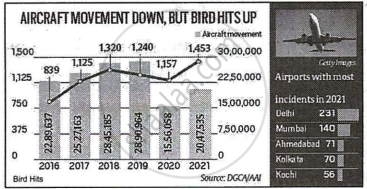 |
|
| (1) |
How bird hits happen, why they are a concern? New Delhi June 20 At least two bird strike incidents happened on Sunday. Both aircrafts returned to their airports of origin and were grounded for maintenance. An ABC aircraft, which took off from Guwahati towards Delhi, suffered damage to its left engine following a bird hit at 1600 feet. The pilots returned to Guwahati. The other strike happened on another flight from Patna to Delhi. The pilots of the aircraft suspected a bird strike during the take-off roll but continued to climb. Following the take-off rotation, they were informed by the cabin crew of sparks emanating from the left engine. Subsequently, the pilots were also informed by air traffic control of smoke coming out of one of the engines. The pilots declared an emergency and returned to Patna. |
| (2) |
Why are bird strikes a concern? Bird strikes are among the most common threats to aircraft safety, and they typically occur during take-off or landing. Dozens of bird-strikes happen each day but some can be more dangerous than others. Typically, when birds collide with an aircraft's airframe, it is unlikely to cause significant problems for the pilots flying. But there are instances when the aircraft engine ingests the birds. This can lead to a loss of thrust for the engine and cause manoeuvrability problems for the crew. In these cases, where a jet engine ingests a bird, procedures would generally call for pilots to land the plane at the closest airport. While most airframe bird strikes are not considered critical to air safety, if a collision cracks a window or a wind screen, pilots will look to land as early as possible. |
| (3) |
How critical are bird strikes to air safety? Smaller planes would generally be more susceptible to the dangers of bird strikes than larger ones. However, given that bird strikes mostly happen during take-off and landing, these incidents could distract the pilots during what are highly critical phases of flights that demand the complete attention of the crew. |
| (4) |
What causes bird-strikes? The presence of birds around an aircraft increases the chances of a bird strike. In the monsoon, as water puddles emerge on open grounds attracting insects to breed, the presence of birds increases. In some cases, bird hits also happen at higher altitudes when a plane is cruising. These are more dangerous than the low-altitude hits, given that they can cause rapid depressurization of cabins. Other reasons for bird activity around the airfield could be presence of landfills or waste disposal sites that can attract a large number of birds. |
- Does the following statement agree with the information given in paragraph 1? (1)
When an airplane is hit by a bird or is suspected to have been hit, the passengers must be asked to get down at once.
Select from the following:
True: If the statement agrees with the information.
False: If the statement contradicts the information.
Not Given: If there is no information on this. - Select the option that displays the most likely reason for bird hits. (1)
- when the aircraft is overloaded
- at the time of landing or taking off
- when the crew become negligent
- when the passengers become panicky
- Complete the sentence appropriately with one word. (1)
Smaller planes are generally more ______ than larger ones. - Complete the sentence by selecting the most appropriate option: (1)
When the window or the windscreen of the airplane is cracked due to a bird hit ______.- the crew must rush to the cockpit
- the pilot must land at the earliest airport
- the pilot must inform the maintenance engineer
- the pilot must get instructions from the aviation wing on what should do in emergency
- Based on the reading of the text, state a point to further the statement. (1)
Dozens of bird hits take place every day ______.
- but only a few are dangerous
- all of them are fatal
- but after every bird hit it is imperative to land the aircraft
- the pilot should ignore them
- Complete the sentence based on the following statement: (1)
Complete attention of the crew is demanded during take-off and landing.
We can say this because ______. - Complete the sentence appropriately with one/two words. (1)
In cases where the aircraft engine infests the bird, it leads to the loss of thrust and causes problems in ______. - Which are the areas more prone to bird hits? (1)
- Based on the reading of the text, state a point to challenge the given statement: (1)
The area around air fields should be clear of any waste disposal sites. - Look at the graph. It shows that between 2016 and 2021, whereas air flights have come down, the bird-hits have gone up. This implies that the incidence of bird hits has: (1)
- decreased
- increased
- remained constant
- been alarming
Read the extract and complete the activities given below:
|
This is what Camus meant when he said that "what gives value to travel is fear"-disruption, in other words, (or emancipation) from circumstance, and all the habits behind which we hide. And that is why many of us travel not in search of answers, but of better questions. I, like many people, tend to ask questions of the places I visit, and relish most the ones that ask the most searching questions back of me: "The ideal travel book," Christopher Isherwood once said, "should be perhaps a little like a crime story in which you're in search of something." And it's the best kind of something, I would add, if it's one that you can never quite find. I remember, in fact, after my first trips to Southeast Asia, more than a decade ago, how I would come back to my apartment in New York, and lie in my bed, kept up by something more than jet lag, playing back, in my memory, over and over, all that I had experienced, and paging wistfully through my photographs and reading and re-reading my. diaries, as if to extract some mystery from them. Anyone witnessing this strange scene would have drawn the right conclusion: I was in love. When we go abroad is that we are objects of scrutiny as much as the people we scrutinize, and we are being consumed by the cultures we consume, as much on the road as when we are at home. At the very least, we are objects of speculation (and even desire) who can seem as exotic to the people around us as they do to us. All, in that sense, believed in "being moved" as one of the points of taking trips, and "being transported" by private as well as public means; all saw that "ecstasy" ("ex-stasis") tells us that our highest moments come when we're not stationary, and that epiphany can follow movement as much as it precipitates it. |
A1. Read and rewrite the following sentences and state whether they are True or False: (2)
-
- A traveller may sink in love with his travel-memoirs.
- One gets inspected as he inspects the world around him.
- Quest for something may end in more mystery.
- Staying in comfort at home gives one more happiness than travelling.
A2. Match the persons given in column 'A' with opinions/ characteristics given in column 'B': (2)
| Column 'A' | Column 'B' |
|
(1) Narrator
|
a) ideal travel should be like a crime story. |
|
(2) Camus
|
b) in love with his memoirs. |
|
(3) Isherwood
|
c) more happy when on move. |
| (4) Traveller | d) fear gives value to travel. |
A3. Give reasons: (2)
"We are objects of scrutiny," because
- ______
- ______
A4. "Travelling is an interesting teacher." Write your views in 3-4 sentences. (2)
A5. Do as directed: (2)
- I like to ask questions of the places I visit. (Choose the correct tense form of the above sentence from the following options and rewrite.)
- Simple past tense
- Simple present tense
- Past perfect tense
- Present perfect tense
- I would come back to my apartment in New York. (Choose the correct option using 'used to' for the given sentence and rewrite.
- I use to come back to my apartment in New York.
- I have used to come back to my apartment in New York.
- I used to come back to my apartment in New York.
- I had used to come back to my apartment in New York.
A6. Find out the words from passage which mean: (2)
- reminiscence
- exhilaration
Read the following extract and Complete the activities given below:
|
Love is a great force in Private life; it is indeed the greatest of all things, but love in public affairs does not work. It has been tried again and again; by the people of the Middle Ages, and also by the French Revolution, a secular movement which reasserted the Brotherhood of Man, And it has always failed. The idea that nations should love one another, or that business concerns or marketing boards should love one another or that a man in Portugal should love a man in Peru of whom he has never heard — it is absurd, unreal, dangerous. ‘Love is what is needed,” we chant, and then sit back and the world goes on as before. The fact is we can only love what we know personally. And we cannot know much. In public affairs, in the rebuilding of civilization, something much less dramatic and emotional is needed, namely tolerance. Tolerance is a very dull virtue. It is boring. It is negative. It merely means putting up with people, being able to stand things. No one has ever written an ode to tolerance or raised a statute to her. Yet this is the quality which will be most needed after the war. This is the sound state of mind which we are looking for. This is the only force which will enable different races and classes and interests to settle down together to the work of reconstruction. The world is very full of people— appallingly full; it has never been so full before and they are all tumbling over each other. Most of these people one doesn’t know, and some of them doesn't like. Well, what is one to do? If you don't like people, put up with them as well as you can. Don't try to love them; you can't. But try to tolerate them. On the basis of that tolerance, a civilized future may be built. Certainly, I can see no other foundation for the post-war world. |
A1. Choose two correct alternatives which define the theme of the extract: (2)
- Love is a greater force in private as well as in public affairs.
- To rebuild civilization we need tolerance more than love.
- Patience is the solution in any sort of confrontation.
- When you do not like people, nations or civilizations, you need to love them to change them.
A2. Complete the following table with the help of the extract: (2)
Give one merit and one demerit of ‘Love’ and ‘Patience.’
| Love | (i) ______ |
| (ii) ______ | |
| Patience | (i) ______ |
| (ii) ______ |
A3. Write how we can build up a civilized society; with the help of the extract: (2)
A4. ‘Love and tolerance are the true indicators of a civilized person.’ Justify. (2)
A5. Do as directed: (2)
- It has been tried again and again.
(Identify the Active Voice of the above sentence from the given options and rewrite.)
- They had tried it again and again.
- They has tried it again and again.
- They tried it again and again.
- They have tried it again and again.
- It is the sound state of mind which we are looking for.
(Identify the correct simple sentence from the given options and rewrite.)- It is the sound state of mind and we are looking for it.
- We are looking for the sound state of mind.
- We are looking for it but it is the sound state of mind.
- The sound state of mind is looked for.
A6. Match the words in column ‘A’ with their meanings in column ‘B’. (2)
| Column ‘A’ | Column ‘B’ |
| (i) Secular | (a) feeling of great friendship and understanding between people. |
| (ii) Absurd | (b) a society which has its own highly developed culture and ways of life. |
| (iii) Civilization | (c) not connected with any religion. |
| (iv) Brotherhood | (d) not at all logical or sensible. |
Read the following passage carefully:
|
(1) Rotation of crops is a universal phenomenon which is practised by most of the farmers of the tropical and temperate countries. The main objective of rotation of crops is to obtain higher agricultural returns on the one hand, and to maintain the soil fertility on the other. (2) In other words, the rotation of crops helps in making agriculture more sustainable. The importance of crop rotation is more in the areas where farmers grow two, or more than two crops in the same field in a year. Irrigation facilities have also been appreciably developed in the country during the last three decades. The availability of water to the arable land has helped in the intensification of agriculture. (3) In the areas such as Punjab and Haryana, where the Green Revolution is a big success, one soil exhaustive crop (rice) is followed by another soil exhaustive crop (wheat). Subsequently, the field vacated by wheat is devoted to either rice or maize or cotton. Thus, in one year, the farmers are harvesting three soil exhaustive crops from the same field. Such a rotation of crops may fetch more income to the farmers, but depletes the soil fertility at a faster pace. (4) A number of field studies were conducted to assess the traditional crop rotation pattern. One such field study about the changes in the rotation of crops was conducted in the village Banhera (Tanda), Haridwar district. The main rotation of crops of the village is shown in the table below. |
| Traditional Rotation of Crops (1960-65) in Banhera (Tanda) | ||||
| Year | Kharif (mid-June to mid-October) | Rabi (mid-October mid-April) | Zaid (April to June) | No. of days land left fallow |
| 1960 | Millet/fodder/rice | Gram | Fallow | 90 |
| 1961 | Fallow | Wheat | Fallow | 210 |
| 1962 | Millet/fodder/rice | Gram | Fallow | 90 |
| 1963 | Fallow | Wheat | Fallow | 210 |
| 1964 | Millet mixed with urad/fodder/rice | Gram | Fallow | 90 |
| 1965 | Fallow | Wheat | Fallow | 210 |
Answer the following questions, based on the above passage:
- Fill in the blanks with the appropriate option from those given in brackets, based on your understanding of para 2.
One of the reasons that there has been an intensification of agriculture in the country is the development of irrigation facilities is a/an ______ (fact/opinion) because it is a/an ______ (subjective judgement/objective detail). - Based on your understanding of paras 1 and 2, state whether the following statement is true or false.
If proper irrigation facility is provided, higher agricultural returns can be obtained by making crop rotation more sustainable. - Justify the following in about 40 words.
Crop rotation may fetch more income to the farmers, but depletes the soil fertility at a faster pace. - Based on the table, mention the years when the land was left fallow for maximum number of days.
- The study conducted in village Banhera (Tanda) reflects that during the years 1960 to 1965, from April to June, the land was left fallow or uncultivated throughout. State any one inference that can be drawn from this.
- Select the option that correctly states the significance of crop rotation as given below:
- Crop rotation is done to obtain higher agricultural returns.
- Higher agricultural returns can be obtained by harvesting soil-exhaustive crops.
- Crop rotation demands that land should be left fallow for a few months to increase the fertility of soil.
- Better irrigation facility to the arable land has helped in the intensification of agriculture.
- If crops to be harvested are chosen wisely, crop rotation can help in maintaining fertility of soil.
- (1), (2) and (4)
- (1) only
- (3) and (5)
- (1) and (5)
- Crop rotation is helping in making agriculture more sustainable. Mention one benefit and one drawback of crop rotation. (Answer in about 40 words)
- Which of the following is the main takeaway from the study mentioned in the passage?
- The study needs to include more valid data to support the practice of crop rotation
- Crop rotation is a sustainable practice that can transform the agricultural sector.
- The impact of crop rotation on farmer’s upliftment has been thoroughly explained.
- Crop rotation is independent of the type of crops harvested and availability of water for irrigation.
