Advertisements
Advertisements
Question
Read the extract and do the activities that follow:
“And that skeleton,” I asked. “ What about the skeleton in the cupboard? Did you know about it?”
“Yes, I knew about it. But I have no idea whose skeleton it was. You see, back in the twenties, when Green took over this hotel, he had one of his sudden enthusiasms and was convinced this town needed a medical school or college, and he set about preparing the ground for one. He was ready to finance the project, or part of it. And of course medical students need a skeleton. So he acquired one from the Lady Hardinge Medical College in New Delhi. It was a medical school skeleton you found. And if you’d looked closely you'd have noticed that it was varnished.”
“Why was it varnished?” I asked.
“To help preseve it, of course. It was also articulated”
“Articulated?”
“That means the joints were connected up, so that the whole thing wouldn't fall apart. Want to be a doctor, young man?”
“No,” I said. “A detective.”
“Well, you didn't solve this case”.
“I wasn't here. And now we'll never be able to identify the skeleton.”
“Some poor woman of the streets, no doubt. Unclaimed, unwanted. But in the end you gave her a decent burial-even if she wan't a Cristian. Padre Duett is a bit embarrassed, but I've told him I don’t mind my name on the tombstone. I’ll be returning to Africa shortly, and when I die I shall have another tombstone there. Not everyone is lucky enough to have two tombstones! “
B1. True/False - (2)
State whether the following statements are true or false:
(i) The narrator wanted to be a doctor.
(ii) Mrs. Green counted herself lucky to have two tombstones.
(iii) The skeleton was varnished to preserve it for a longer time.
(iv) Mrs. Green was embarrased to see her name on the tombstone.
B2. Provide a different ending: (2)
Provide a different ending to the above given extract in about 50 words.
Advertisements
Solution
B1
(i) False
(ii) True
(iii) True
(iv) False
B2
Mrs Green belonged to christian family who was alive. Hence she got panicked as she got to know that here burial was done and there was a tombstone of her name. She went to the court to find out who had done this so that the person would get punished. After doing so the concerned person was identified, punished. Later, she left for Mexico and lived there alone happily.
APPEARS IN
RELATED QUESTIONS
 During the devastating July 2005 floods that hit Mumbai, Rajen Dutia received an urgent call from a relative, Lopa Vyas late in the evening. “A friend’s mother is stranded near your home, Rajen. Can you please take her home? Her name is Rashmi,” Vyas told him.
Mumbai had come to a halt and people were trapped everywhere. Despite power failure and raging rain, Dutia stepped out and made his way to the spot, where he found Rashmi as well as a dozen other people. They were stranded in the dark, shivering in the rain. They all lived far away and had no place to go for the night.
Rajen took all of them to his one-bedroom flat, where he served them dinner and invited them to spend the night.
"By doing so," says Rajen, "I was simply fulfilling my karma, paying the universe back for the good it had done for me."
"God is kind. My daughter had just started her new job that day, and had gone for her training. She was stranded too. While she was trying to get to our relatives, she almost drowned, but a young stranger saved her. He and his friends even dropped her to my relative's place and phoned me to say she was safe. One good turn deserves another."
A2. Order
Look at the following sentences from the passage and put them in the correct sequence: (2)
(a) He took them to his one-bedroom flat.
(b) Rajen found Rashmi as well as a dozen other people shivering in the rain.
(c) Mumbai had come to a halt and people were trapped everywhere.
(d) Rajen Dutia received an urgent call.
A3
During the devastating July 2005 floods that hit Mumbai, Rajen Dutia received an urgent call from a relative, Lopa Vyas late in the evening. “A friend’s mother is stranded near your home, Rajen. Can you please take her home? Her name is Rashmi,” Vyas told him.
Mumbai had come to a halt and people were trapped everywhere. Despite power failure and raging rain, Dutia stepped out and made his way to the spot, where he found Rashmi as well as a dozen other people. They were stranded in the dark, shivering in the rain. They all lived far away and had no place to go for the night.
Rajen took all of them to his one-bedroom flat, where he served them dinner and invited them to spend the night.
"By doing so," says Rajen, "I was simply fulfilling my karma, paying the universe back for the good it had done for me."
"God is kind. My daughter had just started her new job that day, and had gone for her training. She was stranded too. While she was trying to get to our relatives, she almost drowned, but a young stranger saved her. He and his friends even dropped her to my relative's place and phoned me to say she was safe. One good turn deserves another."
A2. Order
Look at the following sentences from the passage and put them in the correct sequence: (2)
(a) He took them to his one-bedroom flat.
(b) Rajen found Rashmi as well as a dozen other people shivering in the rain.
(c) Mumbai had come to a halt and people were trapped everywhere.
(d) Rajen Dutia received an urgent call.
A3(i). Fill in the blanks :
Select the words given in the passage (1)
(i) Thousands Of pilgrims were …………….. due to the cloud burst in Uttarakhand.
(ii) The tiger was ……………… by the hunter.
(ii). Antonyms:
Select the correct antonyms for the given words from the alternatives :
(1) Please :
(a) unplease (b) displease (c) misplease
(2) Safe: '
(a) insafe (b) safeless (c) unsafe
A4(i) Tags :
Select the correct tag for the alternatives given below :
One good turn deserves another.
(a) Doesn’t it? (b) don’t it (c) does it?
(ii). Guess:
Choose the correct answer : (1)
Rajen can you please take her home? ‘Can’ indicates :
(a) Obligation (b) ability (c) permission
A5. Personal Response :
‘ one good turn
Deserves another.’
Explain with an
example of your own.
The natural life span of a domesticated horse is about 25 – 30 years, 10 years down from what it was in the wild. You can tell a horse’s age from the number of teeth he has. They get all their teeth by the age of 5, after which those teeth just get longer. Horses have close to 360 degree all round vision. The only place they cannot see is directly behind or right in front of themselves, which is why it’s dangerous to stand behind a horse. If they later I it also means that they cannot see a jump once they are about four feet from it, and have to rely on memory as to its height and shape! Each of the horse’s two eyes work independently wherever a horse’s ear points is where the horse is looking. A horse is able to sleep standing up as he is able to lock his leg muscles so that he dosen’t fall asleep. Nor do all horses in the same field ever lie down at once – one animal always stands “on look out” duty.
1) What is the life span of a wild horse?
(2) Why do the horse owners cover their horse’s eyes with blinkers?
(3) What prevents a horse from falling while asleep?
(4)
(a) Falls /shorter/ the mane/ on the/ side/ legged.[Rearrange the words to make a meaningful sentence]
(b) Form antonyms by adding a prefix :
(i) able
(ii) direct
(5)
(a) They get all their teeth by the age of five. [Pick out the prepositions]
(b) If they feel something behind them they may kick. [Rewrite using ‘unless’]
(6) How have horses helped man through the ages?
The hopping kangaroo is a familiar sight in every snapshot relating to Australia. Members of the kangaroo family can be as small as a rat or as big as a man. Kangaroos are found mainly in Australia, Tasmania and New Guinea. Kangaroos, which are big-footed marsupials that evolved in Australia, use their short front legs like arms. The man-sized kangaroos of Australia are capable of speeding up to 88 km/hr for short distances, their means of locomotion being their powerful hind legs, which carry them over the ground in jumps of 9 m or more at a time.
Weighing around 70 kg, they have an average lifespan of around six to eight years and a maximum lifetime of 20 years. When bothered by predators, kangaroos often head for the water, standing submerged to the chest and attempting to drown the attacker by holding him under water. Another defensive technique is to get their back to a tree and kick at their adversary with their clawed hind feet, sometimes with sufficient force to kill a man. Normally shy animals, they alert other kangaroos to danger by beating on the ground with their hind feet. This loud alarm signal carries over a long distance.
The tail is important for kangaroos. It holds them in balance and supports them when they sit or fight against other kangaroos. The kangaroo uses its short legs as arms. With them it scratches itself, cleans its fur and holds branches when it eats leaves. Kangaroos are marsupials and the females carry newborns in a pouch in front of their abdomens. The babies are born small and climb up into safety of the pouch. There, for the next 225 days or so, they eat, sleep and grow. Once they reach full development, they leave the pouch. A young kangaroo that leaves the pouch is called a ‘joey’. To keep from getting too hot, the kangaroos take naps in the afternoon and do most of their grazing at night. But the best stay-cool secret of these creatures is the spit bath! Kangaroos drool and lick saliva all over their faces and bodies to cool down.
On the basis of your reading of the above passage, complete the following sentences with appropriate words/phrases:
(a) When followed by predators, kangaroos submerge ____________ and _________________.
(b) The powerful hind legs help kangaroos to __________________.
(c) Kangaroos are mainly found in Australia and are ____________________.
(d) They use their front legs to ___________________.
(e) Kangaroos warn others of danger by _______________________.
(f) The secret of kangaroos to stay cool is ______________________.
(g) They use their tails to _________________________.
(h) Before becoming ‘joeys’, the young ones stay in the ______________ and ________________.
It is rare to find someone with good technical and communication skills. You can get far ahead of your colleagues if you combine the two early in your career. People will judge, evaluate, promote or block you based on your communication skills. Since habits form by repeating both good and bad forms of communication, learn to observe great communicators and adopt their styles and traits — in written and verbal forms. The art of listening and learning from each and every interaction is another secret recipe. Develop the subconscious habit of listening to yourself as you speak and know when to pause.
Learning what not to say is probably more important than learning what to say. As your career develops, you will realize that the wise speak less. Speak when you have value to add, else refrain. Poorly constructed emails with grammatical errors are acceptable between friends, but they should be seriously avoided while communicating formally with your seniors. Avoid any communication in an emotional state when might say things you will regret later. One unnecessary word uttered at the wrong time or place can ruin a relationship, career or even your life. Such is the power of words. If such a thing happens, you should immediately apologise, else it may haunt you for life.
Another problem to overcome is speaking too fast. Since our minds are working faster than our speech, we are inclined to speak fast. This does not necessarily mean that the person hearing it will get it any faster. On the contrary, it is always the reverse. So slow down and think before you speak. “When I get ready to speak to people,” Abraham Lincoln said, “I spend two-thirds of the time thinking what they want to hear and one-thirds of the time thinking what they want to hear and one-third thinking what I want to say.” Adding humour and wit is also essential. But realize that not all jokes are funny and observe certain boundaries. Never say anything that could offend. Remember you are not a comedian who must offend as many people as you can to be witty.
2.1 Answer the following questions briefly:
(a) Why is it necessary to have good communication skills?
(b) How can communication skills be developed?
(c) What, according to the writer, should be avoided while communicating?
(d) Why should you be careful when you tend to be humorous?
2.2 Choose the most appropriate meanings of the given words from the options provided:
(a) evaluate (para 1)
(i) estimate
(ii) assume
(iii) punish
(iv) evolve
(b) trait (para 1)
(i) treaty
(ii) trail
(iii) quality
(iv) liberty
(c) utter (para 2)
(i) flatter
(ii) speak
(iii) rot
(iv) unique
(d) haunt (para 2)
(i) hunt
(ii) chant
(iii) trouble
(iv) avoid
One of the greatest advances in modern technology has been the invention of computers. They are widely used in industries and in universities. Now there is hardly any sphere of human life where computers have not been pressed into service of man. We are heading fast towards the day when a computer will be as much part of man's daily life as a telephone or a calculator.
Computers are capable of doing extremely complicated work in all branches of learning. They can solve the most complex mathematical problems or put thousands of unrelated facts in order. These machines can be put to varied uses. For instance, they can provide information on the best way to prevent traffic jams. This whole process by which machines can be used to work for us has been called 'automation'. In the future 'automation' may enable human beings to enjoy more leisure than they do today. The coming of automation is bound to have important social consequences.
Some years ago an expert on automation, Sir Leon Bagrit, pointed out that it was a mistake to believe that these machines could 'think'. There is no possibility that human beings will be "controlled by machines". Though computers are capable of learning from their mistakes and improving on their performance, they need detailed instructions from human beings to operate. They can never, as it were, lead independent lives or "rule the world" by making decisions of their own.
Sir Leon said that in future, computers would be developed which would be small enough to carry in the pocket. Ordinary people would then be able to use them to obtain valuable information. Computers could be plugged into a national network and be used like radios. For instance, people going on holiday could be informed about weather conditions. Car drivers can be given alternative routes when there are traffic jams. It will also be possible to make tiny translating machines. This will enable people who do not share a common language to talk to each other without any difficulty or to read foreign publications.
a) What is the greatest advancement in modern technology?
b) What complicated works are computers capable of doing?
c) Write one use of computers.
d) Explain automation.
e) Why can't computers lead independent lives or rule the world?
f) How would computers as translating machines help people?
g) What was the prediction of Sir Leon about computers in the future?
h) How can computers help people going on holiday?
Read the following passage:
In India, eating organic food is more of a style statement than due to health worries because the stuff is expensive. But people who can, do indulge in not only organic vegetables but even organic eggs laid by 'happy hens', who are allowed to roam around freely whereas 'unhappy hens' are kept in coops. Then there are companies that have installed music channels in their cowsheds and the milk from those sheds are sold at a marked up price since it has more nutritional value because the animals are happy thanks to lilting 24×7 music. We don't know yet any farmer using music to improve his crop quality, but then you never know : plants are known to respond to music.
Why such pickiness about food ? These days, the huge number of TV shows and articles that we see and read on food provide bread and butter for the specialist. But instead of decoding food, its sources and what has gone into growing it, isn't it much better to enjoy what's on the plate ?
Complete the statements given below by choosing the correct options from those that follow:
(a) According to a Stanford University study, organic food in relation to conventional food is________.
(i) less nutritious
(ii) more nutritious
(iii) very conventional
(iv) as nutritious
(b) The study will not be welcomed by _________.
(i) farmers of conventional food
(ii) makers of pesticides
(iii) all sectors
(iv) exporters of organic food
(c) We can save some hard cash by _________.
(i) buying organic food
(ii) not buying organic food
(iii) going to the shop
(iv) not buying food with pesticides
(d) Music channels are installed in the cowshed because the _________.
(i) cows then give more milk
(ii) milk is sold at a higher price
(iii) milk becomes more pure
(iv) workers becomes happy
(e) In the second paragraph, the author's attitude to the people who eat food sourced from 'happy' animals is that he _________.
(i) is happy with them
(ii) is unhappy with them
(iii) is laughing at them
(iv) wants crops to be grown similarly
(f) One benefit of organic food is that __________.
(i) it is fashionable to eat
(ii) only rich people can afford it
(iii) it is less contaminated with pesticides
(iv) even poor people can afford it
(g) The word 'contaminated' means ________.
(i) adulterated
(ii) for adults
(iii) containing
(iv) not healthy
Read the following passage carefully:
Gandhiji As a Fund Raiser
Gandhiji was an incurable and irrestible fund raiser. He found special relish in getting jewellery from women. Ranibala of Burdwan was ten years old. One day she was playing with Gandhiji. He explained to her that her bangles were too heavy for her delicate little wrists. She removed the bangles and gave them away to Gandhiji.
He used to talk jokingly to small girls and created distaste for ornaments and created a desire in them to part with the jewellery for the sake of the poor. He motivated them to donate their jewellery for social usage.
Kasturbai didn’t appreciate this habit of Gandhiji. Once she stated calmly, ‘You don’t wear jewels, it is easy for you to get around the boys. But what about our daughters-in-law ? They would surely want them.
“Well!” Gandhiji put in mildly, "our children are young and when they grow up they will not surely choose wives who are found of wearing jewellery.” Kasturbai was very upset with the answer.
Gandhiji was determined to keep the jewels to raise community fund. He was of the opinion that a public worker should accept no costly gifts. He believed that he should not own anything costly, whether given or earned. Kasturbai was a female with a desire to adorn. But Gandhiji moved towards renunciation and donated every penny earned in South Africa to the trustees for the service of South African Indians.
2.1 Answer the questions given below:
(ii) untreatable
(iii) disagreeable
(iv) unbeatable
(ii) emboldened
(iii) incited
(iv) softened
(ii) furious
(iii) confused
(iv) distressed
(ii) disagreement
(iii) opposition
(iv) termination
Read the extract given below and answer the questions that follow:
I even considered fleeing to my hometown, where I could have been a real lawyer right away, without going through this unpleasant training period
(a) Who is 'I'?
(b) How did 'I' suffer during the training period?
(c) What does the word, 'fleeing' mean?
Read the passage given below:
1. Every morning Ravi gives his brain an extra boost. We're not talking about drinking strong cups of coffee or playing one of those mind-training video games advertised all over Facebook. "I jump onto my stationary bike and cycle for 45 minutes to work," says Ravi. "When I get to my desk, my brain is at peak activity for a few hours." After his mental focus comes to a halt later in the day, he starts it with another short spell of cycling to be able to run errands.
2. Ride, work, ride, repeat. It's scientifically proven system that describes some unexpected benefits of cycling. In a recent study in the Journal of Clinical and Diagnostic Research, scientists found that people scored higher on tests of memory, reasoning, and planning after 30 minutes of spinning on a stationary bike than they did before they rode the bike. They also completed the tests faster after pedalling.
3. Exercise is like fertilizer for your brain. All those hours spent on exercising your muscles, create rich capillary beds not only in leg and hip muscles, but also in your brain. More blood vessels in your brain and muscles mean more oxygen and nutrients to help them work. When you pedal, you also force more nerve cells to fire. The result: you double or triple the production of these cells – literally building your brain. You also release neurotransmitters (the messengers between your brain cells) so all those cells, new and old, can communicate with each other for better, faster functioning. 'That's a pretty profound benefit to cyclists.
4. This kind of growth is especially important with each passing birthday, because as we age, our brains shrink and those connections weaken. Exercise restores and protects the brain cells. Neuroscientists say, "Adults who exercise display sharper memory skills, higher concentration levels, more fluid thinking, and greater problem-solving ability than those who are sedentary."
5. Cycling also elevates your mood, relieves anxiety, increases stress resistance, and even banishes the blues. "Exercise works in the same way as psychotherapy and antidepressants in the treatment of depression, maybe better," says Dr. Manjari. A recent study analyzing 26 years of research finds that even some exercise – as little as 20 to 30 minutes a day – can prevent depression over the long term.
6. Remember: although it's healthy, exercise itself is a stress, especially when you're just getting started or getting back into riding. When you first begin to exert yourself, your body releases a particular hormone to raise your heart rate, blood pressure, and blood glucose levels, says Meher Ahluwalia, PhD, a professor of integrative physiology. As you get fitter, it takes a longer, harder ride to trigger that same response.
On the basis of your understanding of the passage, complete the statements given below with the help of the options that follow:
(a) Ravi gets his brain to work at peak level by
(ii) playing games that need brain activity.
(iii) cycling on a stationary bike.
(iv) taking tablets to pump up his brain.
(b) When nerve cells work during exercise then
(ii) the brain is strengthened by multiplying them.
(iii) you start to lose your temper.
(iv) your stationary cycle starts to beep.
Answer the following questions briefly:
(c) How does exercise help the brain?
(d) Why does Ravi do a circuit of 'ride, work, ride'?
(e) What is the work of neurotransmitters?
(f) What benefits other than greater brain activity does one get from cycling?
(g) Why is exercise so important for adults?
(h) How is exercise itself a stress?
(ii) inactive (para 4)
Read the passage given below and answer the questions that follow:
1. We sit in the last row, bumped about but free of stares. The bus rolls out of the dull crossroads of the city, and we are soon in open countryside, with fields of sunflowers as far as the eye can see, their heads all facing us. Where there is no water, the land reverts to desert. While still on level ground we see in the distance the tall range of the Mount Bogda, abrupt like a shining prism laid horizontally on the desert surface. It is over 5,000 metres high, and the peaks are under permanent snow, in powerful contrast to the flat desert all around. Heaven Lake lies part of the way up this range, about 2,000 metres above sea-level, at the foot of one of the higher snow-peaks.
2. As the bus climbs, the sky, brilliant before, grows overcast. I have brought nothing warm to wear: it is all down at the hotel in Urumqi. Rain begins to fall. The man behind me is eating overpoweringly smelly goat's cheese. The bus window leaks inhospitably but reveals a beautiful view. We have passed quickly from desert through arable land to pasture, and the ground is now green with grass, the slopes dark with pine. A few cattle drink at a clear stream flowing past moss-covered stones; it is a Constable landscape . The stream changes into a white torrent, and as we climb higher I wish more and more that I had brought with me something warmer than the pair of shorts that have served me so well in the desert .The stream (which, we are told rises in Heaven Lake) disappears, and we continue our slow ascent. About noon, we arrive at Heaven Lake, and look for a place to stay at the foot, which is the resort area. We get a room in a small cottage, and I am happy to note that there are thick quilts on the beds.
3. Standing outside the cottage we survey our surroundings. Heaven Lake is long, sardine-shaped and fed by snowmelt from a stream at its head. The lake is an intense blue, surrounded on all sides by green mountain walls, dotted with distant sheep. At the head of the lake, beyond the delta of the inflowing stream, is a massive snow-capped peak which dominates the vista; it is part of a series of peaks that culminate, a little out of view, in Mount Bogda itself.
5. "Swimming?" Mr. Cao says. "You aren't thinking of swimming, are you?"
6. "I thought I might," I confess. "What's the water like?"
7. He doesn't answer me immediately, turning instead to examine some receipts with exaggerated interest. Mr. Cao, with great off-handedness, addresses the air. "People are often drowned here," he says. After a pause, he continues. "When was the last one?" This question is directed at the cook, who is preparing a tray of mantou (squat white steamed bread rolls), and who now appears, wiping his doughy hand across his forehead. "Was it the Beijing athlete?" asks Mr. Cao.
On the basis of your understanding of the above passage, complete the statements given below with the help of options that follow:
(a) One benefit of sitting in the last row of the bus was that:
(b) The narrator was travelling to:
(c) On reaching the destination the narrator felt relieved because:
(d) Mount Bogda is compared to:
Answer the following questions briefly:
(e) Which two things in the bus made the narrator feel uncomfortable?
(f) What made the scene look like a Constable landscape?
(g) What did he regret as the bus climbed higher?
(h) Why did the narrator like to buy food from outside?
(i) What is ironic about the pair of trousers lent by Mr. Cao?
(j) Why did Mr. Cao not like the narrator to swim in the lake?
(k) Find words from the passage which mean the same as the following:
Read the passage given below and answer the questions that follow:
The most alarming of man’s assaults upon the environment is the contamination of air, earth, rivers, and sea with lethal materials. This pollution is for the most part irrevocable; the chain of evil it initiates is for the most part irreversible. In this contamination of the environment, chemicals are the sinister partners of radiation in changing the very nature of the world; radiation released through nuclear explosions into the air, comes to the earth in rain, lodges into the soil, enters the grass or corn, or wheat grown there and reaches the bones of a human being, there to remain until his death. Similarly, chemicals sprayed on crops lie long in soil, entering living organisms, passing from one to another in a chain of poisoning and death. Or they pass by underground streams until they emerge and combine into new forms that kill vegetation, sicken cattle, and harm those who drink from once pure wells.
It took hundreds of millions of years to produce the life that now inhabits the earth and reached a stage of adjustment and balance with its surroundings. The environment contained elements that were hostile as well as supporting. Even within the light of the sun, there were short wave radiations with power to injure. Given time, life has adjusted and a balance reached. For time is the essential ingredient, but in the modern world is no time.
The rapidity of change and the speed with which new situations are created follow the heedless pace of man rather than the deliberate pace of nature. Radiation is no longer the bombardment of cosmic rays; it is now the unnatural creation of man’s tampering with the atom. The chemicals to which life is asked to make adjustments are no longer merely calcium and silica and copper and all the rest of the minerals washed out of the rocks and carried in the rivers to the sea; they are the synthetic creations of man’s inventive mind, brewed in his laboratories, and having no counterparts in nature.
(a) On the basis of your understanding of the above passage make notes on it using headings and sub-headings. Use recognizable abbreviations (wherever necessary-minimum four) and a format you consider suitable. Also supply a title to it.
(b) Write a summary of the passage in about 80 words.
Read the passage given below and answer the questions that follow:
The most alarming of man’s assaults upon the environment is the contamination of air, earth, rivers, and sea with lethal materials. This pollution is for the most part irrevocable; the chain of evil it initiates is for the most part irreversible. In this contamination of the environment, chemicals are the sinister partners of radiation in changing the very nature of the world; radiation released through nuclear explosions into the air, comes to the earth in rain, lodges into the soil, enters the grass or corn, or wheat grown there and reaches the bones of a human being, there to remain until his death. Similarly, chemicals sprayed on crops lie long in soil, entering living organisms, passing from one to another in a chain of poisoning and death. Or they pass by underground streams until they emerge and combine into new forms that kill vegetation, sicken cattle, and harm those who drink from once pure wells.
It took hundreds of millions of years to produce the life that now inhabits the earth and reached a stage of adjustment and balance with its surroundings. The environment contained elements that were hostile as well as supporting. Even within the light of the sun, there were short wave radiations with power to injure. Given time, life has adjusted and a balance reached. For time is the essential ingredient, but in the modern world is no time.
The rapidity of change and the speed with which new situations are created follow the heedless pace of man rather than the deliberate pace of nature. Radiation is no longer the bombardment of cosmic rays; it is now the unnatural creation of man’s tampering with the atom. The chemicals to which life is asked to make adjustments are no longer merely calcium and silica and copper and all the rest of the minerals washed out of the rocks and carried in the rivers to the sea; they are the synthetic creations of man’s inventive mind, brewed in his laboratories, and having no counterparts in nature.
(a) On the basis of your understanding of the above passage make notes on it using headings and sub-headings. Use recognizable abbreviations (wherever necessary-minimum four) and a format you consider suitable. Also supply a title to it.
(b) Write a summary of the passage in about 80 words.
Read the passage given below :
1. To ensure its perpetuity, the ground is well held by the panther both in space and in time. It enjoys a much wider distribution over the globe than its bigger cousins and procreates sufficiently profusely to ensure its continuity for all time to come.
(ii) in the branches of the trees
(iii) behind the tree trunks
(iv) at its heels
(ii) trains its cubs
(iii) watches the progress of the mother
(iv) is impulsive and impatient
Answer the following questions briefly :
(ii) came down / fell (para 7)
Read the passage given below:
People tend to amass possessions, sometimes without being aware of doing so. They can have a delightful surprise when they find something useful which they did not know they owned. Those who never have to change house become indiscriminate collectors of what can only be described as clutter. They leave unwanted objects in drawers, cupboards, and attics for years in the belief that they may one day need them. Old people also accumulate belongings for two other reasons, lack of physical and mental energy, and sentiment. Things owned for a long time are full of associations with the past, perhaps with the relatives who are dead, and so they gradually acquire a sentimental value.
Some things are collected deliberately in an attempt to avoid wastage. Among these are string and brown paper, kept by thrifty people when a parcel has been opened. Collecting small items can be mania. A lady cuts out from newspaper sketches of model clothes that she would like to buy if she had money. As she is not rich, the chances are that she will never be able to afford such purchases. It is a harmless habit, but it litters up her desk.
Collecting as a serious hobby is quite different and has many advantages. It provides relaxation for leisure hours, as just looking at one’s treasure is always a joy. One doesn’t have to go out for amusement as the collection is housed at home. Whatever it consists of - stamps, records, first editions of books, china – there is always something to do in connection with it, from finding the right place for the latest addition to verifying facts in reference books. This hobby educates one not only in the chosen subject but also in general matters which have some bearing on it.
There are other benefits also. One gets to meet like-minded collectors to get advice, compare notes, exchange articles, to show off one’s latest find. So one’s circle of friends grows. Soon the hobby leads to traveling, perhaps a meeting in another town, possibly a trip abroad in search of a rare specimen, for collectors are not confined to one country. Over the years one may well become an authority on one’s hobby and will probably be asked to give informal talks to little gatherings and then, if successful, to larger audiences.
(a) On the basis of your understanding of the above passage make notes on it using headings and sub-headings. Use recognizable abbreviations (wherever necessary-minimum four) and a format you consider suitable. Also, supply an appropriate title to it.
(b) Write a summary of the passage in about 80 words.
Read the passage given below :
1. We often make all things around us the way we want them. Even during our pilgrimages we have begun to look for whatever makes our heart happy, gives comfort to our body and peace to the mind. It is as if external solutions will fulfil or needs, and we do not want to make any special efforts even in our spiritual search. Our minds is resourceful − it works to find shortcuts in simple and easy ways.
2. Even pilgrimages have been converted into tourism opportunities. Instead, we must awaken our conscience and souls and understand the truth. Let us not tamper with either our own nature of that of the Supreme.
3. All our cleverness is rendered ineffective when nature does a dance of destruction. Its fury can and will wash away all imperfection. Indian culture, based on Vedic treatises, assists in human evolution, but we are not using our entire energy in distorting these traditions according to our convenience instead of making efforts to make ourselves worthy of them.
4. The irony is that humans are not even aware of the complacent attitude they have allowed themselves to sink to. Nature is everyone's Amma and her fierce blows will sooner or later corner us and force us to understand this truth. Earlier, pilgrimages to places of spiritual significance were rituals that were undertaken when people became free from their worldly duties. Even now some seekers take up this pious religious journey as a path to peace and knowledge. Anyone travelling with this attitude feels and travels with only a few essential items that his body can carry. Pilgrims traditionally travelled light, on foot, eating light, dried chickpeas and fruits, or whatever was available. Pilgrims of olden days did not feel the need to stay in special AC bedrooms, or travel by luxury cars or indulge themselves with delicious food and savouries.
5. Pilgrims traditionally moved ahead, creating a feeling of belonging towards all, conveying a message of brotherhood among all they came across whether in small caves, ashrams or local settlements. They received the blessings and congregations of yogis and mahatmas in return while conducting the dharma of their pilgrimage. A pilgrimage is like penance or sadhana to stay near nature and to experience a feeling of oneness with it, to keep the body healthy and fulfilled with the amount of food, while seeking freedom from attachments and yet remaining happy while staying away from relatives and associates.
6. This is how a pilgrimage should be rather than making it like a picnic by taking a large group along and living in comfort, packing in entertainment, and tampering with environment. What is worse is giving a boost to the ego of having had a special darshan. Now alms are distributed, charity done while they brag about their spiritual experiences!
7. We must embark on our spiritual journey by first understanding the grace and significance of a pilgrimage and following it up with the prescribed rules and rituals − this is what translates into the ultimate and beautiful medium of spiritual evolution. There is no justification for tampering with nature.
8. A pilgrimage is symbolic of contemplation and meditation and acceptance, and is a metaphor for the constant growth or movement and love for nature that we should hold in our hearts.
9. This is the truth!
One the basis of your understanding of the above passage answer the questions that follow with the help of given options:
(a) How can a pilgrim keep his body healthy?
(i) By travelling light
(ii) By eating small amount of food
(iii) By keeping free from attachments
(iv) Both (i) and (ii)
(b) How do we satisfy our ego?
(i) By having a special darshan
(ii) By distributing alms
(iii) By treating it like a picnic
(iv) Both (i) and (ii)
Answer the following as briefly as possible:
(c) What change has taken place in our attitude towards pilgrimages?
(d) What happens when pilgrimages are turned into picnics?
(e) Why are we complacent in our spiritual efforts?
(f) How does nature respond when we try to be clever with it?
(g) In olden days with what attitude did people go on a pilgrimage?
(h) What message does the passage convey to the pilgrims?
(i) Find words from the passage which mean the same as the following:
(i) made/turned (para 3)
(ii) very satisfied (para 4)
Read the following extract and answer the questions given below:
The Jahangir Art Gallery, the State Bank of lndia building and the canteen close by which offered affordable fare, the amazing street fare, bhelpuri and vadapav. The joy of reading Bombay Times with its page 3 people one would never meet but who seemed like old friends. The Strand bookstore where one could browse for hours. And just when a book was longingly but firmly put down from nowhere, Mr Shanbagh would materialise magically at one's elbow with a special price. Not to forget the joys of trawling the booklined pavements at Fountain, where one could watch the world go by. And wherever I chose to go, there was always my friend, the sea, oh. I loved her, in all her moods, but especially in the monsoon when violent and enraged she splattered Worli seaface with walls of sea spray. My friends are lost, some passed away, some moved away, there were many whose names I never found out, though we took the train together, or met in the lift, every day.
Like every migrant, I promise myself, someday I will return. I may, perhaps, return sometime, but even so, I know, "that one cannot step into the same river twice." You seduced me steadily, o Mumbai, with your glamour and bright lights. City of dreams, tinsel town. I pay tribute to you. Today, I say good-bye with a heavy heart.
(1) What does this extract focus on?
(2) Which mood of the sea did the writer like the most?
(3) How would the writer spend her free time?
( 4) According to you, how can you make your locality clean and beautiful?
(5) Rewrite the following sentences in the ways instructed :
(i) She splattered Worli seaface with walls of sea spray.
(Rewrite it using the Simple Present tense.)
(ii) I never found out their names though we took the train together
(Make it a Compound Sentence.)
(iii) I promise myself, someday I will return.
(Rewrite it using the modal auxiliary 'must'.)
(6) Find out the words from the extract which mean -
(i) courageously
(ii) attracted
Read the following extract and answer the questions given
below:
Prominent among the urges that inspire and drive a person in life, is the mge to be a somebody. It is quite human, especially in the early stages of life, to want to do something to win laurels and admiration of all around. There's a pitfall though - the very process of becoming a somebody may subtly reduce yon to a nobody.
American poet Emily Dickinson, who lived in obscurity, has an interesting poem on this theme. "I'm nobody!" she declares, with apparent pride.
"Who are you?
Are you nobody, too?"
Why should anybody be happy about being nobody?
The poem explains :
"How dreaiy to he somebody!
How public, like a frog
To tell your name the livelong day
To an admiring bog!
The word 'bog' is significant. When you become a somebody, you invite adulation :
this then begins to bog you down. The moment you think you have arrived, you begin to stagnate, or, worse, your downslide begins. An endless list of writers, artists, sportsmen, politicians ..... fit this pattern of personal history.
To sustain your development in absolute terms, to become a true somebody, it is important to remain a temporal nobody. Even if destiny makes you a temporal somebody,
you should be able to see yourself as merely an agent of a superior power; no more. This requires an exercise of will. You have to constantly watch out and talk to yourself morning and evening.
(1) What is the main idea of the extract? (1)
(2) Why is it important for one to remain a temporal nobody? How? (1)
(3) What does Emily Dickinson declare with pride? Why? (2)
(4) What would you like to be in your life - Somebody or nobody? Why? (2)
(5) Rewrite the following sentences in the ways instructed
(i) This requires an exercise of will.
(Rewrite it using the Simple Future tense.) (1)
(ii) You have to constantly watch out and talk to yourself.
(Rewrite it using another modal auxiliary showing 'compulsion'.) (1)
(iii) You begin to stagnate.
(Rewrite it using the noun form of the word underlined.) (1)
(6) Find out the words from the extract which mean -
(i) danger (1/2)
(ii) praise (1/2)
Read the following extract and answer the questions given below :
One day, I saw the tree was being cut. I rushed to the site and begged the tree cutters to spare the trunk as it wast the home of many a parrot. But I was laughed at and the tree fell with a great thud. I ran to the top end to see two just hatched chicks thrown out of their nest and smashed to death. I looked into all the nests and saw smashed eggs in two of them and one little chick in the other one. Fortunately, the little one survived the fall. I brought it home. The chick can be identified as a parrot only by the shape and colour of its beak. No feathers had come out. 1 carefully fed it with milk and within two weeks it began to eat bananas; and two months later, it started to fly and I let him fly away. But he would not fly long. He used to liner on the coconut trees in our compound and when I reached home from school, he would fly down and land on my head!
I would show him my finger and he would jump on to it from my head and drink the milk I offered him in a little plate. By putting the sharp end of the upper beak stationaty in the plate, he would drink the milk by moving his tongue and lower beak to and fro. Then he would fly on to my shoulder and eat paddy from mypahn.
(1) What is the extract about? (1)
(2) Describe how did the boy save the life of a chick ? (2)
(3) What was the parrot's daily routine at the author's home? (2)
(4) Do you think, we have deprived the birds of their natural habitats? What are its effects? (2)
(5) Rewrite the following sentences in the ways instructed :
(i) I rushed to the site. (Rewrite the sentence using 'used to'.) (1)
(ii) The tree was being cut. (Rewrite it beginning with 'They .... .' (1)
(iii) I looked into all the nests and saw smashed eggs in two of them. (Rewrite the sentence using the word 'when'. (1)
(6) Find out the words from the extract which mean -
(i) neatly (1/2)
(ii) stay for longer (1/2)
Read the following extract and answer the questions given below:
One day, King Amrit and Chandan were taking a walk on the terrace of the palace. The terrace offered a beautiful view of the surroundings, and they could see far into the distance. They spotted the weekly market from up there, with people in colourful clothes buying and selling all kinds of things. There was plenty to buy and people had money to buy too. There were no poor people to be seen anywhere. The King watched with a smile on his face. He was delighted to see the prosperity of his kingdom. Like any good ruler, he was happy ·when his people were happy.
He turned to Chandan and said, ''See how contented my people are. But I want to check this first-hand by talking to them. Tomorrow, summon people from all walks of life to the court, and I will ask them myself how they are doing.'' Chandan was used to the king's strange requests and went off to carry out this order.
The next day, the King arrived in the court humming a happy tune to himself. Seeing all the people gathered there waiting for him, he was even more pleased. He cleared his throat and said in a loud voice, ''I have called you here to ask you a very important question. As your king, I need to know if all of you are contented. Do you have enough for your needs? Do you know anyone who is not happy about anything?''.
(1) What do you understand about the King from this extract?
(2) Why did the King want to talk to his people?
(3) How did the King come to know about the prosperity of his kingdom?
(4) According to you, what should the Government do for the bettennent of the poor people?
(5) Rewrite the following sentences in the ways instructed :
(i) He was delighted to see the prosperity of his kingdom.
(Make it a rhetorical question.)
(ii) Summon people from all walls of life to the court
(Rewrite it beginning with 'Let ..... ')
(iii) As soon as the King arrived in the court humming a
happy tune to himself, he cleared his throat.
(Rewrite it using 'No sooner .... than'.)
(6) Find out the words from the extract which mean:
(i) development
(ii) examine
Read the following extract and answer the questions given below:
There are some glimmers of hope. I met up young Navdeep. Ahuja who along with another colleague began the innocuously named Graduates Welfare Association, Fazilka. They are bringing about change with the mandate of citizens' participation in governance and are facilitating the creation of physical and social infrastructure across 22 cities in Punjab. They have put in place a network of cycle rickshaws called Eco-cabs which can be booked through a mobile phone. They are also developing car tree zones, food and culture streets in these cities. All this is being done very efficiently and at a low cost. We need many such organizations. However, my idea of a city in 2020 is not a utopian dream. It is achievable. It has streets where people walk on wide footpaths shaded by leafy trees. Streets are usually one-third of a city's area and its most democratic segment. Public space dedicated to pedestrians reduces inequality and should be accorded priority when developing cities. Adjoining the streets should be cycle lanes where bicycles and, rickshaws can sail past smoothly. It'll have a great public transport system with buses, metro and taxis. Parking will be difficult and expensive so people will use public transport rather than cars. There will be parks and gardens and the air will be clean, as pollution levels will have dropped dramatically. And then cities will become areas of graceful living and a charmed way of life.
(1) What is the extract about?
(2) What will happen when parking becomes difficult and expensive?
(3) How has Graduates Welfare Association brought about changes in some cities?
(4) What efforts will you take to make your city a livable place?
(5) Rewrite the following sentences in the ways instructed :
(i) We need many such organizations.
(Frame a ' Wh-question' to get the underlined part as an answer.)
(ii) It reduces inequality.
(Rewrite it using the Present Perfect Tense.)
(iii) The air will be clean, as pollution levels will. have dropped dramatically.
(Rewrite it using 'unless')
(6) Find out the words from the extract which mean:
(i) co-worker
(ii) small signs
Read the following extract and answer the questions given below:
Researchers recently announced the earth could actually withstand up to 200,000 times the current population. They arrived at this figure by calculating the amount of heat a human body emits, and only at 1·3 million billion would the earth be too hot to be habitable. And though it would feel like being ina can of sardines if that figure were ever reached, the earth is capable of comfortably sustaining a population several times the current 6·5 billion.
In fact, fertility is actually on the decline worldwide. Though the population has grown, the rate of growth has fallen sharply. Twenty years ago, the UN projected that the population would reach 11·I6 billion in 2050, today they say it will reach only 9·3 billion. Moreover, the human population will stabilize at about 11·5 billion. While this figure is almost twice the current one, it is hardly claustrophobic.
True, the demands on resources are heavy even now, but this is more due to the manner in which these resources are being used. In fact, figures show that a bigger population does not amount to greater consumption. Over 20% of the world's people in the highest-income countries account for 86% of total private consumption expenditure - the poorest 20% a tiny 1·3%. With just 5% of the world's population, the US consumes about 40% of the world's resources. Would you say the US is overpopulated?
Concerns on the scarcity of food are equally baseless. In fact, global food production has actually kept up with population growth. If people starve in many countries it is not because food is becoming scarce; it is because those people cannot afford it.
Questions:
(1) What conclusions did the researchers arrive at?
(2) How does the writer explain that fertility is on the decline?
(3) What does the extract predict about the fear of scarcity of food?
(4) How will the population become a gift in the global market scene?
(5) Rewrite the following sentences in the ways instructed:
(i) The earth could withstand up to 200,000 times the current population.
(Rewrite the sentence using the modal auxiliary showing 'certainty'.)
(ii) The earth would be too hot to be habitable.
(Remove 'too' and rewrite the sentence.)
(iii) These resources are being used.
(Rewrite the sentence beginning with, 'We ........... .')
(6) Write the antonyms of:
(i) habitable
(ii) stabilize
(A) Read the following extract and answer the questions given below:
Chronic floods during the monsoon, on average, affect more than 30 million Indians annually Ironically, 60% of India's farmland, 66% of its livestock and its entire forest area depend on rains for survival.
According to a recently released Central Water Commission (CWC) report, on an average, 7·21 million hectares (roughly 72,000 sq. km.) go under floodwater. This water typically ravages 3·78 million hectares of agricultural land, damaging crops worth Rs. 1, 118 crores annually.
Heavy rains and floods account for nearly 1,700 lives lost annually. Apart from this, I ·25 lakh houses are annually damaged by torrential rains that also wipe out nearly 96,000 livestock.
Floods are the most recurrent natural calamity, hitting India almost every year. According to the CWC's report on financial aspects of flood control, anti-sea erosion and drainage projects, it is not possible to provide absolute protection instantly to all flood-prone areas. It says that such an attempt will neither be practical nor economically viable.
The CWC's analysis of floods in India from 1953 to 2011 shows a marginal decline in flood-affected areas over the years, the data shows 1977 1978 and 1979 were the worst-hit. The 1977 floods killed over 11,000 people, six-time the average for the 59 years, between 1953 and 2011. In terms of area and population affected, the floods of 1978 were the most destructive.
In terms off the financial loss, recent floods have been far more destructive. The total loss of crops, houses and public utilities in 2009 was Rs. 32541 crores, the highest for any year.
Question
(1) What is the above extract about?
(2) How do floods adversely affect India?
(3) Why is it not possible to provide absolute protection to all flood-prone areas?
(4) How would you help the flood-affected people?
(5) Rewrite the following sentences in the ways instructed :
(i) The floods of 1978 were the most destructive.
(Change the sentence into the 'positive degree'.)
(ii) Floods are the most recurrent natural calamity hitting India almost every year.
(Make it a complex sentence.)
(iii) Floods have been far more destructive.
(Rewrite the sentence using the Simple Present tense.)
(6) Give the meanings of:
(i) entire
(ii) calamity
(B) Write a brief summary of the above extract with the help of the points given below and suggest a suitable title.
Floods - natural, recurrent calamity in India - destroy life and property - no absolute protection - neither practical nor economically viable- floods in 1977 and 1978.
Read the following extract and answer the questions given below:
|
We often hear this statement that “many of our young people spend more time before their T.V. sets, than they do in their classrooms or with their textbooks. “A bit exaggerated though it may sound, it is nearly true and our teenagers are being considerably influenced by the electronic media, particularly the T.V. The television has become the single most powerful influence in the lives of many of our youngsters today. Too often this happens to us much before we realise it ourselves. I am in no way trying to deny the many advantages of T.V. or minimise its manifold contributions to our world. On the other hand, I consider T.V. as one of the greatest scientific achievements of our times, bringing people closer than ever before. Television’s use of the modern satellite technology brings today even the remotest regions of the world to us in seconds, making the world a small (global) village. As we know, television also provides us with a fuller and more impressive coverage of current events than any other media. The T.V. does serve. In addition, as medium of education as well as entertainment. Besides, helping us to learn subjects taught in schools, college in greater depth, it enables us (National Geographic, Discovery channel etc.) to see and appreciate from close quarters (without having to go there, which is very expensive or even impossible for most of us) the wonders of God’s creation in any part of the world. |
- Our young people spend more time before their T.V. set than in their classrooms. (1)
(Rewrite it using positive degree) - The T.V. does serve as medium of education as well as an entertainment. (1)
(Rewrite it using ‘not only ..... but also’) - I consider T.V. as one of the greatest scientific achievements of our times. (1)
(Rewrite it using the noun form of the underlined word.)
Read the following extract and answer the questions given
below :
In 1945 in Bay Roberts, Canada, a 12-year-old boy saw something in a shop window that set his heart racing. But the price -five dollars-was far beyond Reuben Earle's means. Five dollars would buy almost a week's groceries for his family.
Reuben couldn't ask his father for the money. Everything Mark Earle made by fishing, Reuben's mother, Dora, stretched like elastic to feed and clothe their five children.
Nevertheless, he opened the shop's weathered door and went inside. Standing proud and straight in his flour-sack shirt and washed out trousers, he told the shopkeeper what he wanted, adding, "but I don't have the money now. Can you please hold it for me?" ·
"I will try," the shopkeeper smiled. ''Folks around here don't usually have that kind of money to spend on things. It should keep for a while.,.
Reuben respectfully touched his worn cap and walked out into the May sunlight. The bay rippled in a freshening wind that ruffled his short hair. There was purpose in his loping stride. He
would raise the five dollars and not tell anybody.
Hearing the sound of hammering from a side street, Reuben had an idea.
He ran towards the sound and stopped at a construction site. People built their own homes in Bay Roberts, using nails purchased in burlap sack from a local factory. Sometimes the sacks were discarded in the flurry of buildings, and Reuben knew he could sell them back to the factory for five cents a piece.
(1) What did Reuben decide to do to raise the required amount?
(2) How much money did Reuben need? Why?
(3) Why couldn't Reuben ask his father for the money?
(4) What is special about the gifts which are given on special occasions?
(5) Rewrite the following sentences as directed :
(i) Reuben couldn't ask his father for the money.
(Rewrite the sentence using ' be able to'.)
(ii) Hearing the sound of hammering from a side street, Reuben had an idea.
(Rewrite the sentence using 'and'.)
(iii) He could sell them back to the factory.
·(Rewrite the sentence beginning with: 'They ..... ')
(6) Match the words in column 'A' with their meanings in
column 'B':
| column 'A' | column 'B' |
| folk | natural harbour |
| bay | sticks |
| people |
Read the following passage and do the activities.
Galaxies are vast clusters of thousands of millions of stars, planets, gases and dust, which are held together by gravity. There are over one thousand million galaxies, and each is a very long way from its nearest neighbour.
Galaxies were formed during the Big Bang explosion about 15,000 million years ago. When this phenomenon occurred, everything that was in the universe flew out in different directions. Scientists believe that the galaxies were formed from lumps of matter that resulted. However, the process is nowhere near complete. The universe is still expanding, galaxies are still moving away from each other, new stars are still being created.
Galaxies are classified according to their shapes. There are three main types. The most common type of galaxy is The Spiral. This has several spiral arms radiating out from the center. Spiral galaxies have a large cluster of stars in their nucleus. The second type is the Barred spiral. In this type of galaxy, the spiral arms curve away from the opposite ends of a sort of bar going through the middle of the nucleus. These contain large amounts of gas and dust as well stars. The third type of galaxy is electrical. These consist almost entirely of stars and contain very little gas or dust. Some galaxies have irregular, uneven shapes and cannot be classified.
(A1) State whether the following statements are true or false. 02
(1) The most common type of galaxy is the barred spiral.
(2) Galaxies are clusters, held by gravity.
(3) Scientists do not believe in the Big Bang explosion.
(4) Galaxies are moving from each other.
(A2) Complete the web chart. 02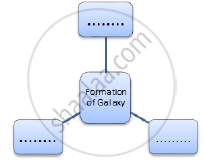
(A3)
(a) Find out similar words from the passage. 01
(i) mass (ii) happenings
(b) Give the verb form of the given words. 01
(i) classified (ii) directions
(A4) Identify and name the clause. 02
Scientists believe that the galaxies were formed from the lumps of matter.
(A5) Can there be life in another galaxy? Give reasons for your answer. 02
(B) Read the passage given in Q. 4 (A) and write the summary of it. Suggest a suitable title to your summary. (05)
We were an argrarian people. And my main hobby in my early teens was to wander through paddy field to see the different kinds of birds and how they nest. On the outskirts of the paddy fields, there had been many coconut trees and black palm trees. Beautifully crafted nests of the weaver-birds thookkanaam kuruvikal-would be seen dangling from the ends of palm leaves. Hundreds of these little birds would land on the paddy to squeeze the milk from the tender rice. They would come to the fields when the young stalks come out of the rise-plants. At this stage of the paddy, my father would send me to our field with a tin drum to scare these birds away. But often I have enjoyed the sight of these little birds balancing on the tender stalks and squeezing the milk out of the green rice. When the paddy is ripe enough to harvest, flocks of parrots would land there and cut the ripe stalks with their sharp beaks and fly away with the stalks dangling in their beaks. I have always liked to see this sight also.
The nest of parrots were neatly crafted holes in the trunks of palm trees. I continued to wonder how they made chose holes on the hard trunks until I saw the patient work of the woodpeckers. They were the carpenters and their long, sharp and strong beaks, chisels. They make the holes (in search of worms inside the weak spots of the trunks) and the parrots occupy them. If I heard the sound tak, tak, tak. I knew it was a woodpeckers chiselling a had trunk. I would go after him. It seems that the woodpecker is the only bird which can walk perpendicularly on the tree trunks! How beautiful the sight was! Its strong legs, red crest, the dark red stripe on the face and black beak and the tak, tak, tak sound used to captivate me
A1. Complete the following table :Choose two sentence that appropriately mention the theme of the passage :
(i) The extract deals with the techniques to scare the birds away.
(ii) The extract depicts how parrots make holes on the tree trunks.
(iii) The extract depicts the writer’s love towards the birds.
(iv) The extract deals with the activities of different birds.
A2. Complete the flow-chart :

A3. Complete the following table :

A4. Vocabulary -
Match the pairs of the words in column ‘A’ with their meaning in column ‘B’ :
| Column ‘A’ | Column ‘B’ |
| (i) dangling | (a) connected with farming |
| (ii) squeezing | (b) attract the attention |
| (iii) agrarian | (c) hanging freely |
| (iv) captivate | (d) pressing firmly |
A5. Personal response -
Suggest two measures to increase the number of birds.
A6. Grammer -
Rewrite the following sentences in the way instructed
(i) The paddy is ripe enough to harvest
(Remove ‘enough’ and rewrite the sentence.)
(ii) How beautiful the sight was!
(Rewritte as an assertive sentence)
Read the extract and do the activities that follow :
‘Your father was my enemy,’ said Frederick. ‘I would have been better pleased by your brave deed if you had told me of another father?’
‘I am proud to be Sir Rowland's son,’ answered Orlando angrily,’ and I would not change my place to be the heir of this dukedom.’
The Duke and his lords went away, leaving Orlando alone with Rosalind and Celia. Celia was angry with her father for speaking so unkindly to Orlando. ‘Would I have done this in my father’s place?’ she said to Rosalind.
‘My father loved Sir Rowland as much as his own soul,’ Rosalind said to Celia, ‘and all the world agreed with him. If I had known that his young man was Sir Rowland’s son I should have begged him with tears not to take so great a risk.’
‘Let us go and speak to Orlando,’ said gentle Celia. ‘I am ashamed of my father’s rude and angry words.’
The two girls went up to Orilando and praised him for his bravery. Rosalind took a gold chain from her neck and gave it to him. ‘I would like to give you more’, she said, ‘but I am not rich.’ Then she and Celia went away.
Orlando, however, could not forget them. He had already fallen in love with the fair Rosalind, but he could not stay at the Duke’s palace. His friends warned him that Frederick was angry and jealous of him. They told Orlando to leave the dukedom, because the Duke meant to do him harm.
A1. Match -
Match the characters and their attributes:
| A | B | ||
| i. | Celia | a. | fair |
| ii. | Orlando | b. | rude and unkind |
| iii. | Frederick | c. | gentle |
| iv. | Rosalind | d. | brave |
A2. Write an imaginary paragraph:
Write an imaginary paragraph in about 50 words in continuation with the given extract.
(B) Read the extract and do the activities that follows :
“May I come in?” asked the pink lady.
“Please come in,” said my mother. “Do sit down. Do you require a room?”
“Not today, thank you. I’m staying with Padre Dutt. He insisted on putting me up. But I may want a room
for a day or two – just for old times’ sake.”
“You’ve stayed here before.”
“A long time ago. I’m Mrs. Green, you know. The missing Mrs. Green. The one for whom you put up that handsome tombstone in the cementery. I was very touched by it. And I’m glad you didn’t add ‘Beloved wife of Henry Green’, because I didn’t love him any more than he loved me.”
“Then – then – you aren’t the skeleton?” Stammered my mother.
“Do I look like a skaleton?”
“No!”, we said together.
“But we heard you disappeared,” I said, “and when we found that skeleton —”
“You put two and two together.”
“Well, it was Miss Kellner who convinced us,” said my mother. “And you did disappear mysteriously. You
were missing for years. And everyone knew Mr. Green was a philander.”
“Couldn’t wait to get away from him,” said the pink lady. “Couldn’t stand him any more. He was a ladykiller
but not a real killer.”
“But your father came looking for you. Didn’t you get in touch with him?”
“ My father and I were never very close. Mother died when I was very young, and the only relative I had
was a cousin in West Africa. So that’s where I went – Sierra Leone!”
B1. Complete -
Complete the following sentenses :
(i) Mrs. Green couldn’t stand Mr. Green, because ________.
(ii) The relationship between Mrs. Green and her father ________.
(iii) Mrs. Green cousin lived in ________.
(iv) Miss. Kellner convinced the narrator’s mother that the skeleton was of Mrs. Green, because ______.
B2. Convert dialogue into a story :
Convert the above dialogue into a story form in about 50 words.
Read the following passage and do the given activities :
A1. Fill up the blanks with virtues of dogs : (2)
(1) __________
(2) __________
(3) __________
(4) __________
| Human and dogs are inseparable for thousands of years and they are dependent on each other for protection and survival. Relationship between humans and dogs is often characterized by strong emotional bonds which run both way. Dogs are very popular as pets and companions. Dog is the ‘Man’s Best Friend’ and a family member. The dog is one of the most loyal, faithful and devotee animal. In earlier days dogs were kept mainly for hunting and guarding; now they are kept for companionship, protection and showmanship. There are millions of people all over the world who are dog lovers Puppies need more attention at the, early age. As much as possible try many methods of socialization, such as playing with them, taking them for walk, expose them to crowds, make them to obey the orders etc. |
A2. Methods of socialization of puppies are : (2)
(1) …......................
(2) …......................
(3) …......................
(4) …......................
A3. Cross out the odd man : (2)
(i) Inseparable, dependent, protection, popular.
(ii) Hunting. guarding, playing, petting.
(iii) Earlier, human, relationship, family
(iv) Often, mainly, now, emotional
A4.
(1) There are millions of people all over the world. (1)
(Pick out the determiners and write them)
(2) Puppies need more attention. (1)
(Rewrite the sentence without changing its meaning beginning with : Puppies don’t ….....)
A5. Should we ban keeping pets ? Justify. (2)
Read the following extract and answer the questions given below :
Reuben arrived at the factory. The sack buyer was about to lock up.
"Mister! Please don't close up yet." The man turned and saw Reuben, dirty and sweat-stained.
"Come back tomorrow, boy."
"Please, Mister. I have to sell the sacks now-please." The man heard a tremor in Reuben's voice and could tell he was close to tears.
"Why do you need this money so badly?"
"It's a secret."
The man took the sacks, reached into his pocket and put four nickels into Reuben's hand. Reuben murmured a quiet thank-you and ran home.
Then, clutching the tin can, he headed for the store.
"I have the money" he solemnly told the owner, pouring his coins onto the counter.
The man went to the window and retrieved Reuben's treasure. He wiped the dust off and gently wrapped it in brown paper. Then he placed the parcel in Reuben's hands.
Racing home, Reuben burst through the front door. His mother was scrubbing the kitchen range. "Here Mum!Here!" Reuben exclaimed as he ran to her side. He placed a small box in her work-roughened hand.
She unwrapped it carefully, to save the paper. A blue-velvet jewel box appeared. Dora lifted the did, tears beginning to blur her vision.
In gold tettering on a small, almond-shaped brooch was the word 'Mother'
It was Mother's Day, 1946
Dora had never received such a gift; she had no finery except her wedding ring. Speechless, she smiled radiantly and gathered her son into her arms.
(1) Why did Reuben insist on the sack buyer to buy his sacks that day only?
(2) How did the mother react when Reuben gave her the gift?
(3) In what way was Reuben's gift special to his mother?
(4) What do you plan to do on Mother's Day?
(5) Rewrite the following sentences in the ways instructed :
(i) I have to sell the sacks.
(Rewrite it replacing the underlined part with the modal auxiliary showing 'compulsion'.)
(ii) She smiled radiantly and gathered her son into her arms. (Use 'As soon as'.)
(iii) She unwrapped it carefully.
(Rewrite the sentences using the noun form of the underlined word.)
(6) Find out the words/phrases from the extract which mean:
(i) showing joy (ii) got back
Read the following extract and answer the questions given below:
Researchers recently announced the earth could actually withstand up to 200,000 times the current population. They arrived at this figure by calculating the amount of heat a human body emits, and only at 1.3 million billion would the earth be too hot to be habitable. And though it would feel like being in a can of sardines if that figure were ever reached, the earth is capable of comfortably sustaining a population several times the current 6.5 billion.
In fact, fertility is actually on the decline worldwide. Though the population has grown, the rate of growth has fallen sharply. Twenty years ago, the UN projected that the population would reach 11.16 billion in 2050, today they say it will reach only 9.3 billion. Moreover, the human population will stabilize at about 11.5 billion. While this figure is almost twice the current one, it is hardly claustrophobic.
True, the demands on resources are heavy even now, but this is more due to the manner in which these resources are being used. In fact, figures show that a bigger population does not amount to greater consumption. Over 20% of the world's people in the highest-income countries account for 86% of total private consumption expenditure - the poorest 20% a tiny 1.3%. With just 5% of the world's population, the US consumes about 40% of the world's resources. Would you say the US is overpopulated?
Concerns on the scarcity of food are equally baseless. In fact, global food production has actually kept up with population growth.
(1) What is the main idea of the first paragraph?
(2) What is the relationship between the population and the available resources?
(3) Why do the researchers claim that the earth is capable of sustaining a bigger population?
(4) What, according to you, are the problems caused by the increasing population?
(5) Rewrite the following sentences in the ways instructed :
(i) The earth would be too hot to be habitable. (Remove 'too'.)
(ii) Though the population has grown, the rate of growth has fallen sharply. (Rewrite it using 'but')
(iii) Moreover, the human population will stabilize at about 11.5 billion. (Make it 'less definite'.)
(6) Find out the words from the extract which mean :
(i) natural capacity to produce (ii) shortage
Read the following extract and complete the table given below:
Children are perpetually asking questions. As adults, we are awkward with questions. We link the act of asking questions to ignorance. It indicates that we do not know; hence, we may look stupid while asking questions.
Children have no shame, whereas adults suffer from layers and layers of shame. Because children have no shame, they are more capable of failing at something and moving on from it. Our sense of shame makes us inhibited. So we do not try new things at work.
Children quickly make friends with strangers. Put two small kids alongside a few toys and they will start playing before they care to know about each other’s antecedents. As adults, we seek the false comfort of known relationships before we agree to play with each other.
Children freely express their emotions; adults learn to suppress their emotional side. We come to the workplace and are frequently counselled, “Do not get emotional.”
Children play. They find play in everything. Adults shun play and consider it the opposite of “serious work”. To a child, every act is an act of play.
Traits Delinking Childhood and Adulthood:
| Traits | Children | Adults | |
| 1 |
Asking Questions |
Perpetually ask questions freely |
(1) Feet awkward with questions (2) ___________ |
| 2 |
Feeling Shame |
(1) Feel no shame (2) ____________ |
(1) Suffer from shame (2) Inhibited to try new things at work |
| 3 |
Making friends |
(1) Quick in making friendship without knowing each other |
(1) ____________ |
| 4 |
Expressing emotions |
(1) ____________ |
(1) Suppress emotions. |
Read the following passage and do the given activities.
A1. State whether the following statements are true or false:
i. The narrator writes comics.
ii. Sudhir qualified as a friend.
iii. The narrator met Sudhir in Dehra.
iv. Friendship is all about disintegration.
FRIENDSHIP IS ALL ABOUT DOING THINGS TOGETHER. IT MAY BE Climbing a mountain, fishing in a mountain stream, cycling along a country road, camping in a forest clearing or simply traveling together and sharing the experiences that a new place can bring.
On at least two of these counts, Sudhir qualified as a friend, albeit a troublesome one, given to involving me in his adolescent escapades.
I met him in Dehra soon after my return from England. He turned up at my room, saying he’d heard I was a writer and did I have any comics to lend him?
“I don’t write comics”, I said; but there were some comics lying around, leftover from my own boyhood collection. So I gave these to the lanky youth who stood smiling in the doorway, and he thanked me and said he’d bring them back. From my window, I saw him cycling off in the general direction of Dalanwala.
He turned up again a few days later and dumped a large pile of new-looking comics on my desk. “Here are all the latest”, he announced. “You can keep them for me. I’m not allowed to read comics at home”.
A2. Complete the web chart with the information from the passage:

A3. Find out four compound words from the passage.
A4. Do as directed:
i. I am not allowed to read comics at home.
(Pick out the infinitive)
ii. From my window, I saw him cycling.
(Use ‘when’ and rewrite the sentence)
A5. According to you, what are the qualities of a good friend?
Read the extract and do the activities that follow :
Two weeks later, I wrote: "Dear Mum, thanks for the socks. But I wish you had sent me a food parcel instead. How about some guava cheese? And some mango pickle. They don't give us pickle in school. Headmaster's wife says it heats the blood."
"About that skeleton. If a dead body was hidden in that cupboard after 1930- must have been, if the newspapers of that year were under the skeleton - it must have been someone who disappeared around that time or a little later. Must have been before Tirloki joined the hotel, or he'd remember. What about the registers- would they give us a clue?"
Received a parcel containing guava cheese, strawberry jam, and mango pickle. HEadmaster confiscated the pickle. Maybe he needed it to heat his blood.
A note enclosed with parcel read: "Old hotel registers missing. Must have been thrown out. Or perhaps Mr. Green took them away when he left. Tirloki says a German spy stayed in the hotel just before the War broke out. The spy used to visit the Gurkha Lines and the armaments factory. He was passing information on to a dentist who visited Germany every year. When war broke out, the dentist was kept in a prisoner-of-war camp. The spy disappeared-some say to Tibet. Could the spy have been silenced and put away in the cupboard? But I keep forgetting it was a woman's skeleton. Tirloki says the spy was a man. But a clever spy may have been a woman dressed as a man. But a clever spy may have been a woman dressed as a man. what do you think? "
It was the football season, and I wasn't doing much thinking. Chasing a football in the monsoon mist and slush called for single-minded endurance, especially when we were being beaten 5-0 by Simla Youngs, a team of junior clerks from the government offices. Not the ideal training for a boy-detective. The winter holidays were still four months distant, and the case of the unidentified skeleton appeared to be resolving itself with a little help from my mother and her friends.
B1. Complete :
Complete the following sentences :
(1) The narrator's football team was beaten 5-0 by ___________ .
(2) Headmaster's wife says that ___________ .
(3) Things that the narrator received in the parcel are __________ .
(4) The German spy was passing information ___________ .
B2. Write a gist :
Write a gist of the extract in about 50 words.
(A) Read the following extract and answer the questions given below:
One afternoon in 1977, as his parents and two brothers fished in the Gulf of Mexico, 12-year old Michael Dell sat on the beach. painstakingly putting together a trotline - a maze of ropes to ''which several fish hooks could be attached."You're wasting your time," the rest of the family called to Michael, as they pulled in fish. "Grab a pole and join in the fun."
Michael kept working. It was dinner time when he finished, and everyone else was ready to call it a day. Still, the youngster
cast the trotline far into the water. anchoring it to a stick that he plunged deep in the sand.
Over dinner, his family teased young Michael about coming away empty-handed. But afterward, Michael reeled in his trotline, and on the hooks were more fish than the others had caught all together!
Michael Dell has always been fond of saying, "If you think you have a good idea, try it!" And today, at 29 he has discovered the power of another good idea that has helped him rise in just a few years from teen to a tycoon. He has become the fourth-largest manufacturer of personal computers in America and the youngest man ever to head a Fortune 500 corporation.
(1) What were Michael Dell’s achievements at his age of 29?
(2) What is the secret of Michael Dell’s Success?
(3) How did Michael surprise his family members?
(4) Do you think trying new ideas can make your life successful? How?
(5) Rewrite the following sentences in the ways instructed:
(i) He has discovered the power of another good idea.
(Rewrite the sentence beginning with 'The power of ...' )
(ii) Michael Dell sat on the beach.
(Rewrite it using past perfect continuous tense.)
(iii) The youngster cast the trotline.
(Frame a Wh-question to get the underlined part as
its answer.)
(6) 'Grab a pole and join in the fun'.
Pick out the contextual meaning of the underlined word from
the options are given below:
(i) smash
(ii) hold firmly
(iii) throw away
Read the following extract and answer the questions given below :
But being named an 'AdarshGaon · is far from easy. Villages had to give a proposal after Which a committee headed by Mr. Pawar inspected the villages. "The villages had to show dedication in the struggle to fight mediocrity. They had to follow all the conditions of becoming an 'AdarshGaon '. We chose villages with a revolutionary spark." Mr. Pawar says.
Villages need to follow strict rules. The process begins with effective water managc1nent through the watershed technique and Water auditing. taking responsibility for the village's natural resources -phmting trees and stopping grazing, contributing labour for the village Work, and then expanding to bring about behavioral changes in the people for harbouring social change. Hiware Bazaar is free of any kind of addiction and there are no liquor or tobacco shops in the village. Vasectomy has been made co1npulsory. as is the pre-marital HIV test.
The 'AdarshGaon · n1odcl prides itself of being based on the joint decisions made by the (Gram Sabha, Where all the villagers are present. Even while selecting the new villages under the scheme, Mr. Pawar made sure that the decision to become an ideal village was taken by the entire village together.
The greatest victory for Hiware Bazaar so far has been the reverse migration that the village has witnessed since 1989. As many as 93 families have come back to the village, "from the slums in Mumbai and Pune." Mr. Pawar says.
(1) What features of 'AdarshGaon' are given in this extract?
(2) What is the procedure for selecting 'AdarshGaon'?
(3) What is the greatest victory for Hiware Bazaar?
(4) Do you think all villages in Maharashtra should follow the ideals of Hiware Bazaar? Why?
(5) Rewrite the following sentences in the Ways instructed :
(i) Mr. Pawar inspected the villages.
(Rewrite it using the noun form of the word underlined.)
(ii) Vasectomy has been made compulsory by the villagers.
(Rewrite it beginning with -"The villagers ........ ".)
(iii) There are no liquor or tobacco shops in the village.
(Rewrite it using 'neither ........ nor'.)
(6) Find out the words from the extract which mean :
(i) causing a great change
(ii) the quality of being average
Read of the following passage and answer the questions:
When I casually mentioned this to a friend, he casually replied that I had better get one in the Tigris marshes, for there they were as common as mosquitoes, and were often tamed by the Arabs. We were going to Basra to the Consulate-General to collect and answer our mail from Europe. At the Consulate-General we found that my friend's mail had arrived but that mine had not.
Questions :
(a) What was 'they'?
(b) Where could the author get 'one'?
(c) Find the exact word from the extract which means 'domesticated.'
(d) What did the author find at the Consulate-General?
Read the passage given below:
During our growing up years we as children were taught both at home and school-to worship the photos and idols of the gods of our respective religions. When we grow a little older, we were to read holy books like The Bhagwad Gita, Bible, and Quran; we were told that there are a lot of life lessons to be learned from these holy books. We were then introduced to stories from our mythologies which taught us about ethics and morality-what is good and what is bad I also learned to be respectful towards my parents who made my life comfortable with their hard work and love and care, and my teachers who guided me to become a good student and a responsible citizen.
Much later in life, I realised that though we learn much from our respective holy books, there is a lot to learn from our surroundings. This realization dawned upon me when I learned to enquire and explore. Everything around us- the sun, the moon, the stars, rain, rivers, stones, rocks, birds, plants, and animals-teach us many valuable life lessons.
No wonder that besides the scriptures in many cultures nature is also worshipped. The message that we get is to save our environment and maintain ecological balance. People are taught to live in harmony with nature and recognize that there is God in all aspects of nature.
Nature is a great teacher. A river never stops flowing. If it finds an obstacle in its way in the form of heavy rock, the river water fights to remove it from its path or finds an alternative path to move ahead. This teaches us to be progressive in life, and keep the fighting spirit alive.
Snakes are worshipped as they eat insects in the field that can hurt our crops, thus protecting the grains for us. In fact, whatever we worship is our helper and makes our lives easy for us. There are many such examples in nature, but we are not ready to learn a lesson, Overcome with greed, we are destroying nature. As a result, we face natural disasters like drought, floods, and landslides. We don't know that nature is angry with us.
However, it is never too late to learn. If we learn to respect nature the quality of our life will improve.
2.1 Answer briefly the following questions:
(a) What are we taught in our childhood and growing up years?
(b) Why should we respect our parents and teachers?
(c) What message do we get when we worship nature?
(d) How does a river face an obstacle that comes in its way?
2.2 Choose meanings of the words given below with the help of options that follow:
(e) guided
(i) answered
(ii) advised
(iii) fought
(iv) polished
(f) explore
(i) search
(ii) frequent
(iii) describe
(iv) request
(g) valuable
(i) proper
(ii) desirable
(iii) available
(iv) useful
(ii) friendship
(iii) discomfort
(iv) honesty
A. Read the following passage and do the given activities:
A1. List the benefits of Yoga (02)
- ______
- ______
- ______
- ______
We give undue importance to our health and the treatment of diseases. A large number of medicines treat only the symptoms of the disease, and not the root cause. In fact, the cause of many chronic ailments is still being researched. It is here that Yoga therapy comes to our assistance. Yoga emphasizes the treatment of the root cause of an ailment. It works in a slow, subtle and miraculous manner. Modern medicine can claim to save a life at a critical stage, but, for complete recovery and regaining of normal health, one must believe in the efficiency of Yoga therapy.
The Yogic way of life includes a code of ethics, regulations, discipline, combined with prayer and meditation. Even a discussion of these subjects helps one relieve mental tensions and change attitudes. Simple Asana has helped to stretch and relax the whole body and release tensions. The sincere practice of Yoga postures is beneficial, for the mind and body.
The continued practice of Yoga has a profound effect on the inner dimensions of life. Yoga aims at developing mental, physical, spiritual, and emotional facilities. Other forms of physical exercises, like aerobics, assure only physical well-being. They have little to do with the development of the soul and mind.
A2. Complete the following statement according to the passage: (02)
- One must believe in the ________
- Aerobics assure only __________
A3. Fill up the word-formation chart: (02)
| Noun | Verb | Adjective |
| development | ______ | ______ |
| ______ | believe | ______ |
A4.
- Yoga emphasizes the treatment of the root cause of an ailment.
(Frame ‘Wh-‘ Question to get the underlined part as an answer) (02) - We give undue importance to our health.
(Begin with Undue importance......) (02)
A5. Do you believe Yoga Asanas are better than physical exercises? Justify your answer.
B. Summary Writing (5)
Write a short summary of the passage given in above and suggest a suitable title.
Read the passage given below and answer the questions that follow:
| 1. | A fisherman, enfeebled with age, could no longer go out to sea so he began fishing in the river. Every morning he would go down to the river and sit there fishing the whole day long. In the evening he would sell whatever he had caught, buy food for himself and go home. It was a hard life for an old man. One hot afternoon while he was trying to keep awake and bemoaning his fate, a large bird with silvery feathers alighted on a rock near him. It was Kaha, the heavenly bird. “Have you no one to care for you, grandpa?” asked the bird. “Not a soul.” “You should not be doing such work at your age,” said the bird. “From now on I will bring you a big fish every evening. You can sell it and live in comfort.” True to her word, the bird began to drop a large fish at his doorstep every evening. All that the fisherman had to do was take it to the market and sell it. As big fish were in great demand, he was soon rolling in money. He bought a cottage near the sea, with a garden around it and engaged a servant to cook for him. His wife had died some years earlier. He had decided to marry again and began to look for a suitable woman. |
| 2. | One day he heard the royal courtier make an announcement. Our king has news of a great bird called Kaha,” said the courtier. “Whoever can give information about this bird and help catch it, will be rewarded with half the gold in the royal treasury and half the kingdom!” The fisherman was sorely tempted by the reward. Half the kingdom would make him a prince! |
| 3. | “Why does the king want the bird,” he asked. “He has lost his sight,” explained the courtier. “A wise man has advised him to bathe his eyes with the blood of Kaha. Do you know where she can be found?” “No…I mean …no, no…” Torn between greed and his sense of gratitude to the bird, the fisherman could not give a coherent reply. The courtier, sensing that he knew something about the bird, informed the king. The king had him brought to the palace. |
| 4. | “If you have information about the bird, tell me”, urged the king. “I will reward you handsomely and if you help catch her, I will personally crown you king of half my domain.” “I will get the bird for you,” cried the fisherman, suddenly making up his mind. “But Kaha is strong. I will need help. The king sent a dozen soldiers with him. That evening when the bird came with the fish, the fisherman called out to her to wait. “You drop the fish and go and I never get a chance to thank you for all that you‘ve done for me," he said. “Today I have laid out a feast for you inside. Please alight and come in. Kaha was reluctant to accept the invitation but the fisherman pleaded so earnestly that she finally gave in, and alighted. The moment she was on the ground, the fisherman grabbed one of her legs and shouted to the soldiers hiding in his house to come out. They rushed to his aid but their combined effort could not keep Kaha down. |
| 5. | She rose into the air with the fisherman still clinging to her leg. By the time he realised he was being carried away, the fisherman was too high in the air to let go. He hung on grimly, and neither he nor Kaha was ever seen again. |
Based on your understanding of the above passage, answer the questions.
- Why did the fisherman start fishing in the river?
- How did the fisherman spend the day before he met Kaha?
- How did the fisherman betray Kaha?
- Why was the fisherman doubtful about revealing information about Kaha to the courtier?
Read the given case-based passage carefully and answer the questions that follow.
|
Case study of museums |
|
| 1. |
We don’t go to museums. We prefer malls, cinema halls, and restaurants. Visiting a museum is best left to schools which makes it mandatory. After all, it is an academic exercise. And what entertainment can these places possibly offer? India doesn’t boast the greatest of museums, but one can’t doubt the collection of artefacts in these repositories of heritage, even for a second. Our eventful history has handed down us numerous masterpieces, but unfortunately, we don’t find them compelling enough. A cultural historian and museologist Jyotindra Jain says that the habit of going to museums has just not been inculcated in us. One of the best museums in the country, the National Museum in Delhi charges a mere Rs. 20. According to Joyoti Roy, outreach consultant, National Museum, it receives between 6,00,000 to 7,00,000 visitors each year and anything between 2,500 and 3,000 per day. The mix includes Indians, foreigners, and school students. For an Indian museum, it is an astounding figure, but still nowhere close to the footfalls museums, we consider the finest, get. |
| 2. | It has not been many days since the National Gallery of Modern Art, Bangalore, hosted A. Ramachandran’s expansive retrospective covering five decades of his artistic journey. As we sat outside the first-floor gallery after Ramachandran walked me through his sketches, sculptures, and paintings, the senior artist, a bit disappointed said, “Had an exhibition of this scale taken place abroad, people would have come in thousands.” There were about three-five visitors inside the gallery at that time. Jain, who has also helmed institutions like the Crafts Museum and Indira Gandhi National Centre for the Arts in Delhi, puts the onus on museums. “We developed the museums but didn’t evolve the infrastructure around it. And it is the museum’s responsibility to do it. When you know, people are not going to come to you, you must go to them. Crafts Museum shares its wall with India Trade Promotion Organisation. It receives lakhs of people during the trade fair. I fought tooth and nail to get that door opened during my tenure (1984-89) so that the visitors spill over to the Crafts Museum as well. Museums need to rethink their strategies and outreach should be a major point of concern for them.” |
| 3. | In 2010, UNESCO brought out a report on the terrible conditions at India’s top eight museums, citing substandard maintenance, lighting, and signage, among other issues. The Ministry of Culture put together a 14 - point museum reforms agenda and things have moved forward since then. Dr Bhau Daji Lad Museum, the oldest museum in Mumbai has received 3,00,000 visitors over the past year. On average, the museum witnesses 500 visitors every day, with an average of 2,000 visitors over weekends. Not big numbers again, but impressive enough in the Indian context. And this is when the museum re-emerged after a revamp in 2008 with an extensive exhibition programme. Collaborations, screenings of movies of different genres, and workshops for adults and children contributed to the increase in the number of footfalls. The public-private partnership model of the museum is unique and can be replicated in other cases as well. |
| 4. | Robust publicity of exhibitions and creating links between different art spaces can also fetch the audience. Different art institutions located in proximity can host a series of events to be held in each one of them simultaneously. Museums also need to transform their cafes, upgrade their museum shops, and most importantly, invest in their human resource. So, what do we do until then? Let’s go and explore these storehouses of history, culture, and knowledge because unless and until we claim them, they will remain indifferent to our needs. |
After studying the case study of museums, answer the following questions.
- What according to the author is the reason for fewer footfalls in the museums in India?
- What measures are suggested in the passage to multiply the visitors to the museums?
- What was the proposition given by A. Ramachandran during his tenure at Crafts Museum?
- Between the National Museum of Delhi and Dr. Bhau Daji Lad Museum, which museum has more footfall on daily basis? Justify using statistics provided in the study.
Read the passage given below.
| 5 | Changing food preferences have brought about rapid changes in the structure of the Indian diet. The rapid proliferation of multinational fast food companies and the influence of Western culture have replaced traditional home-cooked meals with ready-to-eat, processed foods thus increasing the risk of chronic diseases in urban Indians. Therefore, nurturing healthy eating habits among Indians from an early age would help to reduce health risks. |
| 10 | To date, little is known about the quality and quantity of foods and beverages consumed by urban Indian adolescents. This lack of evidence is a significant barrier to the development of effective nutrition promotion and disease prevention measures. |
|
15
20
|
Therefore, a self-administered, semi-quantitative, 59-item meal-based food frequency questionnaire (FFQ) was developed to assess the dietary intake of adolescents. A total of 1026 students (aged 14-16 years) attending private, English-speaking schools in Kolkata completed the survey. A sample percentage of the food consumption pattern is displayed.
The survey results report poor food consumption patterns and highlight the need to design healthy eating initiatives. Interestingly, while there were no gender differences in the consumption of legumes and fried snacks, the survey found more females consumed cereals, vegetables and fruits than their male counterparts. |
| 25 | In conclusion, the report suggested that schools ought to incorporate food literacy concepts into their curriculum as they have the potential of increasing the fruit and vegetable intake of teenagers. Additionally, healthy school canteen policies with improved availability, accessibility, variety and affordability of healthy food choices would support the consumption of nutritious food in students. |

Based on your understanding of the passage, answer the questions given below.
- What does the researcher mean by ‘changing food preferences'?
- Why was this survey on the food consumption of adolescents undertaken?
- With reference to the above figure, write one conclusion about students' consumption of energy-dense drinks.
- What can be concluded from the ‘no intake’ data of fruit consumption versus energy-dense snacks, with reference to the above figure?
- There were gender differences observed in the consumption of healthy foods, according to the survey. Substantiate.
- Why is ‘affordability’ recommended as a significant feature of a school canteen policy?
- Identify a word from lines 9-18 indicating that the questionnaire was specifically designed to be completed by a respondent without the intervention of the researcher collecting the data.
Read the following passage and complete the activities:
A1. Complete the chart on the life stages of fireflies: (2)

|
Fireflies are beetles and go through several life stages, starting out as an egg, then hatching into larvae. At the juvenile stage, they turn into pupae and then, finally adults. Fireflies spend most of their lives in a larval stage, hidden away. There are 2000 different species of fireflies. But they all go through a long juvenile stage and a short adult life, which is mainly about courtship, mating and reproduction. The juveniles living underground or underwater, are very different though-they're hunters, they eat snails and soft-bodied insects and they have very different habitats. Conserving them is essential for human life as fireflies are a key part of the food web. They are predators of agricultural pests. In turn, they are prey for spiders and other insects. They are completely enmeshed in the web of life. In addition, about 70 years ago, scientists unravelled the mystery of fireflies' light-producing talents. Since then, the bio-chemical reactions that fireflies experience have been used in detecting bacterial contamination in foods, testing drugs against cancer, developing drought-resistant crops. They have been used in space exploration. So fireflies give us beauty and inventions. Fireflies carry oxygen, calcium, magnesium and a natural chemical called luciferin. These react together to produce the photons. This is how the fireflies glow. Firefly tourism is growing across the world. In Maharashtra, for example, a particular species monsoon fireflies, emerge before the rains. They're beautiful and a festival is held in Purushwadi, encouraging firefly tourism. Its wonderful that people around the world go to see fireflies in their natural habitat. We need to be cautious. Too many people can disturb adult and larval habitats. Fireflies need darkness to communicate with each other and we need fireflies because they are harbingers of hope. |
A2. Write two reasons for the conservation of fireflies. (2)
A3. Make antonyms of the following words using prefix: (2)
- different × ______
- experience × ______
- bacterial × ______
- natural × ______
A4. Do as directed: (2)
(i) Too many people can disturb adult and larval habitat.
(Rewrite using 'as well as')
(ii) These react together to produce photons.
(Pick out the infinitive from the given sentence)
A5. Can you think of any other insect that teaches us some values of life? Explain with examples. (2)
Read the following passage and do the activities.
A1. Complete the following sentences.
- Vegetarianism has not spread as desired because ______.
- Vegetarians are of various types ______.
|
Vegetarianism promotes a natural way of life. But despite its implicit message of universal love and nonviolence, it has not spread as it should have. This may be because it usually is an inward looking habit and is best cultivated in the mind. Leading a vegetarian way of life helps the animal kingdom to coexist with man. The animals supply milk, manure and energy. This has been central to Indian culture for thousands of years. A vegetarian lifestyle is natural, multifaceted and helps preservation in a healthy way. Food and health are closely related. Vegetarians are of various types. There are lacto-vegetarians who consume dairy products; Lacto-ovo-vegetarians include eggs in addition to dairy products. Vegans are pure vegetarians who do not consume any food derived from animals. The Western science of food considers food as something to sustain only the human body, whereas Indian science considers food as something which sustains not only the body, but also maintains the purity of heart, mind and soul. Thus, an item of food which is injurious to the mind is not considered to be fit for consumption, even if it is otherwise beneficial to the body or satisfies the taste. Indian food science does not give so much importance to protein or even to a balanced diet but it gives importance to food that increases the strength of the body and its vitality. Vegetarian foods provide an infinite variety of flavours whereas non-vegetarian foods have hardly any taste of their own. In fact, non-vegetarian foods have to be seasoned with ingredients from the vegetable kingdom to make them palatable. |
A2. What is the importance of eating vegetarian food?
A3.
- Pick out two adjectives from the given passage.
- Find words in the passage which mean the following:
- Indirect
- Tasty
A4. Convert the following sentence to negative without changing the meaning.
Leading a vegetarian way of life helps the animal kingdom to coexist with man.
A5. Why do you think vegetarianism is being promoted on a global level? Justify with your response.
Read the passage given below and answer the questions that follow:
|
1. The Higgs boson has been called, or miscalled, the God particle, enabling it to pass into the realm of popular scientific lore, like the discovery of the smallpox vaccine, the structure of DNA, or the theory of relativity. It would be difficult for most people to understand its significance, just as it would be to comprehend the notion of relativity, but such problems are overcome by locating science in personalities as well as cultural and national traditions. The first thing that you and I know about the Higgs boson is that it’s named after Peter Higgs, a physicist at Edinburgh University who made the discovery - although the original insight, in one of those recurrent back stories of science, was Philip Anderson’s. 2. Still, we have Higgs, and Edinburgh, and western civilisation to fall back on. The rest - “the Higgs boson is a hypothetical elementary particle predicted by the Standard Model of particle physics. It belongs to a class of particles known as bosons ...” - we needn’t worry too much about. But maybe we should worry just enough to ask, “What is a boson?” since the word tends to come up as soon as Higgs does. Is it, an ignoramus such myself would ask, akin to an atom or a molecule? It is, in fact, along with the fermion (named after Enrico Fermi), one of the two fundamental classes of subatomic particles. 3. From Bose The word must surely have some European genealogy. In fact, “boson” is derived from Satyendra Nath Bose, an Indian physicist from Kolkata who, in 1924, realised that the statistical method used to analyse most 19th-century work on the thermal behaviour of gases was inadequate. He first sent off a paper on quantum statistics to a British journal, which turned it down. He then sent it to Albert Einstein, who immediately grasped its immense importance, and published it in a German journal. Bose’s innovation came to be known as the Bose-Einstein statistics and became a basis of quantum mechanics. Einstein saw that it had profound implications for physics; that it had opened the way for this subatomic particle, which he named, after his Indian collaborator, “boson.” Still, science and the West are largely synonymous and coeval: they are words that have the same far-reaching meaning. Just as Van Gogh and Toulouse-Lautrec’s paintings digest the Japanese prints they were responding to so we don’t need to be aware of Japanese prints when viewing the post-impressionists, western science is pristine, and bears no mark of what’s outside itself. 4. Other Indian contributions The last Indian scientific discovery that is universally acknowledged is zero. Indians are very strong at maths, and the only modern Indian who’s remotely part of the western mythology of science is Srinivasa Ramanujan, equally well known for his Hindu idiosyncrasies and his agonised stay in Cambridge as he is for his mathematical genius. 5. Indians can be excellent geeks, as demonstrated by the tongue-tied astrophysicist Raj Koothrappalli in the U.S. sitcom Big Bang Theory; but the Nobel prize can only be aspired to by Sheldon Cooper, the super-geek and genius in the series, for whom Raj’s country of origin is a diverting enigma, and miles away from the popular myth of science on which Big Bang Theory is dependent. Bose didn’t get the Nobel Prize; nor did his contemporary and namesake, J.C. Bose, whose contribution to the fashioning of wireless predates Marconi’s. The only Indian scientist to get a Nobel Prize is the physicist C.V. Raman, for his work on a light at Kolkata University. Other Indians have had to become Americans to get the award. 6. Conditions have always been inimical to science in India, from colonial times to the present day; and despite that, its contributions have occasionally been huge. Yet non-western science (an ugly label engendered by the exclusive nature of western popular imagination) is yet to find its Rosalind Franklin, its symbol of paradoxical success. Unlike Franklin, however, scientists were never in a race that they lost; they simply came from another planet. |
Based on your reading of the passage, answer twelve out of fifteen questions that follow:
(a) What is the first thing which the narrator knows about Higgs Boson?
(b) What is Bose-Einstein statistics?
(c) How does Sheldon view Raj’s country of origin?
(d) What do Van Gogh’s paintings do to Japanese prints?
(e) Has India always got credit for its merit?
(f) What do Higgs Boson have in common with Smallpox vaccine?
- Both are used in medical radiography.
- Both are part of scientific myth and legends now.
- Both were met with scepticism on their discovery.
- Both fetched their teams a Nobel prize.
(g) Which statement is not true about Boson?
- They were not discovered by Enrico Fermi.
- They constitute one class of subatomic particle.
- It is named after an Indian Physicist.
- It was discovered by Satyendra Nath Bose.
(h) Choose the word which is an apt synonym of the word Ignoramus. (used in para 2)
- Idiot
- Intelligent
- Idealist
- Ingenious
(i) How are esoteric scientific concepts made understandable for people?
- By printing short introductory courses.
- By comparing it with other scientific discoveries.
- By locating science in personalities, social and cultural traditions. iv. By revising the country’s educational structure.
(j) Based on the reading of the passage, which statements are correct about Higgs Boson.
- They are called God’s particle.
- Philip Anderson’s study provided the original insight.
- This concept is easily understood by common people.
- A physicist from Edinburgh University made the discovery.
- It was discovered by Albert Einstein.
- 1, 2 & 3
- 2, 3 & 5
- 1, 4 & 5
- 1, 2 & 4
(k) Which field of Physics was SN Bose working on?
- Quantum Mechanics
- Electromagnetism
- Geophysics
- Acoustic
(l) Which scientist/mathematician out of the following won the Nobel prize?
- J C Bose
- C V Raman
- Srinivasa Ramanujan
- S N Bose
(m) What is Srinivasa Ramanujan known for in popular culture?
- Mathematical genius.
- For formulation of game theory.
- Hindu Idiosyncrasies.
- Troubled stay in Cambridge.
- For devising another explanation for chaos theory.
- 1, 2 & 3
- 1, 3 & 5
- 1, 3 & 4
- 1, 4 & 5
(n) The conclusion of third paragraph highlights that ______.
- Western art grants recognition to all its inspirations.
- Van Gogh painted Japanese prints.
- Western art subsumes all the influences under it.
- Van Gogh and Toulouse-Lautrec are post-impressionist painters.
(o) Why did JC Bose deserve a Nobel?
- He was an Indian physicist.
- He was the only one researching on wireless.
- His research & findings on wireless started before Marconi.
- He acquired American citizenship.
Read the following table displaying the details of five House Captains.
| Name | Motto | Participation in activities | Achievements | Awards | Personal Qualities | Drawbacks | Other notable things |
| Rohit | "Together we can achieve greatness" | Debate club, Quiz club | 1st prize in Science Olympiad | Best Student | Diligent, confident, empathetic | Sometimes tends to be overly competitive | Volunteer at a local NGO |
| Sanya | "Service before self" | Social service club, Drama club | 1st prize in Debate competition | Best Orator | Compassionate, organized, responsible | Can be overly self critical at times | Participated in a Model United Nations conference |
| Rajat | "Never give up, always rise up" | Sports club, Music club | 2nd position in Chess competition | Best Sportsperson | Perseverant, team player, adaptable | Can sometimes be indecisive | Plays in a local band |
| Aryan | "Success through hard work" | Photography club, Science club | 1st prize in a Photography competition | Budding Innovator | Creative, curious, detail oriented | Can sometimes procrastinate | Built a working model of a wind turbine for a science fair |
| Ananya | "Strive for excellence" | "Dance club, Art club | 1st prize in Art competition | Creative Mind | Confident, hardworking, imaginative | Tends to overthink things | Published her own poetry collection |
Answer the following questions, based on the table above.
(i) Identify the person who is likely to ask many "why" questions, and support your choice with one reason. (2)
(ii) Which house captain is most likely to struggle the most with handling stress during the school's annual inter-house sports tournament? (1)
- Rohit
- Sanya
- Rajat
- Ananya
(iii) Give two justifications for Sanya being the best fit to lead a school-wide initiative to promote mental health and well-being among students. (2)
(iv) Select the correct option to fill the blank and complete the analogy. (1)
______ : paint brush :: Rajat : tabla
- Rohit
- Sanya
- Aryan
- Ananya
(v) Based on the personal qualities of the House Captains, why is Rajat the most likely to be a collaborative worker? (1)
(vi) Complete the given sentence with the appropriate reason, with reference to the information in the table. (1)
We can infer that Aryan’s overall performance may be negatively impacted by his weakness in time management because ______.
(vii) Explain briefly why situation (b), from the three situations given below, showcases Ananya's motto, "Lead by example"? (1)
- During a group project, Ananya assigns each team member specific tasks and sets a high standard for the project's quality. She tells them to actively participate in the project and take it to fruition.
- During a house debate competition, Ananya notices that a few of her house members are struggling to articulate their arguments effectively. Ananya takes the time to listen to their concerns and provides constructive feedback and support.
- During a fundraising event, Ananya volunteers to be in charge of organizing and coordinating the event but she frequently delegates tasks to others and attends to her school assignment while her team completes the task successfully.
(viii) Select the option that correctly matches the House Captains (a) -(c), to the trophies (i)-(v). (1)
| House Captains | (a) Rajat | (b) Ananya | (c) Aryan |
 |
 |
 |
 |
 |
| (i) | (ii) | (iii) | (iv) | (v) |
- (a) - (ii) , (b) - (i) , (c) - (iii)
- (a) - (i) , (b) - (v) , (c) - (iv)
- (a) - (v) , (b) - (iii) , (c) - (ii)
- (a) - (iii) , (b) - (iv) , (c) - (i)
Read the following text.
| (1) | Reduction in green areas has caused various environmental problems. People squeezed between concrete structures are looking for various ways to meet their longing for green. One of the ways to do so, is vertical gardens and green walls. Vertical gardening is a unique method of gardening where plants are grown in a vertical position or upward, rather than in the traditional method of planting them on the ground. | ||||||||||||||||||||||||||||||||||||||||||||||||||||||||||||||||||||||||||||||||||||||||||||||||||||||||||||||||||||||||||||||
| (2) | The purpose of vertical gardens and green walls, which arises from the studies of different disciplines (landscape architects, architects, engineers, etc.), is to close the cold image of concrete and increase the visual value. In these systems, nature and structures are integrated, and thus, urban areas and the desired environment have become intertwined. | ||||||||||||||||||||||||||||||||||||||||||||||||||||||||||||||||||||||||||||||||||||||||||||||||||||||||||||||||||||||||||||||
| (3) | Vertical garden case studies often show that, though functionality should be in the foreground when vertical gardens are planned, they are generally made as aesthetic elements in the city's underpasses and city squares and decorative elements in residences without seeking functionality. | ||||||||||||||||||||||||||||||||||||||||||||||||||||||||||||||||||||||||||||||||||||||||||||||||||||||||||||||||||||||||||||||
| (4) | Experts support that the visual quality and evaluation of landscape architecture are determined based on the satisfaction of the users. Hence, a survey questionnaire was prepared for residents of varied age groups from of a metropolitan city. The given Table 1, displays these responses: | ||||||||||||||||||||||||||||||||||||||||||||||||||||||||||||||||||||||||||||||||||||||||||||||||||||||||||||||||||||||||||||||
|
|||||||||||||||||||||||||||||||||||||||||||||||||||||||||||||||||||||||||||||||||||||||||||||||||||||||||||||||||||||||||||||||
| (5) | The study acknowledged that vertical gardening has the potential to transform urban spaces into green, sustainable areas, and further research should explore the impact of vertical gardening on the environment and human well-being. | ||||||||||||||||||||||||||||||||||||||||||||||||||||||||||||||||||||||||||||||||||||||||||||||||||||||||||||||||||||||||||||||
Answer the following questions, based on the passage above.
i. Complete the following analogy appropriately, based on your understanding of paragraphs 1 & 2. (1)
We can say that the situation of people living in concrete structures is comparable with a fish living in a fishbowl, and the need for vertical gardens to the need for decorations in the fishbowl because ______.
ii. Fill the blanks with the appropriate option from those given in brackets, based on your understanding of paragraph 2. (1)
The statement that urban spaces have become more closely connected with the desired natural surroundings through the incorporation of nature and structures in vertical gardens and green walls is a _______ (fact/ opinion) because it is a _______ (subjective judgement/ objective detail).
iii. Justify the following, in about 40 words. (2)
While the survey results suggest that vertical gardens may be effective in improving the quality of life in urban areas, further research and evaluation may be necessary to fully understand their effectiveness and potential drawbacks.
iv. Based on the survey results, which two concerns should a city government, looking to install vertical gardens, address? (1)
v. In Table 1, statement 3, "Vertical gardens increase air quality - indoors and outdoors," received the most neutral responses from participants, with 51 respondents indicating a neutral stance. State any one inference that can be drawn from this. (1)
vi. Select the option that correctly displays what ‘intertwined’ signifies. (Reference-Paragraph 2) (1)
 |
 |
 |
 |
 |
| (i) | (ii) | (iii) | (iv) | (v) |
- (i), (iv) and (v)
- Only (ii)
- Only (iii)
- (ii) and (v)
vii. Infer one benefit and one drawback of vertical gardening in comparison to other solutions, such as community gardens or parks. (Answer in about 40 words) (2)
viii. Which of the following is the main takeaway from the study mentioned in the passage? (1)
- Vertical gardening has minimal impact on the environment or human well-being.
- Vertical gardening is a sustainable practice that can transform urban spaces into green areas.
- The impact of vertical gardening on the environment and human well-being has already been thoroughly explored.
- The study needs to include experts from horticultural firms to offer any recommendations for further research.
Read the passage given below:
|
- Infer one reason for the following based on information in paragraph 1. (1)
The 'blackout' phase is significant ______. - Choose the appropriate option to fill in the blank. (1)
From paragraph 1 & 2, we can infer that there will be ______.
1. no communication with the people.
2. blackout phase.
3. satellite will get no communication.
4. the moon will block the earth.
5. the communication break will be for 15 days.- 1, 2 & 3
- 1, 3 & 4
- 2, 3 & 5
- 3, 4 & 5
- The communication with the satellite will break for approximately ______ days. (1)
- 10
- 15
- 20
- 25
- Complete the following analogy correctly with a word/phrase from paragraph 2: (1)
aroma : cooking : : ______ : space research
(Clue - just like aroma is integral to cooking, similarly __ is/are integral to space research.) - According to ISRO official till 8th July, when Sun will block Mars, ______ signal/signals per day will be sent to the spacecraft. (1)
- no
- considerable
- indefinite
- only for few
- Select the correct option to complete the following sentence: (1)
The ISRO officials are ______ about their control over the spacecraft after the blackout phase.
- doubtful
- apprehensive
- confident
- jittery
- The spacecraft's life was extended by six months because of ______. (1)
- extra fuel
- incomplete work
- lack of communication amongst ISRO officials
- technical problems in its landing
- Read the following sentences: (1)
(A) The blackout was a sudden development.
(B) Because of this, the officials are very nervous about the success of the spacecraft.
- Both (A) & (B) are true.
- Both (A) & (B) are false.
- (A) is true and (B) is false.
- (A) is false and (B) is true.
- Substitute the word 'nonpareil' with one word similar in meaning in the following sentence from paragraph 5. (1)
India managed to get into the nonpareil club of Mars spacecraft in orbit. - The word scarcity in the passage means the opposite of: (1)
- excess
- plenty
- inadequacy
- surplus
Read the following text.
| (1) | In recent years, there has been a surge in both group and solo travel among young adults in India. A survey conducted among young adults aged 18-25 aimed to explore the reasons behind their travel preferences and recorded the percentage variation for 10 common points that influence travel choices. |
| (2) | Among those who prefer solo travel, the most common reason cited was the desire for independence and freedom (58%), followed closely by the opportunity for introspection and self-discovery (52%). Additionally, solo travellers appreciated the ability to customize their itinerary to their preferences (44%) and the chance to meet new people on their own terms (36%). |
| (3) | On the other hand, those who prefer group travel often cited the desire for socializing and making new friends (61%) as their primary reason. Group travel also provided a sense of security and safety in unfamiliar places (52%) and allowed for shared experiences and memories with others (48%). Additionally, group travellers enjoyed the convenience of having pre-planned itineraries and organized transportation (38%). |
| (4) | Interestingly, both groups had similar levels of interest in exploring new cultures and trying new experiences (40% for solo travellers, 36% for group travellers). Similarly, both groups valued the opportunity to relax and escape from the stresses of everyday life (36% for solo travellers, 32% for group travellers). |
| (5) | However, there were also some notable differences between the two groups. For example, solo travellers placed a higher priority on budget-friendly travel options (38%) compared to group travellers (24%). Conversely, group travellers were more likely to prioritize luxury and comfort during their travels (28%) compared to solo travellers (12%). |
| (6) | Overall, the survey results suggest that both group and solo travel have their own unique advantages and appeal to different individuals, based on their preferences and priorities. |
Answer the following questions, based on given passage.
- Infer two possible ways that the survey, mentioned in paragraph (1) could be beneficial. Answer in about 40 words. (2)
- Which travel choice point of the survey would influence tour operators to incorporate group dinners, social events, and shared accommodations in their itinerary? (1)
- Freedom to customise itinerary
- Luxury and comfort
- Security and safety
- Desire for making new friends
- What do the top choices in the survey, for travelling solo and in a group suggest about young adults? (1)
- Identify the solo traveller from the following three travellers: (1)
- Reshma- I don’t want to keep hunting for rickshaws or taxis. A pre-booked vehicle is perfect.
- Nawaz-I’m happy sharing a room in a hostel. I don’t need hotel accommodation.
- Deepak-I’m not worried about my well-being, even while exploring remote areas.
- Which of the following is an example of an opportunity for self-discovery, as mentioned in paragraph 2? (1)
- Trying new cuisine
- Hiring a tour guide
- Purchasing local artifacts
- Advance booking travel tickets
- How might the differences in budget priorities between solo and group travellers impact the types of accommodations and activities offered by the travel industry in India? (2)
- Complete the sentence appropriately. The similarities in the percentage of both solo and group travellers who are interested in exploring new cultures and trying new experiences may be due to ______. (1)
- State TRUE or FALSE. (1)
The title, "Wanderlust: The Solo Travel Trend Among Young Adults in India", is appropriate for this passage.
Read the passage given below.
|
Most cities, may not be prohibit hawking as a profession, but do place restrictions on the use of urban space. Therefore, a comprehensive study was conducted in 1998-99 on street vending, to provide concrete data for furthering the cause of the hawkers. Eight cities were selected - Mumbai, Ahmedabad, Kolkata, Imphal, Patna, Bhubaneswar and Bangalore. Three points were important while selecting respondents –hawkers were from different parts of a city; sold a variety of goods and adequate numbers of women were covered. The questionnaire was included questions on personal details, details regarding the work and the hazards faced. Table: Results of the survey
It is fair to say that hawkers cannot be removed, because apart from their own livelihood, their services benefit the common urban dweller. |

Based on your understanding of the passage, answer the given questions.
- Fill in the blank by selecting the appropriate option. 1
The study aims to ______ the practice of street vending in urban spaces.
- support
- discourage
- understand
- prove
- Jagan goes door to door with his basket of goods to sell bananas in the city. What action from his end would lead to a prohibition on hawking? 1
- State TRUE or FALSE. 1
The following question could have been a part of the study survey.
What are the challenges presented by the security guards? - Complete the sentence appropriately. 1
The most preferred form of source of capital, according to the survey table, exposes the hawkers to exploitation because ______. - State a point in support for the given opinion: 1
Street vending must be legalised as a profession.
Read the passage given below:
| (1) | When we think of the game of cricket, we come to the conclusion that it is primarily a game that depends on outstanding physical activities, good hand-eye coordination, speed, skill and strength. It provides entertainment and generates strong feelings of excitement. A good match of cricket or of any other game neither adds to the existing stock of human knowledge nor reveals any secret of existence. It does not carry any deep meaning but most people, particularly the lover of sports attach deep emotions and numerous meanings to it. Games are thought of as a metaphor for life. They are supposed to teach many lessons. In fact, more is said and written about a cricket match than about scientific findings or great philosophy. |
| (2) | This is because games, like a morality play, in which settings and rules are made by us, can easily make people test their fair and foul conduct, principles of reward and punishment, and emotions of joy and disappointment. They can make us experience the thrill of war without exposing us to its dangers. A man watching a cricket match on T.V. and munching popcorn is like a surrogate warrior. In fact, games provide us with a safe outlet for our aggressiveness. If games become aggressive, they lose the very purpose of providing entertainment and purging us of our aggressiveness. They can calm our impatience without creating any conflict. |
| (3) | Commentators, journalists, politicians and analysts can do a great favour to the competing teams by keeping the excitement within limits. The teams should play without being dominated by feelings of national honour and shame. Excellent performance of the players of both teams should be enjoyed and appreciated. Winning or losing in a game should not be taken seriously. A game is fun if it is played with true spirit of sportsmanship. |
Based on your understanding of the passage, answer the questions given below:
- Complete the sentence by choosing an appropriate option: (1)
Most people conclude that cricket is primarily a game because ______.- it is played as a match
- it requires two teams
- it includes physical activity
- it depends only on skill and strength.
- Comment on the writer's reference to 'that cricket does not reveal any secret of existence. (1)
- List two responses to which watching a game of cricket gives rise to. (1)
- Select the option that conveys the opposite of 'destroy' from words used in the passage. (1)
- reveals
- experience
- generate
- purging
- The writer would not agree with the given statements based on paragraph 2, EXCEPT (1)
- Rules of any game are made by people.
- Watching a cricket match makes the viewer believe that he is fighting a battle.
- It is necessary for a game to be aggressive in order to build excitement.
- A game can test people's sense of fair judgement.
- With reference to the passage, a spectator is compared to a 'surrogate warrior'. (1)
Choose the option that best describes this phrase:- a spectator who is paid to watch.
- a spectator who is in pain while watching the match.
- a spectator who enjoys the match as an armchair soldier.
- a spectator who makes judgments about reward and punishment.
- Why does the writer compare games to a morality play? (1)
- Complete the given sentence with an appropriate inference with respect to the following: (1)
The writer says that games can calm our impatience without creating any conflict by ______. - The writer advises the players that games should not become aggressive because ______. (1)
- Select the most suitable title for the above passage. (1)
- Excellent Performance by Cricketers
- The Benefits of Playing Cricket
- Cricket - The King of Games
- The True Spirit of Playing Games
Read the following passage carefully:
|
(1) Plastic pollution has become one of the most pressing environmental issues, as rapidly increasing production of disposable plastic products overwhelms the world’s ability to deal with them. Plastic pollution is most visible in developing Asian and African nations, where garbage collection systems are often inefficient or nonexistent. But the developed world, especially in countries with low recycling rates, also has trouble properly collecting discarded plastics. Plastic trash has become so ubiquitous that it has prompted efforts to write a global treaty negotiated by the United Nations. (2) Plastics made from fossil fuels are just over a century old. Production and development of thousands of new plastic products accelerated after World War II. It transformed the modern age so much that life without plastics is unrecognizable today. Plastics revolutionized medicine with life-saving devices, made space travel possible, lightened cars and jets-saving fuel and pollution- and saved lives with helmets, incubators, and equipment for clean drinking water. (3) The conveniences plastics offer, however, led to a throw-away culture that reveals the material’s dark side: today, single-use plastics account for 40 percent of the plastic produced every year. Many of these products, such as plastic bags and food wrappers, have a lifespan of mere minutes to hours, yet they may persist in the environment for hundreds of years. (4) Most of the plastic trash in the oceans, Earth’s last sink, flows from land. Trash is also carried to sea by major rivers, which act as conveyor belts, picking up more and more trash as they move downstream. Once at sea, much of the plastic trash remains in coastal waters. But once caught up in ocean currents, it can be transported around the world. (5) Millions of animals are killed by plastics every year, from birds to fish to other marine organisms. Nearly 700 species, including endangered ones, are known to have been affected by plastics. Nearly every species of seabirds eats plastics. Most of the deaths of animals are caused by entanglement or starvation. Seals, whales, turtles, and other animals are strangled by abandoned fishing gear or discarded six-pack rings. (6) The solution is to prevent plastic waste from entering rivers and seas in the first place, many scientists and conservationists – including the National Geographic Society – say. This could be accomplished with improved waste management systems and recycling, better product design that takes into account the short life of disposable packaging, and reduction in manufacturing of unnecessary single-use plastics. |
Answer the following questions, based on the above passage:
- Which of the following statements best describes the reason why plastic pollution has become one of the most pressing environmental issues?
- Plastic trash collection systems have become inefficient or nonexistent.
- Rapidly increasing production of disposable plastic products overwhelms the world’s ability to deal with them.
- Some plastics have a lifespan of mere minutes to hours, yet they may persist in the environment for hundreds of years.
- The developed world, especially in countries with low recycling rates, has trouble properly collecting plastics.
- What is the tone of the writer in the given lines from paragraph 2? Rationalise your response in about 40 words.
‘It transformed the modern age so much that life without plastics is unrecognizable today.' - The passage includes some words that are opposites of each other. From the sets (A) – (E) below, identify two sets of synonyms.
- garbage and trash
- starvation and strangled
- disposable and reductio
- persist and downstream
- transformed and revolutionized
- Complete the sentence appropriately:
The writer says that most of the plastic trash is found in the Earth’s last sink and the reason it is transported around the world is _______. - Based on the reading of the passage, examine, in about 40 words, the downside of the convenience that plastic offers.
- Complete the sentence appropriately:
According to conservationists, the two ways in which most of the deaths of animals are caused are _______. - Based on the passage, how can we contribute to the reduction of plastic waste?
- by internationalising the waste management system
- by minimizing the use of single-use plastics
- by not abandoning fishing gear
- by not using helmets made of plastic
- State one reason why plastic pollution is most visible in developing Asian and African nations.
