Advertisements
Advertisements
Question
Prove that the volume of a parallelopiped with coterminal edges as ` bara ,bar b , barc `
Hence find the volume of the parallelopiped with coterminal edges `bar i+barj, barj+bark `
Advertisements
Solution
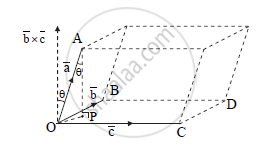
Let, `bar a, bar b and bar c` be the position vectors of points A, B and C respectively with respect to origin O.
Complete the parallelopiped as shown in the figure with ` bar(OA) , bar(OB) and bar(OC)` as its coterminus edges.
AP is a perpendicular drawn to the plane of `bar b and bar c` . Let, θ be the angle made by AP with OA.
Volume of parallelopiped = (Area of parallelogram OCDB) x (height)
Now, area of parallelogram OCDB = `|barb xxbarc| ….(i)`
Height of parallelepiped =l(AP)
`=l(OA) cos theta`
`= |bar(OA)| cos theta`
`= |bara| cos theta .....(ii)`
From (i) and (ii) we get,
volume of parallelepiped =`|bara||barbxxbarc|costheta`
`= bar a.(barb xx barc)`
volume of parallelepiped=`[bara barb barc]`
`Let bar a = hati + hatj ,bar b = hatj + hatk , c = hati + hatk`
`[bar a bar b barc]=|[1,1,0],[0,1,1],[1,0,1]|`
=1(1-0)-1(0-1)+0
=1+1
=2
APPEARS IN
RELATED QUESTIONS
If A, B, C, D are (1, 1, 1), (2, 1, 3), (3, 2, 2), (3, 3, 4) respectively, then find the volume of parallelopiped with AB, AC and AD as the concurrent edges.
Show that the four points A(4, 5, 1), B(0, –1, –1), C(3, 9, 4) and D(–4, 4, 4) are coplanar.
Find λ, if the vectors `veca=hati+3hatj+hatk,vecb=2hati−hatj−hatk and vecc=λhatj+3hatk` are coplanar.
Find the volume of a parallelopiped whose edges are represented by the vectors:
`vec a = 2 hat i - 3 hat j - 4 hat k`, `vec b = hat i + 2 hat j - hat k` and `vec c = 3 hat i + hat j + 2 hatk`
Find the volume of the parallelopiped whose coterminus edges are given by vectors `2hati+5hatj-4hatk, 5hati+7hatj+5hatk and 4hati+5hatj-2hatk`
Show of the following triad of vector is coplanar:
\[\hat{a} = \hat{i} - 2 \hat {j} + 3 \hat {k} , \hat {b} = - 2 \hat {i} + 3 \hat {j} - 4 \hat { k}, \hat {c} = \hat { i} - 3 \hat { j} + 5 \hat { k }\]
Find the value of λ so that the following vector is coplanar:
\[\vec{a} = \hat{i} - \hat{j} + \hat{k} , \vec{b} = 2 \hat {i} + \hat {j} - \hat {k} , \vec{c} = \lambda\hat { i} - \hat {j} + \lambda \hat {k}\]
Find the value of λ so that the following vector is coplanar:
\[\vec{a} = \hat{i} + 2\hat { j} - 3 \hat {k} , \vec{b} = 3 \hat{i} + \lambda \hat {j} + \hat {k} , \vec{c} = \hat {i} + 2 \hat {j} + 2 \hat {k}\]
Find the value of λ for which the four points with position vectors
\[-\hat { j} - \hat {k} , 4 \hat {i} + 5 \hat {j} + \lambda \hat {k} , 3 \hat {i} + 9 \hat {j} + 4 \hat {k} \text { and } - 4 \hat {i} + 4 \hat {j} + 4 \hat{k}\]
Prove that: \[\left( \vec{a} - \vec{b} \right) \cdot \left\{ \left( \vec{b} - \vec{c} \right) \times \left( \vec{c} - \vec{a} \right) \right\} = 0\]
If four points A, B, C and D with position vectors 4 \[\hat { i} +3\] \[\hat { j} +3\] \[\hat { k} ,5\] \[\hat { i} +\] \[x\hat { j} +7\] \[\hat { k} ,5\] \[\hat { i} +3\] \[\hat { j}\] and \[7 \hat{i} + 6 \hat{j} + \hat{k}\] respectively are coplanar, then find the value of x.
Write the value of \[\left[ 2 \hat { i } \ 3 \hat { j }\ 4 \hat { k } \right] .\]
Write the value of \[\left[ \hat {i} - \hat {j} \hat {j} - \hat {k} \hat {k} - \hat {i} \right] .\]
For any two vectors \[\vec{a} \text { and } \vec{b}\] of magnitudes 3 and 4 respectively, write the value of \[\left[ \vec{a} \vec{b} \vec{a} \times \vec{b} \right] + \left( \vec{a} \cdot \vec{b} \right)^2 .\]
The value of \[\left[ \vec{a} - \vec{b} , \vec{b} - \vec{c} , \vec{c} - \vec{a} \right], \text { where } \left| \vec{a} \right| = 1, \left| \vec{b} \right| = 5, \left| \vec{c} \right| = 3, \text { is }\]
If \[\vec{r} \cdot \vec{a} = \vec{r} \cdot \vec{b} = \vec{r} \cdot \vec{c} = 0\] for some non-zero vector \[\vec{r} ,\] then the value of \[\left[ \vec{a} \vec{b} \vec{c} \right],\] is
If \[\vec{a,} \vec{b,} \vec{c}\] are non-coplanar vectors, then \[\frac{\vec{a} \cdot \left( \vec{b} \times \vec{c} \right)}{\left( \vec{c} \times \vec{a} \right) \cdot \vec{b}} + \frac{\vec{b} \cdot \left( \vec{a} \times \vec{c} \right)}{\vec{c} \cdot \left( \vec{a} \times \vec{b} \right)}\] is equal to
If \[\vec{a,} \vec{b,} \vec{c}\] are three non-coplanar vectors, then \[\left( \vec{a} + \vec{b} + \vec{c} \right) . \left[ \left( \vec{a} + \vec{b} \right) \times \left( \vec{a} + \vec{c} \right) \right]\] equals
Determine where `bar"a"` and `bar"b"` are orthogonal, parallel or neithe:
`bar"a" = - 9hat"i" + 6hat"j" + 15hat"k"` , `bar"b" = 6hat"i" - 4hat"j" - 10hat"k"`.
Determine where `bar"a"` and `bar"b"` are orthogonal, parallel or neithe:
`bar"a" = 2hat"i" + 3hat"j" - hat"k"` , `bar"b" = 5hat"i" - 2hat"j" + 4hat"k"`
Determine where `bar"a"` and `bar"b"` are orthogonal, parallel or neithe:
`bar"a" = 4hat"i" - hat"j" + 6hat"k"` , `bar"b" = 5hat"i" - 2hat"j" + 4hat"k"`
If `bar"u" = hat"i" - 2hat"j" + hat"k" , bar"v" = 3hat"i" + hat"k"` and `bar"w" = hat"j" - hat"k"` are given vectors, then find `(bar"u" + bar"w").[(bar"u" xx bar"v") xx (bar"v" xx bar"w")]`
If `vec"a", vec"b", vec"c"` are three non-coplanar vectors represented by concurrent edges of a parallelepiped of volume 4 cubic units, find the value of `(vec"a" + vec"b") * (vec"b" xx vec"c") + (vec"b" + vec"c")* (vec"c" xx vec"a") + (vec"c" + vec"a") * (vec"a" xx vec"b")`
Find the altitude of a parallelepiped determined by the vectors `vec"a" = - 2hat"i" + 5hat"j" + 3hat"k", vec"b" = hat"i" + 3hat"j" - 2hat"k"` and `vec"c" = - vec"i" + vec"j" + 4vec"k"` if the base is taken as the parallelogram determined by `vec"b"` and `vec"c"`
Determine whether the three vectors `2hat"i" + 3hat"j" + hat"k", hat"i" - 2hat"j" + 2hat"k"` and `3hat"i" + hat"j" + 3hat"k"` are coplanar
If the scalar triple product of the vectors `-3hat"i" + 7hat"j" - 3hat"k", 3hat"i" - 7hat"j" + lambdahat"k" and 7hat"i" - 5hat"j" - 5hat"j"` is 272 then λ = ______.
If θ is the angle between the unit vectors `bar"a"` and `bar"b"`, the `cos theta = theta/2` = ______.
If the direction cosines of a line are `(1/c, 1/c, 1/c)` then ______.
Let v = `2hati + hatj - hatk` and w = `hati + 3hatk`. If u is a unit vector, then maximum value of scalar triple product [u v w] is ______.
If the points A(1, 2, 3), B(–1, 1, 2), C(2, 3, 4) and D(–1, x, 0) are coplanar find the value of x.
Determine whether `bara and barb` are orthogonal, parallel or neither.
`bara = -3/5 hati + 1/2 hatj + 1/3 hatk, barb = 5 hati + 4 hatj + 3 hatk`
The magnitude of a vector which is orthogonal to the vector \[\hat{\mathrm{i}}+\hat{\mathrm{j}}+\hat{\mathrm{k}}\] and is coplanar with the vectors \[\hat{\mathrm{i}}+\hat{\mathrm{j}}+2\hat{\mathrm{k}}\] and \[\hat{\mathrm{i}}+2\hat{\mathrm{j}}+\hat{\mathrm{k}}\] is
