Advertisements
Advertisements
प्रश्न
Prove that the volume of a parallelopiped with coterminal edges as ` bara ,bar b , barc `
Hence find the volume of the parallelopiped with coterminal edges `bar i+barj, barj+bark `
Advertisements
उत्तर
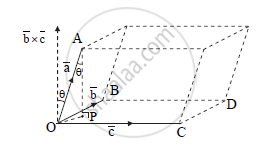
Let, `bar a, bar b and bar c` be the position vectors of points A, B and C respectively with respect to origin O.
Complete the parallelopiped as shown in the figure with ` bar(OA) , bar(OB) and bar(OC)` as its coterminus edges.
AP is a perpendicular drawn to the plane of `bar b and bar c` . Let, θ be the angle made by AP with OA.
Volume of parallelopiped = (Area of parallelogram OCDB) x (height)
Now, area of parallelogram OCDB = `|barb xxbarc| ….(i)`
Height of parallelepiped =l(AP)
`=l(OA) cos theta`
`= |bar(OA)| cos theta`
`= |bara| cos theta .....(ii)`
From (i) and (ii) we get,
volume of parallelepiped =`|bara||barbxxbarc|costheta`
`= bar a.(barb xx barc)`
volume of parallelepiped=`[bara barb barc]`
`Let bar a = hati + hatj ,bar b = hatj + hatk , c = hati + hatk`
`[bar a bar b barc]=|[1,1,0],[0,1,1],[1,0,1]|`
=1(1-0)-1(0-1)+0
=1+1
=2
APPEARS IN
संबंधित प्रश्न
Find the volume of a tetrahedron whose vertices are A(−1, 2, 3), B(3, −2, 1), C(2, 1, 3) and D(−1, −2, 4).
Find the value of λ, if four points with position vectors `3hati + 6hatj+9hatk`, `hati + 2hatj + 3hatk`,`2hati + 3hatj + hatk` and `4hati + 6hatj + lambdahatk` are coplanar.
Give a condition that three vectors \[\vec{a}\], \[\vec{b}\] and \[\vec{c}\] form the three sides of a triangle. What are the other possibilities?
Find \[\left[ \vec{a} \vec{b} \vec{c} \right]\] , when \[\vec{a} =\hat{ i} - 2 \hat{j} + 3 \hat{k} , \vec{b} = 2 \hat{i} + \hat{j} - \hat{k}\text{ and } \vec{c} = \hat{j} + \hat{k}\]
Find the volume of the parallelopiped whose coterminous edges are represented by the vector:
\[\vec{a} = 11 \hat{i} , \vec{b} = 2 \hat{j} , \vec{c} = 13 \hat{k}\]
Show of the following triad of vector is coplanar:
\[\vec{a} = - 4 \hat{i} - 6 \hat{j} - 2 \hat{k} , \vec{b} = -\hat{ i} + 4 \hat{j} + 3 \hat{k} , \vec{c} = - 8 \hat{i} - \hat{j} + 3 \hat{k}\]
Show that the points A (−1, 4, −3), B (3, 2, −5), C (−3, 8, −5) and D (−3, 2, 1) are coplanar.
Find the value of λ for which the four points with position vectors
\[-\hat { j} - \hat {k} , 4 \hat {i} + 5 \hat {j} + \lambda \hat {k} , 3 \hat {i} + 9 \hat {j} + 4 \hat {k} \text { and } - 4 \hat {i} + 4 \hat {j} + 4 \hat{k}\]
Prove that: \[\left( \vec{a} - \vec{b} \right) \cdot \left\{ \left( \vec{b} - \vec{c} \right) \times \left( \vec{c} - \vec{a} \right) \right\} = 0\]
Find λ for which the points A (3, 2, 1), B (4, λ, 5), C (4, 2, −2) and D (6, 5, −1) are coplanar.
Write the value of \[\left[ \hat {i} + \hat {j} \ \hat {j} + \hat {k} \ \hat {k} + \hat {i} \right] .\]
Write the value of \[\left[ \hat {i} - \hat {j} \hat {j} - \hat {k} \hat {k} - \hat {i} \right] .\]
Find the values of 'a' for which the vectors
\[\vec{\alpha} = \hat {i} + 2 \hat {j} + \hat {k} , \vec{\beta} = a \hat {i} + \hat {j} + 2 \hat {k} \text { and } \vec{\gamma} = \hat {i} + 2 \hat {j} + a \hat { k }\] are coplanar.
If \[\left[ 3 \vec{a} + 7 \vec{b} \vec{c} \vec{d} \right] = \lambda\left[ \vec{a} \vec{c} \vec{d} \right] + \mu\left[ \vec{b} \vec{c} \vec{d} \right],\] then find the value of λ + μ.
Find \[\vec{a} . \left( \vec{b} \times \vec{c} \right)\], if \[\vec{a} = 2 \hat {i} + \hat {j} + 3 \hat {k} , \vec{b} = - \hat {i} + 2 \hat {j} + \hat {k}\] and \[\vec{c} = 3 \hat { i} + \hat {j} + 2 \hat {k}\].
If \[\vec{a,} \vec{b,} \vec{c}\] are three non-coplanar mutually perpendicular unit vectors, then \[\left[ \vec{a} \vec{b} \vec{c} \right],\] is
If \[\vec{a,} \vec{b,} \vec{c}\] are non-coplanar vectors, then \[\frac{\vec{a} \cdot \left( \vec{b} \times \vec{c} \right)}{\left( \vec{c} \times \vec{a} \right) \cdot \vec{b}} + \frac{\vec{b} \cdot \left( \vec{a} \times \vec{c} \right)}{\vec{c} \cdot \left( \vec{a} \times \vec{b} \right)}\] is equal to
Let \[\vec{a} = a_1 \hat { i }+ a_2 \hat {j} + a_3 \hat {k} , \vec{b} = b_1 \hat {i} + b_2 \hat { j } + b_3 \hat { k} \text { and } \vec{c} = c_1 \hat { i } + c_2 \hat{j } + c_3\text { k }\] be three non-zero vectors such that \[\vec{c}\] is a unit vector perpendicular to both \[\vec{a} \text { and } \vec{b}\]. If the angle between \[\vec{a} \text { and } \vec{b}\] is \[\frac{\pi}{6},\] , then
\[\begin{vmatrix}a_1 & a_2 & a_3 \\ b_1 & b_2 & b_3 \\ c_1 & c_2 & c_3\end{vmatrix}^2\] is equal to
\[\left[ \vec{a} \vec{b} \vec{a} \times \vec{b} \right] + \left( \vec{a} . \vec{b} \right)^2 =\]
If \[\vec{a,} \vec{b,} \vec{c}\] are three non-coplanar vectors, then \[\left( \vec{a} + \vec{b} + \vec{c} \right) . \left[ \left( \vec{a} + \vec{b} \right) \times \left( \vec{a} + \vec{c} \right) \right]\] equals
Find the value of p, if the vectors `hat"i" - 2hat"j" + hat"k", 2hat"i" -5hat"j"+"p" hat "k" , 5hat"i" -9hat"j" + 4 hat"k"` are coplanar.
Show that the vectors `hat (i) - 2 hat(j) + 3 hat (k), - 2 hat(i) + 3 hat(j) - 4 hat(k) " and " hat(i) - 3 hat(j) + 5 hat(k) ` are coplanar.
Prove by vector method, that the angle subtended on semicircle is a right angle.
If a line has the direction ratios 4, −12, 18, then find its direction cosines
Find `bar"a".(bar"b" xx bar"c")` if `bar"a" = 3hat"i" - hat"j" + 4hat"k" , bar"b" = 2hat"i" + 3hat"j" - hat"k"` and `bar"c" = - 5hat"i" + 2hat"j" + 3hat"k"`
Find the volume of the parallelepiped whose coterminous edges are represented by the vectors `- 6hat"i" + 14hat"j" + 10hat"k", 14hat"i" - 10hat"j" - 6hat"k"` and `2hat"i" + 4hat"j" - 2hat"k"`
If the points having the position vectors `2hat"i" + hat"j" - hat"k", -hat"j", 4hat"i" + 4hat"k"` and `lambdahat"i" + hat"k"` lie on the same plane, then λ is equal to ______.
If θ is the angle between the unit vectors `bar"a"` and `bar"b"`, the `cos theta = theta/2` = ______.
If `veca = hati + hatj + hatk, veca.vecb` = 1 and `veca xx vecb = hatj - hatk`, then find `|vecb|`.
Determine whether `bara and barb` are orthogonal, parallel or neither.
`bara = - 3/5 hati+ 1/2 hatj + 1/3 hatk , barb= 5hati + 4hatj + 3hatk`
If `bar"u" = hat"i" - 2hat"j" + hat"k" , bar"v" = 3hat"i" + hat"k"` and `bar"w" = hat"j" - hat"k"` are given vectors, then find `[bar"u" xx bar"v" bar"u" xx bar"w" bar"v" xx bar"w"]`
If the points A(1, 2, 3), B(–1, 1, 2), C(2, 3, 4) and D(–1, x, 0) are coplanar find the value of x.
Determine whether `bb(bara and barb)` are orthogonal, parallel or neither.
`bara=-3/5hati+1/2hatj+1/3hatk,barb=5hati+4hatj+3hatk`
Determine whether `bara and barb` are orthogonal, parallel or neither.
`bara = -3/5hati + 1/2hatj +1/3 hatk, barb = 5hati + 4hatj +3hatk`
Determine whether `bara and barb` is orthogonal, parallel or neither.
`bara = -3/5hati + 1/2hatj + 1/3hatk, barb = 5hati + 4hatj + 3hatk`
Find the volume of a tetrahedron whose vertices are A(−1, 2, 3) B(3, −2, 1), C (2, 1, 3) and D(−1, −2, 4).
