Advertisements
Advertisements
Question
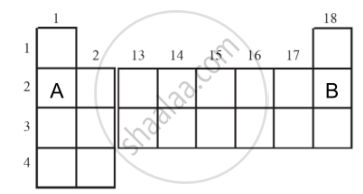
Position of A, B and C three elements is given in the table from the modern periodic table. Answer the following questions.
| Periods | Group 2 | Group 17 |
| 2 | ----- | A |
| 3 | B | ----- |
| 4 | ----- | C |
- What is an element metal or nonmetal?
- Which is the outermost orbit of element B?
- Identify C element and it's physical state.
Advertisements
Solution
- Element A is a non-metal.
- Outermost shell of element B is M.
- Element C is bromine (Br), and it exists in a liquid state.
RELATED QUESTIONS
Fill in the following blank with suitable word:
The basis for modern periodic table is ...............
How many periods and groups are there in the long form of periodic table?
Give two example of group 17 elements.
Name the scientist who prepared modern periodic table.
How would the tendency to gain electrons change on moving from left to right in a period of the periodic table?
What is the number of valence electrons in the atoms of first elements in a period?
What is the major characteristic of the first elements in the periods of the periodic table? What is the general name of such elements?
Explain why all the elements of a period have different chemical properties.
What is a group in the periodic table?
What are the advantages of the periodic table?
What are the periods in a periodic table? Give two characteristics of each.
Which of the following are the correct characteristics of isotopes of an element?
(i) same atomic mass
(ii) same atomic number
(iii) same physical properties
(iv) same chemical properties
(a) (i), (ii) and (iv)
(b) (ii), (iii) and (iv)
(c) (ii) and (iii)
(d) (ii) and (iv)
The following diagram shows a part of the periodic table in which the elements are arranged according to their atomic numbers. (The letters given here not the chemical symbols of the elements):
| a 3 |
b 4 |
c 5 |
d 6 |
e 7 |
f 8 |
g 9 |
h 10 |
|
| i 11 |
j 12 |
k 13 |
l 14 |
m 15 |
n 16 |
o 17 |
p 18 |
(i) Which element has a bigger atom, a or f?
(ii) Which element has a higher valency, k or o?
(iii) Which element is more metallic i or k?
(iv) Which element is more non-metallic, d or g?
(v) Select a latter which represents a metal of valency 2.
(vi) Select a letter which represents a non-metal of valency 2.
Name two elements in each case:
Actinides
How does the electronic configuration of an atom relate to its position in the modern periodic table?
An element barium has atomic number 56. Look up its position in the periodic table and answer the following question.
What will be the formula of its phosphate?
What would be the correct order if Zn, Fe, Al and Cu are arranged in increasing order of reactivity?
How many periods and groups are there in the modern periodic table?
What is the number of elements in the 1st period?
The horizontal rows in a periodic table are called _____.
Give the symbol and valency of the following element and radical.
Hydrogen
What are the periods in a periodic table?
Find the correlation:
Mendeleev’s periodic table : atomic mass : : Modern periodic table : _______
Write a scientific reason.
There was ambiguity about the correct position of hydrogen in Mendeleev’s periodic table.
In the modern periodic table, the positions of 1 to 20 elements are shown here. Identify the elements A and B. Write their atomic number.
Explain structure of modern periodic table in short.
Elements in the modern periodic table are arranged in ______groups and______ periods.
What are groups and periods in the modern periodic table?
______ is the longest period in the periodical table.
The scientist who propounded the modern periodic law is ______.
Which of the following elements does not lose an electron easily?
The three elements A, B and C with similar properties have atomic masses X, Y and Z respectively. The mass of Y is approximately equal to the average mass of X and Z. What is such an arrangement of elements called as? Give one example of such a set of elements.
A part of modern periodic table is given below. On its basis, answer the following questions:
| Group No. → | 1 | 2 | 13 | 14 | 15 | 16 | 17 | 18 |
| Period ↓ | ||||||||
| 2 | A | B | ||||||
| 3 | E | D | F | C |
Which of the element is a Noble gas?
A part of modern periodic table is given below. On its basis, answer the following questions:
| Group No. → | 1 | 2 | 13 | 14 | 15 | 16 | 17 | 18 |
| Period ↓ | ||||||||
| 2 | A | B | ||||||
| 3 | E | D | F | C |
Which of the element is a Metalloid?
Define periods of modern periodic table.
Name the following metal:
A metal present in period 3, group 1 of the periodic table.
Answer the following in respect of element \[\ce{_16^32S}\].
- Give its electronic configuration.
- To which group and period does it belon?
- What is its valency?
- Is it a metal or a non-metal?
- Is it a reducing agent or an oxidising agent?
- Give its formula with hydrogen.
Give reason for the following:
Inert gases do not form ion.
