Advertisements
Advertisements
Question
Point P(– 4, 2) lies on the line segment joining the points A(– 4, 6) and B(– 4, – 6).
Options
True
False
Advertisements
Solution
This statement is True.
Explanation:
Plotting the points P(– 4, 2), A(– 4, 6) and B(– 4, – 6) on a graph paper and connecting the points we get the graph,
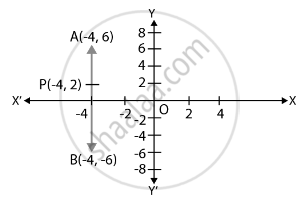
Hence, from the graph it is clear that, point P(– 4, 2) lies on the line segment joining the points A(– 4, 6) and B(– 4, – 6).
APPEARS IN
RELATED QUESTIONS
Find the value of k, if the point P (0, 2) is equidistant from (3, k) and (k, 5).
In what ratio is the line segment joining (-3, -1) and (-8, -9) divided at the point (-5, -21/5)?
If the point ( x,y ) is equidistant form the points ( a+b,b-a ) and (a-b ,a+b ) , prove that bx = ay
Show that the points A(2,1), B(5,2), C(6,4) and D(3,3) are the angular points of a parallelogram. Is this figure a rectangle?
Points P, Q, R and S divide the line segment joining the points A(1,2) and B(6,7) in five equal parts. Find the coordinates of the points P,Q and R
Find the area of quadrilateral ABCD whose vertices are A(-3, -1), B(-2,-4) C(4,-1) and D(3,4)
Find the area of quadrilateral ABCD whose vertices are A(-5, 7), B(-4, -5) C(-1,-6) and D(4,5)
Points A(-1, y) and B(5,7) lie on the circle with centre O(2, -3y).Find the value of y.
Find the coordinates of the centre of the circle passing through the points P(6, –6), Q(3, –7) and R (3, 3).
Find the possible pairs of coordinates of the fourth vertex D of the parallelogram, if three of its vertices are A(5, 6), B(1, –2) and C(3, –2).
Points (−4, 0) and (7, 0) lie
If the point P(x, 3) is equidistant from the point A(7, −1) and B(6, 8), then find the value of x and find the distance AP.
Find the ratio in which the line segment joining the points A(3, −3) and B(−2, 7) is divided by the x-axis. Also, find the coordinates of the point of division.
If three points (x1, y1) (x2, y2), (x3, y3) lie on the same line, prove that \[\frac{y_2 - y_3}{x_2 x_3} + \frac{y_3 - y_1}{x_3 x_1} + \frac{y_1 - y_2}{x_1 x_2} = 0\]
If the centroid of the triangle formed by points P (a, b), Q(b, c) and R (c, a) is at the origin, what is the value of a + b + c?
Find the distance between the points \[\left( - \frac{8}{5}, 2 \right)\] and \[\left( \frac{2}{5}, 2 \right)\] .
If the centroid of a triangle is (1, 4) and two of its vertices are (4, −3) and (−9, 7), then the area of the triangle is
If segment AB is parallel Y-axis and coordinates of A are (1, 3), then the coordinates of B are ______
If the coordinates of the two points are P(–2, 3) and Q(–3, 5), then (abscissa of P) – (abscissa of Q) is ______.
Assertion (A): The point (0, 4) lies on y-axis.
Reason (R): The x-coordinate of a point on y-axis is zero.
