Advertisements
Advertisements
प्रश्न
Point P(– 4, 2) lies on the line segment joining the points A(– 4, 6) and B(– 4, – 6).
विकल्प
True
False
Advertisements
उत्तर
This statement is True.
Explanation:
Plotting the points P(– 4, 2), A(– 4, 6) and B(– 4, – 6) on a graph paper and connecting the points we get the graph,
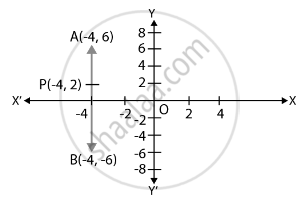
Hence, from the graph it is clear that, point P(– 4, 2) lies on the line segment joining the points A(– 4, 6) and B(– 4, – 6).
APPEARS IN
संबंधित प्रश्न
Find the distance between the following pair of points:
(a, 0) and (0, b)
If two opposite vertices of a square are (5, 4) and (1, −6), find the coordinates of its remaining two vertices.
Find the ratio in which the line segment joining (-2, -3) and (5, 6) is divided by x-axis Also, find the coordinates of the point of division in each case.
If the coordinates of the mid-points of the sides of a triangle be (3, -2), (-3, 1) and (4, -3), then find the coordinates of its vertices.
In what ratio does the point (−4, 6) divide the line segment joining the points A(−6, 10) and B(3,−8)?
If the points p (x, y) is point equidistant from the points A (5, 1)and B (–1, 5), Prove that 3x = 2y
Show that the following points are the vertices of a square:
A (0,-2), B(3,1), C(0,4) and D(-3,1)
If (2, p) is the midpoint of the line segment joining the points A(6, -5) and B(-2,11) find the value of p.
The midpoint P of the line segment joining points A(-10, 4) and B(-2, 0) lies on the line segment joining the points C(-9, -4) and D(-4, y). Find the ratio in which P divides CD. Also, find the value of y.
The distance of the point P (4, 3) from the origin is
If A(−3, 5), B(−2, −7), C(1, −8) and D(6, 3) are the vertices of a quadrilateral ABCD, find its area.
Find the value(s) of k for which the points (3k − 1, k − 2), (k, k − 7) and (k − 1, −k − 2) are collinear.
If \[D\left( - \frac{1}{5}, \frac{5}{2} \right), E(7, 3) \text{ and } F\left( \frac{7}{2}, \frac{7}{2} \right)\] are the mid-points of sides of \[∆ ABC\] , find the area of \[∆ ABC\] .
Two vertices of a triangle have coordinates (−8, 7) and (9, 4) . If the centroid of the triangle is at the origin, what are the coordinates of the third vertex?
Find the distance between the points \[\left( - \frac{8}{5}, 2 \right)\] and \[\left( \frac{2}{5}, 2 \right)\] .
Any point on the line y = x is of the form ______.
Students of a school are standing in rows and columns in their playground for a drill practice. A, B, C and D are the positions of four students as shown in figure. Is it possible to place Jaspal in the drill in such a way that he is equidistant from each of the four students A, B, C and D? If so, what should be his position?
A point both of whose coordinates are negative will lie in ______.
The perpendicular distance of the point P(3, 4) from the y-axis is ______.
Points (1, –1) and (–1, 1) lie in the same quadrant.
