Advertisements
Advertisements
प्रश्न
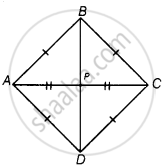
Students of a school are standing in rows and columns in their playground for a drill practice. A, B, C and D are the positions of four students as shown in figure. Is it possible to place Jaspal in the drill in such a way that he is equidistant from each of the four students A, B, C and D? If so, what should be his position?
Advertisements
उत्तर
Yes, from the figure we observe that the positions of four students A, B, C and D are (3, 5), (7, 9), (11, 5) and (7, 1) respectively i.e., these are four vertices of a quadrilateral.
Now, we will find the type of this quadrilateral.
For this, we will find all its sides.
We see that, AB = BC = CD = DA i.e., all sides are equal.
Now, AB = `sqrt((7 - 3)^2 + (9 - 5)^2` ...`["By distance formula", d = sqrt((x_2 - x_1)^2 + (y_2 - y_1)^2)]`
AB = `sqrt((4)^2 + (4)^2`
= `sqrt(16 + 16)`
AB = `4sqrt(2)`
BC = `sqrt((11 - 7)^2 + (5 - 9)^2`
= `sqrt((4)^2 + (-4)^2`
= `sqrt(16 + 16)`
= `4sqrt(2)`
CD = `sqrt((7 - 11)^2 + (1 - 5)^2`
= `sqrt((-4)^2 + (-4)^2`
= `sqrt(16 + 16)`
= `4sqrt(2)`
And DA = `sqrt((3 - 7)^2 + (5 - 1)^2`
= `sqrt((-4)^2 + (4)^2`
= `sqrt(16 + 16)`
= `4sqrt(2)`
We see that, AB = BC = CD = DA i.e., all sides are equal.
Now, we find length of both diagonals.
AC = `sqrt((11 - 3)^2 + (5 - 5)^2`
= `sqrt((8)^2 + 0)`
= 8
And BD = `sqrt((7 - 7)^2 + (1 - 9)^2`
= `sqrt(0 + (-8)^2`
= 8
Here, AC = BD
Since, AB = BC = CD = DA and AC = BD
Which represent a square.
Also known the diagonals of a square bisect each other.
So, P be position of Jaspal in which he is equidistant from each of the four students A, B, C and D.
∴ Coordinates of point P = Mid-point of AC
= `((3 + 11)/2, (5 + 5)/2)` ...`[∵ "Since, mid-point of a line segment having points" (x_1, y_1) "and" (x_2, y_2) = ((x_1 + y_1)/2, (x_2 + y_2)/2)]`
= `(14/2, 10/2)`
= (7, 5)
Hence, the required position of Jaspal is (7, 5).
APPEARS IN
संबंधित प्रश्न
If G be the centroid of a triangle ABC, prove that:
AB2 + BC2 + CA2 = 3 (GA2 + GB2 + GC2)
Prove that (4, 3), (6, 4) (5, 6) and (3, 5) are the angular points of a square.
Find the co-ordinates of the point equidistant from three given points A(5,3), B(5, -5) and C(1,- 5).
Show that the points A(2,1), B(5,2), C(6,4) and D(3,3) are the angular points of a parallelogram. Is this figure a rectangle?
The midpoint of the line segment joining A (2a, 4) and B (-2, 3b) is C (1, 2a+1). Find the values of a and b.
Find the ratio which the line segment joining the pints A(3, -3) and B(-2,7) is divided by x -axis Also, find the point of division.
Find the area of the quadrilateral ABCD, whose vertices are A(−3, −1), B (−2, −4), C(4, − 1) and D (3, 4).
The measure of the angle between the coordinate axes is
The area of the triangle formed by the points P (0, 1), Q (0, 5) and R (3, 4) is
If A(3, y) is equidistant from points P(8, −3) and Q(7, 6), find the value of y and find the distance AQ.
Find the ratio in which the line segment joining the points A(3, −3) and B(−2, 7) is divided by the x-axis. Also, find the coordinates of the point of division.
Write the coordinates the reflections of points (3, 5) in X and Y -axes.
If the points A (1,2) , O (0,0) and C (a,b) are collinear , then find a : b.
The perimeter of the triangle formed by the points (0, 0), (0, 1) and (0, 1) is
If (x , 2), (−3, −4) and (7, −5) are collinear, then x =
If the centroid of the triangle formed by the points (a, b), (b, c) and (c, a) is at the origin, then a3 + b3 + c3 =
If the line segment joining the points (3, −4), and (1, 2) is trisected at points P (a, −2) and Q \[\left( \frac{5}{3}, b \right)\] , Then,
Write the equations of the x-axis and y-axis.
The point R divides the line segment AB, where A(−4, 0) and B(0, 6) such that AR=34AB.">AR = `3/4`AB. Find the coordinates of R.
Abscissa of a point is positive in ______.
