Advertisements
Advertisements
प्रश्न
Point P(– 4, 2) lies on the line segment joining the points A(– 4, 6) and B(– 4, – 6).
पर्याय
True
False
Advertisements
उत्तर
This statement is True.
Explanation:
Plotting the points P(– 4, 2), A(– 4, 6) and B(– 4, – 6) on a graph paper and connecting the points we get the graph,
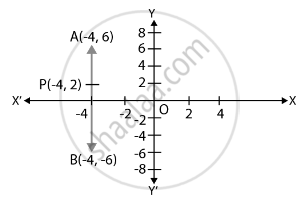
Hence, from the graph it is clear that, point P(– 4, 2) lies on the line segment joining the points A(– 4, 6) and B(– 4, – 6).
APPEARS IN
संबंधित प्रश्न
Name the quadrilateral formed, if any, by the following points, and given reasons for your answers:
A(4, 5) B(7, 6), C (4, 3), D(1, 2)
Prove that the points (3, 0), (4, 5), (-1, 4) and (-2, -1), taken in order, form a rhombus.
Also, find its area.
Determine the ratio in which the point P (m, 6) divides the join of A(−4, 3) and B(2, 8). Also, find the value of m.
Find the co-ordinates of the point equidistant from three given points A(5,3), B(5, -5) and C(1,- 5).
If the point A (4,3) and B ( x,5) lies on a circle with the centre o (2,3) . Find the value of x.
Show that the following points are the vertices of a square:
A (6,2), B(2,1), C(1,5) and D(5,6)
Points A(-1, y) and B(5,7) lie on the circle with centre O(2, -3y).Find the value of y.
Find the centroid of ΔABC whose vertices are A(2,2) , B (-4,-4) and C (5,-8).
Find the coordinates of the points of trisection of the line segment joining the points (3, –2) and (–3, –4) ?
Find the coordinates of the circumcentre of a triangle whose vertices are (–3, 1), (0, –2) and (1, 3).
If the points A(−2, 1), B(a, b) and C(4, −1) ae collinear and a − b = 1, find the values of aand b.
Write the formula for the area of the triangle having its vertices at (x1, y1), (x2, y2) and (x3, y3).
If the distance between the points (4, p) and (1, 0) is 5, then p is equal to ______.
If three points (0, 0), \[\left( 3, \sqrt{3} \right)\] and (3, λ) form an equilateral triangle, then λ =
The area of the triangle formed by (a, b + c), (b, c + a) and (c, a + b)
If the centroid of the triangle formed by the points (a, b), (b, c) and (c, a) is at the origin, then a3 + b3 + c3 =
If Points (1, 2) (−5, 6) and (a, −2) are collinear, then a =
If the points P (x, y) is equidistant from A (5, 1) and B (−1, 5), then
Point (0, –7) lies ______.
Abscissa of a point is positive in ______.
