Advertisements
Advertisements
प्रश्न
If \[D\left( - \frac{1}{5}, \frac{5}{2} \right), E(7, 3) \text{ and } F\left( \frac{7}{2}, \frac{7}{2} \right)\] are the mid-points of sides of \[∆ ABC\] , find the area of \[∆ ABC\] .
Advertisements
उत्तर
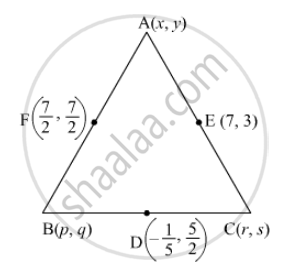
The midpoint of BC is \[D\left( - \frac{1}{5}, \frac{5}{2} \right)\],
The midpoint of AB is \[F\left( \frac{7}{2}, \frac{7}{2} \right)\] ,
The midpoint of AC is \[E\left( 7, 3 \right)\] Consider the line segment BC,
\[ \Rightarrow p + r = - 1 ; q + s = 5 . . . . . (i)\]
\[\text{ Consider the line segment AB, } \]
\[ \Rightarrow \frac{p + x}{2} = \frac{7}{2} ; \frac{q + y}{2} = \frac{7}{2}\]
\[ \Rightarrow p + x = 7 ; q + y = 7 . . . . . (ii)\]
\[\text{ Consider the line segment AC, } \]
\[ \Rightarrow \frac{r + x}{2} = 7 ; \frac{s + y}{2} = 3\]
\[ \Rightarrow r + x = 14 ; s + y = 6 . . . . . (iii)\]
Solve (i), (ii) and (iii) to get
\[BC = \sqrt{\left( - 4 - 3 \right)^2 + \left( 3 - 2 \right)^2} = \sqrt{50}\]
\[\text{ Equation of the line BC is } \]
\[\frac{x + 4}{- 4 - 3} = \frac{y - 3}{3 - 2}\]
\[ \Rightarrow x + 7y - 17 = 0\]
\[\text{ The perpendicular distance from a point } P\left( x_1 , y_1 \right)is\]
\[P = \left| \frac{1\left( 11 \right) + 7\left( 4 \right) - 17}{\sqrt{50}} \right| = \frac{22}{\sqrt{50}}\]
The area of the triangle is \[A = \frac{1}{2} \times \sqrt{50} \times \frac{22}{\sqrt{50}} = 11 \text{ sq . units } \]
APPEARS IN
संबंधित प्रश्न
Prove that the points (3, 0), (6, 4) and (-1, 3) are the vertices of a right-angled isosceles triangle.
On which axis do the following points lie?
Q(0, -2)
Prove that the points (3, 0), (4, 5), (-1, 4) and (-2, -1), taken in order, form a rhombus.
Also, find its area.
If three consecutive vertices of a parallelogram are (1, -2), (3, 6) and (5, 10), find its fourth vertex.
Find the co-ordinates of the point equidistant from three given points A(5,3), B(5, -5) and C(1,- 5).
Find the ratio in which the pint (-3, k) divide the join of A(-5, -4) and B(-2, 3),Also, find the value of k.
Find the centroid of ΔABC whose vertices are A(2,2) , B (-4,-4) and C (5,-8).
If the points A (2,3), B (4,k ) and C (6,-3) are collinear, find the value of k.
Show that `square` ABCD formed by the vertices A(-4,-7), B(-1,2), C(8,5) and D(5,-4) is a rhombus.
Find the value of k, if the points A(7, −2), B (5, 1) and C (3, 2k) are collinear.
If the point P (m, 3) lies on the line segment joining the points \[A\left( - \frac{2}{5}, 6 \right)\] and B (2, 8), find the value of m.
If the points A(−2, 1), B(a, b) and C(4, −1) ae collinear and a − b = 1, find the values of aand b.
Write the coordinates the reflections of points (3, 5) in X and Y -axes.
Write the ratio in which the line segment doining the points A (3, −6), and B (5, 3) is divided by X-axis.
The distance between the points (a cos 25°, 0) and (0, a cos 65°) is
The points (–5, 2) and (2, –5) lie in the ______.
The perpendicular distance of the point P(3, 4) from the y-axis is ______.
The distance of the point (–6, 8) from x-axis is ______.
The distance of the point (–1, 7) from x-axis is ______.
