Advertisements
Advertisements
प्रश्न
The abscissa and ordinate of the origin are
विकल्प
(0, 0)
(1, 0)
(0, 1)
(1 , 1)
Advertisements
उत्तर
As we know that:
The distance of a point from y−axis is called its x−coordinate or abscissa.
The distance of a point from x−axis is called its y−coordinate or ordinate.
The coordinate axes divide the plane into four equal parts which are known as quadrants.
The point of intersection of the coordinate axes is called the origin and the coordinates of origin are (0,0)
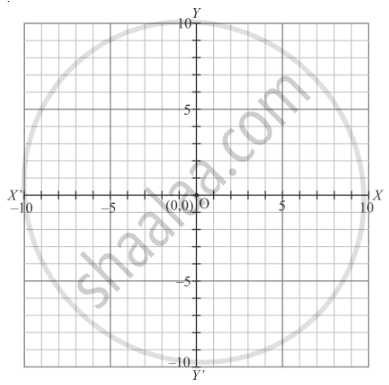
The origin is shown in the graph
APPEARS IN
संबंधित प्रश्न
On which axis do the following points lie?
Q(0, -2)
Name the quadrilateral formed, if any, by the following points, and given reasons for your answers:
A(4, 5) B(7, 6), C (4, 3), D(1, 2)
ABCD is a rectangle whose three vertices are A(4,0), C(4,3) and D(0,3). Find the length of one its diagonal.
If P ( 9a -2 , - b) divides the line segment joining A (3a + 1 , - 3 ) and B (8a, 5) in the ratio 3 : 1 , find the values of a and b .
If the point P (m, 3) lies on the line segment joining the points \[A\left( - \frac{2}{5}, 6 \right)\] and B (2, 8), find the value of m.
If the centroid of the triangle formed by points P (a, b), Q(b, c) and R (c, a) is at the origin, what is the value of a + b + c?
A line segment is of length 10 units. If the coordinates of its one end are (2, −3) and the abscissa of the other end is 10, then its ordinate is
The coordinates of the point on X-axis which are equidistant from the points (−3, 4) and (2, 5) are
If segment AB is parallel Y-axis and coordinates of A are (1, 3), then the coordinates of B are ______
If the points P(1, 2), Q(0, 0) and R(x, y) are collinear, then find the relation between x and y.
Given points are P(1, 2), Q(0, 0) and R(x, y).
The given points are collinear, so the area of the triangle formed by them is `square`.
∴ `1/2 |x_1(y_2 - y_3) + x_2(y_3 - y_1) + x_3(y_1 - y_2)| = square`
`1/2 |1(square) + 0(square) + x(square)| = square`
`square + square + square` = 0
`square + square` = 0
`square = square`
Hence, the relation between x and y is `square`.
