Advertisements
Advertisements
प्रश्न
The abscissa and ordinate of the origin are
पर्याय
(0, 0)
(1, 0)
(0, 1)
(1 , 1)
Advertisements
उत्तर
As we know that:
The distance of a point from y−axis is called its x−coordinate or abscissa.
The distance of a point from x−axis is called its y−coordinate or ordinate.
The coordinate axes divide the plane into four equal parts which are known as quadrants.
The point of intersection of the coordinate axes is called the origin and the coordinates of origin are (0,0)
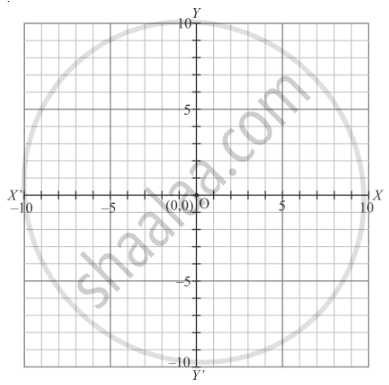
The origin is shown in the graph
APPEARS IN
संबंधित प्रश्न
Which point on the y-axis is equidistant from (2, 3) and (−4, 1)?
Find the coordinates of the circumcentre of the triangle whose vertices are (3, 0), (-1, -6) and (4, -1). Also, find its circumradius.
Prove that the points (4, 5) (7, 6), (6, 3) (3, 2) are the vertices of a parallelogram. Is it a rectangle.
The points A(2, 0), B(9, 1) C(11, 6) and D(4, 4) are the vertices of a quadrilateral ABCD. Determine whether ABCD is a rhombus or not.
If the point P(k - 1, 2) is equidistant from the points A(3, k) and B(k, 5), find the value of k.
If the point P (m, 3) lies on the line segment joining the points \[A\left( - \frac{2}{5}, 6 \right)\] and B (2, 8), find the value of m.
If the points (k, 2k), (3k, 3k) and (3, 1) are collinear, then k
A line intersects the y-axis and x-axis at P and Q , respectively. If (2,-5) is the mid-point of PQ, then the coordinates of P and Q are, respectively
If the coordinates of the two points are P(–2, 3) and Q(–3, 5), then (abscissa of P) – (abscissa of Q) is ______.
The distance of the point (–1, 7) from x-axis is ______.
