मराठी

In Fig. 14.46, the Area of δAbc (In Square Units) is

Advertisements
Advertisements

प्रश्न

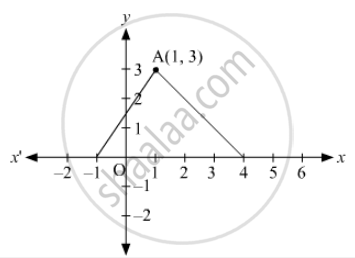
 In Fig. 14.46, the area of ΔABC (in square units) is
पर्याय

  • 15

  • 10

  • 7.5

  • 2.5

MCQ
Advertisements

उत्तर


The coordinates of A are (1, 3).
∴ Distance of A from the x-axis, AD = y-coordinate of A = 3 units
The number of units between B and C on the x-axis are 5.
∴ BC = 5 units
Now,
Area of ∆ABC = \[\frac{1}{2} \times BC \times AD = \frac{1}{2} \times 5 \times 3 = \frac{15}{2} = 7 . 5\]  square units

Thus, the area of ∆ABC is 7.5 square units.


shaalaa.com
  या प्रश्नात किंवा उत्तरात काही त्रुटी आहे का?
पाठ 6: Co-ordinate Geometry - Exercise 6.7 [पृष्ठ ६६]

APPEARS IN

आर.डी. शर्मा Mathematics [English] Class 10
पाठ 6 Co-ordinate Geometry
Exercise 6.7 | Q 43 | पृष्ठ ६६

व्हिडिओ ट्यूटोरियलVIEW ALL [2]

संबंधित प्रश्‍न

If the points A(k + 1, 2k), B(3k, 2k + 3) and C(5k − 1, 5k) are collinear, then find the value of k


On which axis do the following points lie?

R(−4,0)


If the point P (2,2)  is equidistant from the points A ( -2,K ) and B( -2K , -3) , find k. Also, find the length of AP.


Show hat A(1,2), B(4,3),C(6,6) and D(3,5) are the vertices of a parallelogram. Show that ABCD is not rectangle.


`"Find the ratio in which the poin "p (3/4 , 5/12) " divides the line segment joining the points "A (1/2,3/2) and B (2,-5).`


If the point `P (1/2,y)` lies on the line segment joining the points A(3, –5) and B(–7, 9) then find the ratio in which P divides AB. Also, find the value of y.


The base QR of a n equilateral triangle PQR lies on x-axis. The coordinates of the point Q are (-4, 0) and origin is the midpoint of the base. Find the coordinates of the points P and R.


The base BC of an equilateral triangle ABC lies on y-axis. The coordinates of point C are (0, −3). The origin is the midpoint of the base. Find the coordinates of the points A and B. Also, find the coordinates of another point D such that ABCD is a rhombus.


Find the ratio in which the line segment joining the points A (3, 8) and B (–9, 3) is divided by the Y– axis.


Find the area of the quadrilateral ABCD, whose vertices are A(−3, −1), B (−2, −4), C(4, − 1) and D (3, 4).


The area of the triangle formed by the points P (0, 1), Q (0, 5) and R (3, 4) is


Show that the points (−4, −1), (−2, −4) (4, 0) and (2, 3) are the vertices points of a rectangle.


Find the area of a parallelogram ABCD if three of its vertices are A(2, 4), B(2 + \[\sqrt{3}\] , 5) and C(2, 6).                 


If P (2, 6) is the mid-point of the line segment joining A(6, 5) and B(4, y), find y. 


If (x , 2), (−3, −4) and (7, −5) are collinear, then x =


The coordinates of the fourth vertex of the rectangle formed by the points (0, 0), (2, 0), (0, 3) are


The ratio in which the line segment joining points A (a1b1) and B (a2b2) is divided by y-axis is


If P(2, 4), Q(0, 3), R(3, 6) and S(5, y) are the vertices of a parallelogram PQRS, then the value of y is


Point P(– 4, 2) lies on the line segment joining the points A(– 4, 6) and B(– 4, – 6).


Find the coordinates of the point whose abscissa is 5 and which lies on x-axis.


Share
Notifications

Englishहिंदीमराठी


      Forgot password?
Use app×