Advertisements
Advertisements
प्रश्न
If P(2, 4), Q(0, 3), R(3, 6) and S(5, y) are the vertices of a parallelogram PQRS, then the value of y is
पर्याय
7
5
-7
-8
Advertisements
उत्तर
It is given that P(2, 4), Q(0, 3), R(3, 6) and S(5, y) are the vertices of a parallelogram PQRS.
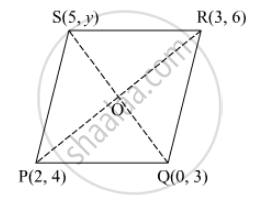
Join PR and QS, intersecting each other at O.
We know that the diagonals of the parallelogram bisect each other. So, O is the mid-point of PR and QS.
Coordinates of mid-point of PR = \[\left( \frac{2 + 3}{2}, \frac{4 + 6}{2} \right) = \left( \frac{5}{2}, \frac{10}{2} \right) = \left( \frac{5}{2}, 5 \right)\]
Coordinates of mid-point of QS = \[\left( \frac{0 + 5}{2}, \frac{3 + y}{2} \right) = \left( \frac{5}{2}, \frac{3 + y}{2} \right)\]
Now, these points coincides at the point O.
\[\therefore \left( \frac{5}{2}, \frac{3 + y}{2} \right) = \left( \frac{5}{2}, 5 \right)\]
\[ \Rightarrow \frac{3 + y}{2} = 5\]
\[ \Rightarrow 3 + y = 10\]
\[ \Rightarrow y = 7\]
Thus, the value of y is 7.
APPEARS IN
संबंधित प्रश्न
Two vertices of an isosceles triangle are (2, 0) and (2, 5). Find the third vertex if the length of the equal sides is 3.
Which point on the y-axis is equidistant from (2, 3) and (−4, 1)?
Show that the points (−3, 2), (−5,−5), (2, −3) and (4, 4) are the vertices of a rhombus. Find the area of this rhombus.
Find the coordinates of the circumcentre of the triangle whose vertices are (3, 0), (-1, -6) and (4, -1). Also, find its circumradius.
Find the coordinates of the point which divides the line segment joining (−1,3) and (4, −7) internally in the ratio 3 : 4
Find the points on the y-axis which is equidistant form the points A(6,5) and B(- 4,3)
Find the ratio in which the point P(m, 6) divides the join of A(-4, 3) and B(2, 8) Also, find the value of m.
Find the area of quadrilateral ABCD whose vertices are A(-3, -1), B(-2,-4) C(4,-1) and D(3,4)
Find the value of a, so that the point ( 3,a ) lies on the line represented by 2x - 3y =5 .
Find the possible pairs of coordinates of the fourth vertex D of the parallelogram, if three of its vertices are A(5, 6), B(1, –2) and C(3, –2).
The area of the triangle formed by the points A(2,0) B(6,0) and C(4,6) is
Show that ΔABC, where A(–2, 0), B(2, 0), C(0, 2) and ΔPQR where P(–4, 0), Q(4, 0), R(0, 2) are similar triangles.
If P ( 9a -2 , - b) divides the line segment joining A (3a + 1 , - 3 ) and B (8a, 5) in the ratio 3 : 1 , find the values of a and b .
Points P, Q, R and S divides the line segment joining A(1, 2) and B(6, 7) in 5 equal parts. Find the coordinates of the points P, Q and R.
If points Q and reflections of point P (−3, 4) in X and Y axes respectively, what is QR?
Write the ratio in which the line segment doining the points A (3, −6), and B (5, 3) is divided by X-axis.
If the points P (x, y) is equidistant from A (5, 1) and B (−1, 5), then
Abscissa of all the points on the x-axis is ______.
In which ratio the y-axis divides the line segment joining the points (5, – 6) and (–1, – 4)?
